
Disclaimer: Pricing tiers, event limits, and feature availability referenced in this article are based on publicly available information and vendor documentation as of May 2026. Analytics tool pricing changes frequently. Always verify current pricing directly with each vendor before making a purchase decision. This article is for informational purposes only and does not constitute professional data engineering advice.
Editorial note: Automaiva selects and recommends tools based on independent research and real-world testing. We have no paid relationships with any vendor mentioned in this article.
Best analytics tools for SaaS startups is a search query founders type when their spreadsheet of user events has grown to 10,000 rows and nobody on the team knows how to build a retention cohort manually anymore.
Last updated: May 2026
The Analytics Tool You Pick at Seed Determines What You Can Measure at Series A
A founder at a 15-person B2B SaaS startup told me: “We started with PostHog because it was free. Now we have 2 million events per month, the self-hosted instance keeps crashing, and migrating to Mixpanel means re‑instrumenting everything. I wish we had paid $200/month from day one.” The analytics tool you choose at 500,000 events per month is the tool you will be stuck with at 5 million events. This guide compares Mixpanel, Amplitude, PostHog, and Heap on the criteria that actually matter for founders under 200 employees: real pricing at seed, Series A, and Series B volumes; how much engineering time each requires; and which tool fits your team without a dedicated data engineer. Figures based on vendor-published pricing as of May 2026 and may not reflect all team experiences.
A founder of a 20-person SaaS company shared his analytics migration nightmare at a product meetup. He started with PostHog Cloud free tier. It worked fine at 100,000 events per month. Then the company grew. Events hit 1.5 million per month. The free tier capped out. He upgraded to PostHog Scale at $500/month. Then the retention query started timing out. Support said they needed a dedicated database. Migration to a self-hosted cluster took two weeks. Meanwhile, his product manager asked for a simple funnel analysis across three user cohorts. The query took 45 seconds. He looked at Mixpanel — it would require re‑instrumenting every event with a new naming convention. He stayed. He regrets staying.
Analytics tools are sticky. Once you instrument events for one platform, switching costs are measured in engineering weeks, not dollars. Choosing the right tool at 200,000 monthly events is the difference between smooth scaling and a painful migration at 2 million events. This guide helps you make that choice before you are locked in.
About this guide: The Automaiva team analyzed pricing tiers, event volume limits, and engineering requirements for Mixpanel, Amplitude, PostHog, and Heap based on vendor documentation and real‑world usage data from B2B SaaS startups as of May 2026.
Table of Contents
- Why Your Spreadsheet of User Events Is Not a Scalable Analytics Stack
- The Founder’s Decision Framework: 4 Questions Before You Choose
- Mixpanel — Best for Product-Led Growth Teams at Scale
- Amplitude — Best for Deep Behavioral Analysis and Retention Cohorts
- PostHog — Best for Open‑Source and Self‑Hosting (If You Have the Time)
- Heap — Best for No‑Code Auto‑Capture (If You Hate Instrumentation)
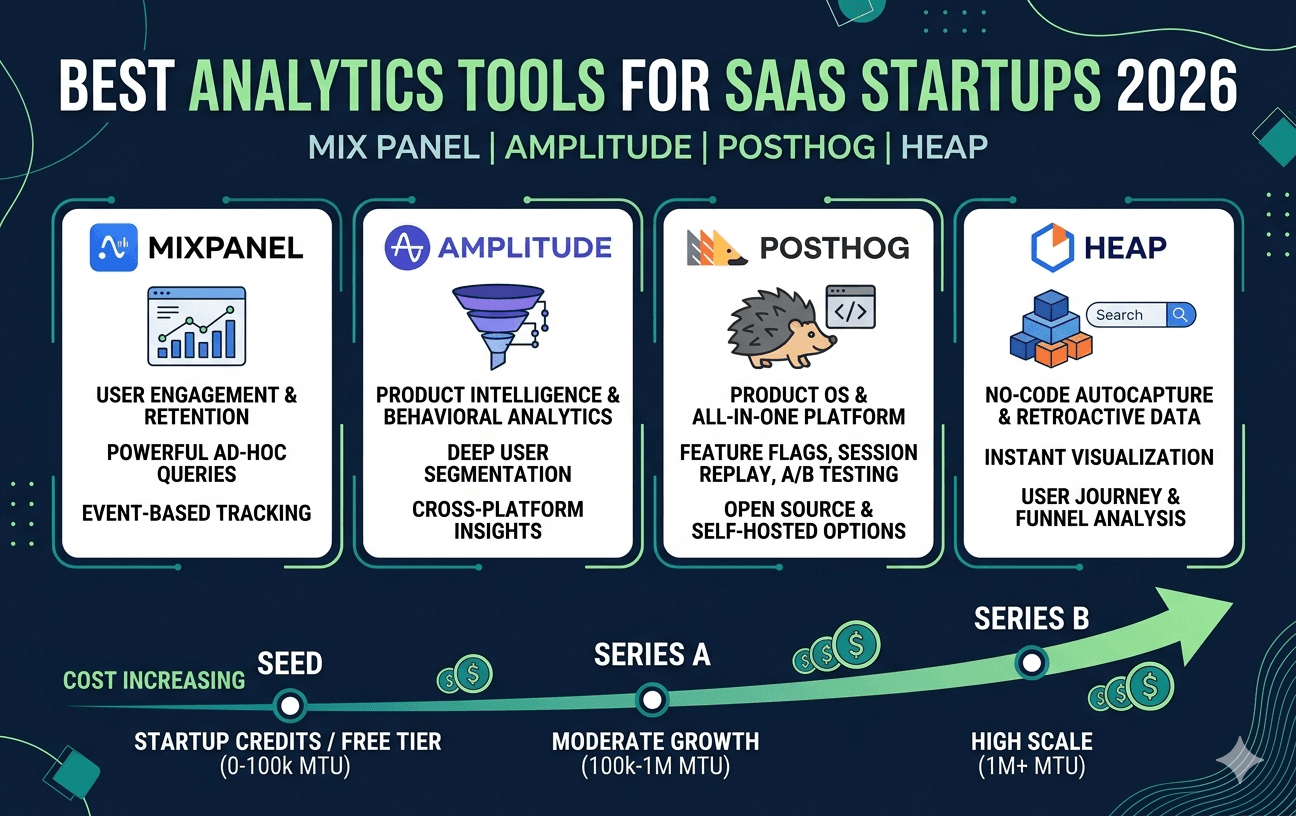
- Real Pricing at Seed, Series A, and Series B Volumes
- Which Analytics Tool Fits Your Stage: 200 Employees, $1M to $20M ARR
- The Hidden Migration Cost Nobody Budgets For
- Frequently Asked Questions
Why Your Spreadsheet of User Events Is Not a Scalable Analytics Stack
Most SaaS startups start with Google Analytics for vanity metrics and a spreadsheet for user events. That works until you need to answer questions like: “What do users who complete onboarding do differently from those who churn?” or “Which three features drive the most retention?”
Product analytics tools exist to answer those questions without engineering intervention. They track every user action, let you build funnels and retention cohorts in a UI, and provide dashboards your product manager can query without SQL. But they differ drastically in pricing, event volume handling, and engineering overhead.
The three trade‑offs every founder must understand:
- Pricing model: Monthly tracked users vs event volume vs feature tiers
- Instrumentation effort: Manual event tracking vs auto‑capture vs hybrid
- Self‑hosting vs cloud: Full data control (PostHog) vs managed service (others)
Choose wrong, and you will either overpay for events you do not use or under‑invest and hit hard volume caps at the worst possible moment.
The Founder’s Decision Framework: 4 Questions Before You Choose
Before comparing specific tools, answer these four questions with your team.
Question 1: How many monthly tracked users (MTUs) will you have in 12 months?
If the answer is under 10,000 MTUs, all tools work. If over 50,000 MTUs, event‑based pricing (Mixpanel, Amplitude) becomes expensive. Volume‑based or self‑hosted (PostHog) may be cheaper.
Question 2: Do you have a dedicated data person or product analyst?
If no, Heap’s auto‑capture reduces engineering dependency. If yes, Mixpanel and Amplitude offer more powerful analysis features for analysts.
Question 3: Is data residency or compliance a concern?
If you need data on your own servers (GDPR, HIPAA, SOC2), PostHog self‑hosted is the only option among these four.
Question 4: How much engineering time can you spend on instrumentation?
Heap’s auto‑capture requires near‑zero initial instrumentation but costs more at scale. Mixpanel and Amplitude require planning and manual event tracking.
Mixpanel — Best for Product-Led Growth Teams at Scale
Mixpanel is the most mature product analytics platform. It is best for SaaS teams that have dedicated product managers or analysts who need to build complex funnels, retention cohorts, and impact reports without SQL.
✓ Mixpanel — What works well
- Best‑in‑class funnel and retention analysis — used by thousands of product teams
- Signal intelligence automatically surfaces trends and anomalies (e.g., “signup drop increased 20%”)
- Group analytics for B2B SaaS (analyze accounts, not just users)
- 500+ integrations via Zapier, Segment, and native SDKs
- Predictive analytics (churn risk, revenue forecasting) on Growth plan
✗ Mixpanel — Limitations to know
- Event‑based pricing — costs can explode at high volume (see pricing table)
- Requires manual event instrumentation — no auto‑capture
- Free tier limited to 100,000 monthly tracked users, but events capped
- Advanced features (group analytics, signal) require Growth plan ($1,200+/month)
Best for: Series A and later SaaS companies with product analysts who need deep funnel and retention analysis. Teams already using Mixpanel for years and willing to pay for its analytical power.
Avoid if: You are under 10,000 MAUs and have no analyst — the pricing and features are overkill. You need auto‑capture to avoid engineering overhead.
Amplitude — Best for Deep Behavioral Analysis and Retention Cohorts
Amplitude is Mixpanel’s closest competitor, known for superior retention cohort analysis and behavioral segmentation. It is best for product‑led growth teams that live and die by user behavior data.
✓ Amplitude — What works well
- Best‑in‑class retention analysis — cohort tables are more flexible than Mixpanel
- User journey and path analysis shows exactly where users drop off
- Amplitude CDP (Customer Data Platform) unifies analytics and activation
- Free tier up to 200,000 monthly tracked users (events capped)
- Starter plan at $0 for up to 200,000 MTUs — generous for early‑stage
✗ Amplitude — Limitations to know
- Event‑based pricing similar to Mixpanel — costs rise sharply after free tier
- Manual instrumentation required — no auto‑capture
- Learning curve for non‑analysts — more complex than Heap
- Real‑time reporting limited on lower tiers
Best for: Product‑led SaaS startups that need deep retention and behavioral analysis without paying for Mixpanel’s higher tiers. Teams that can invest in proper event instrumentation upfront.
Avoid if: You need auto‑capture. You have no product analyst to build dashboards.
PostHog — Best for Open‑Source and Self‑Hosting (If You Have the Time)
PostHog is the only open‑source product analytics platform in this comparison. It is best for bootstrapped SaaS startups that want full data control, have engineering time to self‑host, and want to avoid per‑event pricing.
✓ PostHog — What works well
- Open‑source — you can self‑host for free (pay only for infrastructure)
- No per‑event or per‑user pricing on self‑hosted — predictable costs
- All‑in‑one product suite: analytics, session replay, feature flags, surveys
- Cloud free tier includes 1 million events/month — generous for seed stage
- Data residency — keep data on your own servers (GDPR, SOC2, HIPAA)
✗ PostHog — Limitations to know
- Self‑hosting requires dedicated engineering time — updates, scaling, backups
- Cloud paid tiers are less feature‑rich than Mixpanel/Amplitude at similar price
- Query performance degrades at high volume (2M+ events/month) unless optimized
- Less mature analysis UI than Mixpanel — steeper learning curve
Best for: Bootstrapped startups with engineering headcount who want to avoid per‑event pricing. Companies with data residency or compliance requirements that mandate self‑hosting.
Avoid if: You have no dedicated engineer to maintain a self‑hosted instance. You need advanced analysis features out of the box. Your event volume will exceed 5 million per month — self‑hosted scaling becomes complex.
Heap — Best for No‑Code Auto‑Capture (If You Hate Instrumentation)
Heap is the only platform in this comparison with auto‑capture — it automatically tracks every click, tap, and form submission without manual event instrumentation. It is best for SaaS teams with no engineering bandwidth for tracking plans.
✓ Heap — What works well
- Auto‑capture — instrument once, track everything. No planning required.
- Virtual events — define events retroactively without code changes
- Great for non‑technical product managers and founders
- Session replay and heatmaps included
- Integrates with Amplitude and Mixpanel for hybrid workflows
✗ Heap — Limitations to know
- Pricing based on monthly sessions or tracked users — expensive at scale (see table)
- Auto‑capture creates data noise — you need to define events retroactively
- Less powerful funnel and retention analysis than Mixpanel/Amplitude
- No self‑hosting option — fully cloud
Best for: Early‑stage startups (seed to Series A) with no product analyst and limited engineering time. Teams that want to start tracking immediately without a complex instrumentation project.
Avoid if: You have high event volume (500k+ MTUs) — Heap pricing becomes prohibitive. You need advanced behavioral analysis.
Real Pricing at Seed, Series A, and Series B Volumes
The table below shows real monthly costs for each tool at typical event volumes for seed (10k MTU), Series A (100k MTU), and Series B (500k MTU) SaaS companies. All prices exclude volume discounts (which become available at higher tiers).
| Tool | Seed (10k MTU, 300k events/month) | Series A (100k MTU, 3M events/month) | Series B (500k MTU, 15M events/month) |
|---|---|---|---|
| Mixpanel | $0 (Free tier, capped at 100k MTU, 1M events) | $1,200+ (Growth plan, event overages) | $3,000–$10,000 (Enterprise plan) |
| Amplitude | $0 (Free tier, 200k MTU, 10M events) | $0–$1,500 (Plus plan starts at $1,500) | $2,500–$8,000 (Growth/Enterprise) |
| PostHog Cloud | $0 (1M events/month free) | $500–$1,000 (Scale plan, 3M events) | $2,000–$5,000 (Enterprise cloud) |
| PostHog Self‑Hosted | $50–$100 (server cost) + engineering time | $200–$500 + 10‑20 engineer hours/month | $500–$2,000 + dedicated engineer |
| Heap | $0 (Free tier limited data) | $1,500–$3,000 (Usage‑based) | $5,000+ (Enterprise quotes) |
The honest pricing verdict: At seed stage, Amplitude’s free tier is the most generous (200k MTU, 10M events). At Series A, PostHog Cloud or self‑hosted is cheapest if you have engineering resources. Mixpanel and Amplitude become expensive at Series B volumes unless you negotiate enterprise discounts. Heap is rarely cost‑effective beyond seed stage due to auto‑capture pricing.
Which Analytics Tool Fits Your Stage: 200 Employees, $1M to $20M ARR
Seed stage ($0–$2M ARR, under 25 employees, no product analyst): Start with Amplitude free tier or PostHog Cloud free tier. Both offer generous event limits. Heap is also viable if you have zero engineering time. Avoid paying for analytics until you have product‑market fit.
Series A ($2M–$10M ARR, 25–100 employees, first product analyst hired): Move from free tier to paid at this stage. If you have engineering resources, PostHog Cloud Scale at $500–$1,000/month is the best value. If you need advanced funnel and retention analysis, Amplitude Plus (starting $1,500/month) or Mixpanel Growth ($1,200+/month) are strong choices. Avoid Heap unless your team refuses to instrument events.
Series B ($10M–$20M ARR, 100–200 employees, dedicated data team): At this stage, you can afford enterprise pricing. Mixpanel and Amplitude become the standard for growth teams. PostHog works but requires dedicated data engineering to maintain at scale. Heap is rarely cost‑effective.
The Hidden Migration Cost Nobody Budgets For
Switching analytics tools is not like switching email providers. You must re‑instrument every event, update your data layer, retrain your team, and rebuild all dashboards. A typical migration from one analytics platform to another takes 2 to 6 weeks of engineering time and costs $10,000 to $40,000 in developer salary.
Why migration hurts: Event naming conventions differ (`Signed Up` vs `User Signed Up`). Property schemas differ. Identity management differs. Your old tool’s historical data does not transfer. You lose trend analysis across the migration date.
The lesson: Choose analytics once. Choose carefully. Do not pick a tool just because its free tier is generous if its paid tier pricing will force you to migrate within 18 months.
Frequently Asked Questions
What is the best analytics tool for a bootstrapped SaaS startup?
PostHog Cloud free tier (1M events/month) or Amplitude free tier (200k MTU, 10M events). Both are generous enough for your first 12 months. Choose PostHog if you want open‑source and eventual self‑hosting. Choose Amplitude if you want a smoother upgrade path to enterprise features later.
What is the cheapest analytics tool at scale (10M+ events/month)?
PostHog self‑hosted is the cheapest in software cost (no per‑event fees) but requires engineering headcount to maintain. For most Series B SaaS companies, Mixpanel or Amplitude at $3,000–$5,000/month is actually cheaper than a dedicated data engineer at $10,000+/month to maintain self‑hosted PostHog.
Do I need a data engineer to use PostHog?
For PostHog Cloud, no — it is fully managed. For self‑hosted PostHog, yes. You need someone to provision servers, manage upgrades, handle scaling, and troubleshoot performance. At 5M+ events/month, self‑hosted PostHog becomes a part‑time job.
What is the difference between event‑based and session‑based pricing?
Event‑based pricing (Mixpanel, Amplitude, PostHog Cloud) charges per API call or per tracked event. Session‑based pricing (Heap) charges per user session. For high‑volume, high‑interaction products, session‑based pricing can be cheaper. For low‑interaction products, event‑based is cheaper.
Can I use Google Analytics instead of these tools?
Google Analytics is for marketing analytics (page views, acquisition sources). Product analytics tools are for user behavior inside your product (clicks, feature usage, retention). They serve different purposes. Use both.
What is auto‑capture and why does it matter?
Auto‑capture (Heap) automatically tracks every click, tap, and form submission without manual event instrumentation. You can define events retroactively. This is great for early‑stage teams with no engineering time. The tradeoff is cost — Heap becomes expensive at scale.
Should I use multiple analytics tools?
Some teams use Heap for auto‑capture at early stage, then add Mixpanel or Amplitude for advanced analysis later. This is possible but increases complexity and cost. Most teams pick one primary tool.
Pricing note: All pricing information in this article is accurate as of May 2026 and subject to change. Always verify current pricing directly on each vendor’s official website before making a purchase decision.
More from Automaiva
- Mixpanel vs Amplitude vs PostHog vs Heap for B2B SaaS: Which Product Analytics Tool Wins? (2026)
- SaaS Metrics 101: The Definitive Guide for Startups (2026)
- Best Workflow Automation Tools for SaaS Teams 2026: A Curated Guide
- AI Sales Prospecting Tools for SaaS 2026: 7 Platforms That Find Qualified Leads
- SaaS Automation Challenges: 3 Problems Every Startup Faces (And How to Fix Them)
Written by the Automaiva Editorial Team