Disclaimer: SaaS backup pricing, retention policies, and data protection features referenced in this article are based on publicly available information and vendor documentation as of May 2026. Pricing changes frequently. Always verify current rates directly with each vendor before making a purchase decision. This article is for informational purposes only and does not constitute professional data security or compliance advice.
Editorial note: Automaiva selects and recommends tools based on independent research and real-world testing. We have no paid relationships with any vendor mentioned in this article.
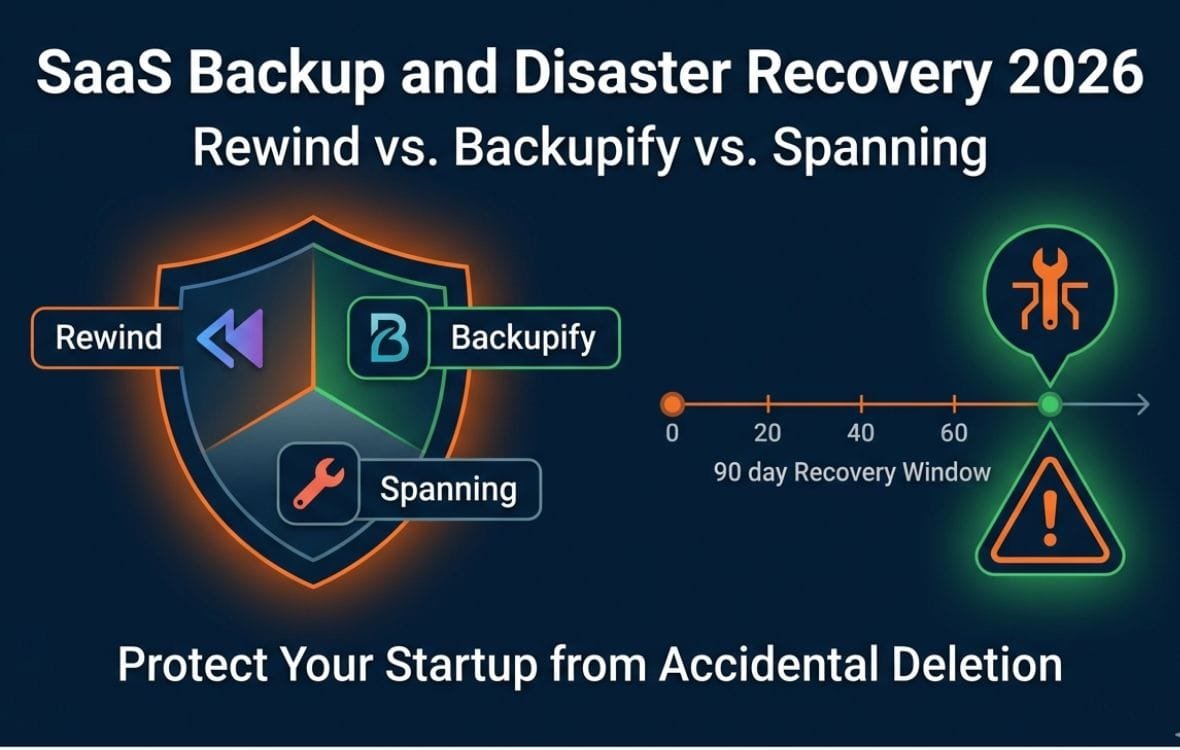
SaaS backup and disaster recovery is the data protection layer most founders skip until they accidentally delete 18 months of HubSpot customer data — and discover that native SaaS recovery windows close after 90 days.
The 90-Day Cliff
A SaaS founder ran a routine CSV import to update contact data in HubSpot. The import was misconfigured — existing blog pages with conflicting URLs were deleted, not overwritten. HubSpot Support confirmed the analytics data from those deleted pages could not be recovered. The company had been running without a dedicated backup solution. Three years of content authority, gone. Native SaaS providers like HubSpot, Salesforce, and Google Workspace do not protect you from accidental deletions, bad imports, or malicious insider actions. They share responsibility for infrastructure uptime, not your data integrity. This guide explains the shared responsibility model, compares the three leading SaaS backup platforms — Rewind, Backupify, and Spanning — on pricing, recovery capabilities, and supported apps, and gives you a decision framework for choosing the right one at your company stage. Plus, why SOC 2 Type II auditors look for backup controls as a red flag. Figures based on vendor-published pricing and user-reported data as of May 2026 and may not reflect all team experiences.
A RevOps lead at a mid-sized SaaS company described the moment as a “stomach-dropping free fall.” She had just finished a routine data clean-up — deleting inactive contacts from HubSpot. Then she realized. That wasn’t the inactive list. It was the VIP client list for the last quarter. Thousands of contacts, along with their associated deals and history, vanished. HubSpot’s recycle bin retains deleted records for 90 days. She discovered the error on day 89. She restored everything just before the window closed. But the experience changed how she thought about data protection forever.
Human error is the number one cause of business-critical data loss in SaaS. It manifests in many ways: accidental bulk deletion, a botched CSV import, a misconfigured workflow, or mistakenly merging records that loses years of notes and email history. The native protections your SaaS vendors provide — recycle bins, version history, soft deletes — are designed for recovery within hours or days, not weeks or months. Once the retention window closes, your data is gone forever unless you have an independent, third-party backup.
This guide covers everything you need to build a SaaS backup and disaster recovery strategy: the shared responsibility model and why it matters, a detailed comparison of Rewind, Backupify, and Spanning, recovery time expectations, a stage-based decision framework, SOC 2 backup control requirements, and seven frequently asked questions.
About this guide: The Automaiva team analyzed SaaS backup pricing, recovery capabilities, and supported platforms using vendor documentation, user reviews, and independent research as of May 2026.
Table of Contents
- Why Native SaaS Backups Are Not Enough — The Shared Responsibility Model
- Human Error Is the #1 Cause of SaaS Data Loss — Real Scenarios
- Rewind — Best for Broad Platform Coverage
- Backupify — Best for Google Workspace and Microsoft 365
- Spanning — Best for Simple Enterprise Pricing
- Pricing Comparison: Rewind vs. Backupify vs. Spanning
- Platform Coverage: Which Tools Does Each Tool Back Up?
- Recovery Time Comparison: Granular Restore vs. Full Restore
- Decision Framework by Company Stage
- SOC 2 Connection — Why Backup Controls Are a Red Flag for Auditors
- Frequently Asked Questions
Why Native SaaS Backups Are Not Enough — The Shared Responsibility Model
SaaS providers like HubSpot, Salesforce, Google Workspace, and Microsoft 365 operate on a shared responsibility model. They are responsible for infrastructure uptime, physical security, and platform availability. You are responsible for your data — its integrity, recovery, and protection from user error.
Here is what your SaaS vendors do not protect you from:
- Accidental deletion — A user with broad permissions deletes active contacts, companies, or deals by misapplying a filter
- Botched imports — A CSV import with incorrect column mapping overwrites thousands of records with wrong information
- Workflow mishaps — A small change to a re-enrolment trigger or a “clear property value” action systematically strips data from records
- Malicious insider actions — A departing employee deletes critical data before their access is revoked
- Third-party integration failures — A connected app writes bad data or deletes records via API
Native recycle bins and version histories are temporary. HubSpot retains deleted records for 90 days. Salesforce for 15 days on some objects. Google Workspace for 25 days. If you do not discover the error within that window — and many errors go unnoticed for weeks — the data is permanently unrecoverable without a third-party backup.
Human Error Is the #1 Cause of SaaS Data Loss — Real Scenarios
Here are real ways operations teams lose data every day, drawn from community reports and support cases:
Scenario 1 — The Wrong Filter: A user with broad permissions attempts to clear out old test data, applies a filter incorrectly, and permanently deletes active VIP contacts, companies, or deals. The error is discovered weeks later during a sales pipeline review.
Scenario 2 — The CSV Import Disaster: During a CSV import to update contact data, the user accidentally maps the email column to the phone number field. Thousands of records are overwritten with wrong information. The team does not notice until a campaign sends to incorrect addresses.
Scenario 3 — The Silent Workflow: A small change to a workflow re-enrolment trigger causes the system to clear a critical property value on every contact that passes through. The data disappears silently over weeks. No error is raised. By the time someone notices, the recycle bin window has closed.
Scenario 4 — The Departing Employee: An admin whose access was not immediately revoked after resignation deletes company data out of spite. By the time IT discovers the action, the native recycle bin has aged out or the deletions were permanent.
These are not edge cases. They are the normal failure modes of teams operating at speed. A third-party backup solution is the only safety net that catches all of them.
Rewind — Best for Broad Platform Coverage
Rewind backs up the tools that businesses rely on so they can restore and recover from small mistakes or big disasters with just a few clicks. It is trusted by over 25,000 organizations and has been operating since 2015. Rewind is the best choice for SaaS companies using diverse platforms — Shopify, GitHub, Jira, Confluence, BigCommerce, QuickBooks Online, Klaviyo, and Mailchimp — because it covers more integrations than any competitor in this comparison.
✓ Rewind — What works well
- Broadest platform coverage — Shopify, GitHub, Jira, Confluence, BigCommerce, QuickBooks, Klaviyo, Mailchimp, and more
- Automatic daily backups — your first full backup kicks off in one click, then runs automatically
- Point-in-time restore — restore your entire account or specific items to any point in time
- Near real-time backup available for critical platforms (Pro and Enterprise plans)
- 7-day free trial — risk-free evaluation
✗ Rewind — Limitations to know
- Pricing varies by platform and volume — not a simple per-user model
- Limited Google Workspace and Microsoft 365 coverage compared to Backupify
- Some user reports of API limitations affecting backup completeness on specific platforms
- Enterprise features (policy-based backup, advanced reporting) require higher-tier plans
Best for: SaaS companies using a diverse set of platforms — especially e-commerce (Shopify, BigCommerce), development (GitHub, Jira), and marketing tools (Klaviyo, Mailchimp). Teams that need a single backup vendor across multiple app categories.
Avoid if: Your primary SaaS stack is Google Workspace and Microsoft 365 — Backupify or Spanning are more specialized and cost-effective for those platforms.
Pricing starts at $3.00 per month (varies by platform).
Backupify — Best for Google Workspace and Microsoft 365
Backupify (owned by Datto) is a backup solution designed specifically to help businesses recover, store, secure, and maintain data across Google Workspace and Microsoft 365 applications. It allows administrators to archive documents or emails for inactive users, configure data retention periods, and provides a centralized dashboard for restores and activity feeds. Backupify is the best choice for SaaS teams whose critical data lives in Google Workspace, Microsoft 365, or Salesforce.
✓ Backupify — What works well
- Deep Google Workspace and Microsoft 365 coverage — email, calendar, contacts, Drive, SharePoint, Teams, OneDrive
- Audit logs, data encryption, user lifecycle management, and data export included
- Centralized dashboard for restore operations and activity monitoring
- Search functionality with multiple parameters to quickly access required files, emails, contacts, and folders
- Archiving for inactive users — retain data after employees leave
✗ Backupify — Limitations to know
- Narrow platform focus — primarily Google Workspace, Microsoft 365, and Salesforce. Limited coverage for other SaaS tools.
- Some user reports of poor customer support experiences
- Per-user, per-application pricing can become complex for large teams
- Less transparent pricing — quotes often require a sales conversation for enterprise plans
Best for: SaaS companies whose critical operations run on Google Workspace, Microsoft 365, or Salesforce. Teams that need compliance-ready archiving and eDiscovery features.
Avoid if: You need to back up a wide variety of SaaS platforms (Shopify, GitHub, Jira, etc.) — Rewind offers broader coverage.
Pricing starts at approximately $3.00–$6.00 per user per month, depending on platform and volume.
Spanning — Best for Simple Enterprise Pricing
Spanning is an enterprise-grade cloud-to-cloud backup and recovery solution for G Suite (now Google Workspace), Office 365, and Salesforce. The platform is designed to protect data in the cloud in the event of user errors, malicious activity, security breaches, and other disasters. Spanning is the best choice for organizations that want simple, predictable pricing with all features included in a single plan.
✓ Spanning — What works well
- Simple enterprise pricing — $48/user/year for all backup and restore features
- Seamless integration with Google Workspace, Microsoft 365, and Salesforce
- Easy and efficient backup of cloud data — restoration process is straightforward and intuitive
- Status tracking for backups and restores
- Enterprise-grade security and compliance features
✗ Spanning — Limitations to know
- Narrow platform focus — Google Workspace, Microsoft 365, and Salesforce only
- No coverage for e-commerce, development, or marketing platforms (Shopify, GitHub, Klaviyo)
- Less frequent backups than real-time solutions
- Less transparent about specific backup interval guarantees
Best for: Enterprise SaaS companies with standardized Google Workspace, Microsoft 365, and Salesforce stacks. Organizations that value simple, predictable per-user pricing and do not need to back up other SaaS platforms.
Avoid if: You need to back up a diverse set of SaaS platforms outside the Google/Microsoft/Salesforce ecosystem.
Pricing: $48/user/year (includes all features).
Pricing Comparison: Rewind vs. Backupify vs. Spanning
The table below shows typical pricing for a 50-person SaaS company backing up critical platforms.
| Platform | Pricing model | Typical monthly cost (50 users) |
|---|---|---|
| Rewind | Per platform / per volume | $3–$50+/platform (varies widely; estimate $50–$300 total) |
| Backupify | Per user, per application | $150–$300 ($3–$6/user/month) |
| Spanning | Per user, annual | $200 ($48/user/year) |
All pricing estimates as of May 2026. Actual costs vary by volume, contract length, and negotiated discounts. Verify current pricing directly with each vendor.
Platform Coverage: Which Tools Does Each Tool Back Up?
| Platform | Rewind | Backupify | Spanning |
|---|---|---|---|
| Google Workspace | ✅ | ✅ Deep coverage | ✅ Deep coverage |
| Microsoft 365 | ✅ | ✅ Deep coverage | ✅ Deep coverage |
| Salesforce | ❌ | ✅ | ✅ |
| HubSpot | ✅ | ❌ | ❌ |
| GitHub | ✅ | ❌ | ❌ |
| Jira / Confluence | ✅ | ❌ | ❌ |
| Shopify / BigCommerce | ✅ | ❌ | ❌ |
| QuickBooks Online | ✅ | ❌ | ❌ |
| Klaviyo / Mailchimp | ✅ | ❌ | ❌ |
Recovery Time Comparison: Granular Restore vs. Full Restore
Recovery speed is often more important than backup speed. When data is missing, every minute of downtime costs money, reputation, and customer trust.
Granular restore: Restore a specific contact, deal, email, or file without touching the rest of your data. Granular restore is essential for recovering from small-scale human errors (e.g., one deleted VIP contact). All three platforms support granular restore for most data types, with Rewind offering the most flexible point-in-time selection.
Full restore / disaster recovery: Restore an entire account or workspace from a previous point in time. Full restore is essential for recovering from catastrophic errors (e.g., a botched import that corrupts your entire database) or ransomware attacks. Expect full restore to take hours, not minutes, depending on data volume. For a typical 50GB HubSpot account, a full restore might take 2-6 hours.
Recovery time objectives (RTOs) by platform:
- Rewind: Granular restore in minutes; full restore in hours (varies by data volume). Real-time backup available on Pro/Enterprise plans
- Backupify: Granular restore via search and filter in minutes; full restore typically within 24 hours
- Spanning: Granular restore via intuitive web interface; full restore typically within 24 hours
If your business cannot tolerate hours of downtime, prioritize platforms with faster RTOs and consider testing your recovery process quarterly.
Decision Framework by Company Stage
Seed stage (0-5 employees, bootstrapped): You are probably on free tiers of Google Workspace and HubSpot. Your data volume is low. Start with manual exports weekly, but evaluate Rewind starting at $3/month for critical platforms. If you have no budget, document a manual recovery process. Do not rely solely on native recycle bins.
Series A (5-50 employees, $2M–$10M ARR): You have customer data you cannot afford to lose. Evaluate Backupify or Spanning for Google Workspace/Microsoft 365, and Rewind for other critical platforms (HubSpot, GitHub, Jira). Budget $200–$500/month for comprehensive backup coverage across 3-5 platforms.
Series B+ (50+ employees, $10M+ ARR): You need enterprise-grade backup with compliance reporting, audit logs, and defined RTOs. Spanning offers simple per-user pricing. Backupify provides deeper Google/Microsoft features. Rewind is best for diverse platform coverage. Also SOC 2 Type II auditors will ask for documented backup and recovery procedures — see next section.
SOC 2 Connection — Why Backup Controls Are a Red Flag for Auditors
A SOC 2 Type II audit evaluates service organizations against Trust Services Criteria, including Security, Availability, and Confidentiality. For backup providers and for companies using SaaS backup, specific controls are required.
According to SOC 2 Availability A1.3, organizations must perform structured recovery testing, validate backup integrity, and define measurable recovery metrics like RTO (Recovery Time Objective) and MTTR (Mean Time to Recovery). Availability A1.1 requires establishing data backup intervals that align with peak system loads and ensuring system integrity under unexpected demand or disruption.
For your own SOC 2 audit, you must demonstrate:
- You have implemented a backup solution for critical SaaS applications
- Backups run on a defined schedule (daily minimum)
- You test restores quarterly and document the results
- You have defined RTOs and RPOs (Recovery Point Objectives)
- Access to backup data is restricted (MFA, RBAC, least privilege)
Auditors view missing backup controls as a high-risk finding. If you cannot restore customer data after an incident, you cannot certify Availability or Security. Do not wait for an audit to discover this gap.
Frequently Asked Questions
Why do I need SaaS backup if HubSpot/Salesforce/Google already backs up my data?
SaaS providers are responsible for infrastructure uptime and platform availability — not your data integrity. The shared responsibility model means you are responsible for protection against user error, bad imports, malicious insiders, and integration failures. Native recycle bins are temporary (typically 15-90 days). Once the window closes, data is permanently unrecoverable without a third-party backup.
What is the difference between Rewind, Backupify, and Spanning?
Rewind offers the broadest platform coverage (Shopify, GitHub, Jira, Confluence, HubSpot, QuickBooks, Klaviyo, Mailchimp). Backupify specializes in Google Workspace, Microsoft 365, and Salesforce with deep feature sets for each. Spanning offers simple, predictable enterprise pricing ($48/user/year) for Google Workspace, Microsoft 365, and Salesforce. Choose Rewind for diverse platforms, Backupify for Google/Microsoft depth, Spanning for pricing simplicity.
How often should I back up my SaaS data?
Daily backups are the minimum standard for production data. For high-velocity platforms (e-commerce, CRM with frequent updates), consider real-time or near-real-time backup. Rewind offers near real-time on Pro plans. Backupify and Spanning typically back up once or twice per day. Match your backup frequency to your change rate and risk tolerance.
How long does it take to restore data from a SaaS backup?
Granular restores (single contact, email, file) typically take minutes. Full account restores take hours depending on data volume — plan for 2-6 hours for a 50GB account. Test your restore process quarterly to understand actual RTOs for your specific data volume.
Is SaaS backup required for SOC 2 compliance?
Yes. SOC 2 Availability criteria require documented backup and recovery procedures, including recovery testing and defined RTOs. Auditors will request evidence of backup implementation, restore testing, and access controls. Missing backup controls are a high-risk finding. See the SOC 2 section above for specific control requirements.
How much does SaaS backup cost for a 50-person company?
Expect to budget $200–$500 per month for comprehensive backup coverage across 3-5 platforms. Backupify and Spanning run $3–$6 per user per month for Google Workspace/Microsoft 365. Rewind varies by platform — $3–$50+ per platform depending on volume. For a typical stack (Google Workspace + HubSpot + GitHub), budget $300–$600 monthly.
What happens if my SaaS backup vendor goes out of business?
This is a legitimate risk in a crowded market. Before committing, verify the vendor’s data export capabilities. Can you download a full copy of all backed-up data in an open format (JSON, CSV, etc.)? Rewind, Backupify, and Spanning all support data export. For mission-critical data, consider a secondary backup strategy (e.g., weekly manual exports to cloud storage) as a fallback.
Pricing note: All pricing information in this article is accurate as of May 2026 and subject to change. Rewind, Backupify, and Spanning pricing may require annual contracts. Always verify current pricing directly on each vendor’s official website before making a purchase decision.
More from Automaiva
- SOC 2 Compliance Tools 2026: Vanta vs Drata vs Secureframe vs Sprinto
- Full SaaS Security Stack Cost: What a 20-Person B2B Team Actually Spends in 2026 (Budget by Stage)
- Zero Trust Security for SaaS Founders: Implementation Without Enterprise Budget (2026)
- SaaS Automation Breaking in Production? 5 Silent Failure Modes and How to Fix Them (2026)
- SaaS Automation Challenges: 3 Problems Every Startup Faces (And How to Fix Them)
Written by the Automaiva Editorial Team