
Updated: April 11, 2026
Disclaimer: The metrics, formulas, and benchmarks in this guide are based on widely accepted SaaS industry standards. However, every business is unique. Benchmarks vary by industry, business model, company stage, and geography. Use these as directional guidance, not absolute rules. For specific financial or investment advice, consult a qualified professional.
Quick Answer
The most important SaaS metrics for early-stage founders are MRR growth rate, activation rate, logo churn, and CAC payback period. As you scale, focus shifts to LTV:CAC ratio (target 3:1), Net Revenue Retention (target >100%), and cohort retention. According to industry benchmarks, companies with NRR above 120% achieve the highest valuations.
I was three months into my first SaaS startup when an investor asked me a simple question: “What is your LTV to CAC ratio?”
I had no idea.
I knew our revenue. I knew how many customers we had signed. But I could not tell you whether we were building a sustainable business or a slowly sinking ship.
That meeting ended early. The investor passed. And I spent the next week learning something I should have understood on day one: SaaS metrics are not just numbers. They are the language of your business.
If you are reading this, you are probably where I was — building something real, but realizing you need to understand the numbers behind it. Good. That awareness puts you ahead of most founders.
This guide is not a dictionary. It is a framework. By the end, you will know exactly which metrics matter at your stage, how to calculate them, and — most importantly — what to do when the numbers tell you something is wrong.
Table of Contents
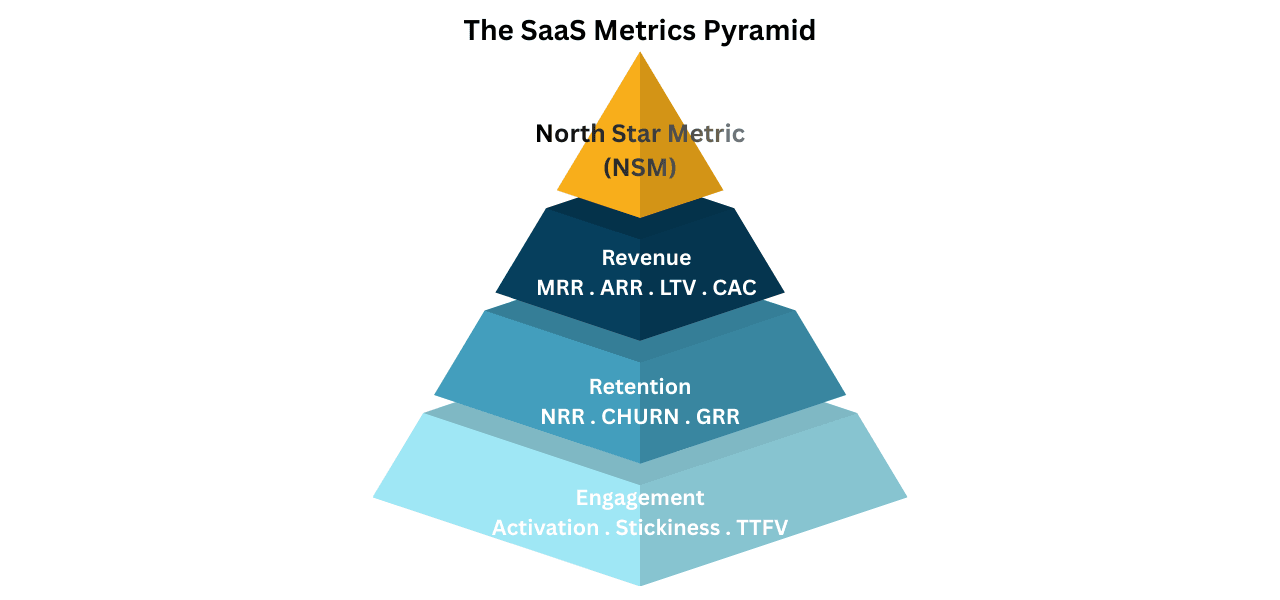
- The North Star Metric
- Revenue Metrics: MRR, ARR, ARPA
- Customer Economics: CAC, LTV, Payback Period
- Retention Metrics: Churn, GRR, NRR
- Engagement Metrics: DAU/MAU, TTFV, Activation
- SaaS Benchmarks 2026 by Stage
- The Metrics That Matter by Stage
- Metrics That Kill Startups (Warning Signs)
- Cohort Analysis: The Most Underused Tool
- Tools for Tracking SaaS Metrics
- Common Metrics Mistakes
- Frequently Asked Questions
The North Star Metric
Before we dive into the dozens of metrics you could track, let us talk about the one you should track.
Every great SaaS company has a North Star metric — a single number that captures the core value they deliver to customers.
- Spotify tracks “Time spent listening.”
- Airbnb tracks “Nights booked.”
- Slack tracks “Messages sent.”
Notice something? None of these are revenue metrics. They are usage metrics. Because revenue follows value. If you are delivering value consistently, money shows up.
Your North Star should be:
- Leading, not lagging — it predicts revenue, does not just report it
- Actionable — your team can influence it daily
- Value-aligned — when it goes up, customers win
For a B2B SaaS company, your North Star might be “Weekly Active Users” or “Features Used per Customer.” For a transaction platform, it might be “Transactions Processed.”
Find yours. Put it on a dashboard that everyone sees. Make it the heartbeat of your company.
Revenue Metrics: MRR, ARR, ARPA
Monthly Recurring Revenue (MRR)
MRR is the lifeblood of SaaS. It is predictable, recurring revenue you can count on every month.
Formula: MRR = Number of Customers × Average Revenue Per Customer
But here is where founders get tripped up: MRR has layers. You need to track:
- New MRR — from brand new customers
- Expansion MRR — from upgrades, add-ons, seat increases
- Churned MRR — from cancellations and downgrades
- Net New MRR — New + Expansion – Churn
Real talk: If you are not tracking these separately, you do not know if your growth is healthy or fragile.
A company adding $50,000 in new MRR but losing $40,000 to churn is treading water. A company adding $30,000 in new MRR with $5,000 churn is building momentum.
Annual Recurring Revenue (ARR)
ARR is just MRR × 12. It is how investors think, especially as you grow past $1 million ARR.
Pro tip: When you talk to investors, use ARR. When you talk to your team about daily execution, use MRR. Both matter, but for different audiences.
Average Revenue Per Account (ARPA)
ARPA tells you your average customer value.
Formula: ARPA = Total MRR / Total Customers
This metric shapes everything:
| ARPA Range | Go-to-Market Motion | Example |
|---|---|---|
| $10-50 per month | Massive volume, self-service onboarding | Canva, Calendly |
| $100-500 per month | Some sales touch, product-led growth | HubSpot, Zoom |
| $1,000+ per month | Enterprise sales, high-touch support | Salesforce, Workday |
Where most founders go wrong: They build a sales process for high ARPA but price for low ARPA. Or they build self-service for enterprise pricing. Your ARPA should dictate your go-to-market motion, not the other way around.
Customer Economics: CAC, LTV, Payback Period
Customer Acquisition Cost (CAC)
CAC is the cost you incur to acquire one paying customer.
Formula: CAC = Total Sales and Marketing Spend / New Customers Acquired
But — and this is critical — what counts as “Sales and Marketing Spend”?
Include:
- Ad spend (Google, LinkedIn, Meta)
- Content creation costs (writers, designers)
- Salaries for sales and marketing team
- Software tools for sales and marketing (CRM, email, automation)
- Agency fees
- Events and sponsorships
Exclude:
- Product development (that is R and D, not acquisition)
- General overhead (rent, admin salaries)
- Customer support (that is retention)
The trap: Many founders undercount CAC by excluding salaries or tools. Be honest. You are only cheating yourself.
Lifetime Value (LTV)
LTV is the total revenue you will get from a customer before they leave.
Simplest formula: LTV = ARPA × Gross Margin × Customer Lifetime
Where Customer Lifetime = 1 / Monthly Churn Rate
Example:
- ARPA = $100 per month
- Gross Margin = 80%
- Monthly Churn = 2% (lifetime = 1 / 0.02 = 50 months)
- LTV = $100 × 0.8 × 50 = $4,000
The LTV to CAC Ratio
This is the big one. The relationship between what you spend to acquire a customer and what they are worth.
The rule of thumb:
| LTV:CAC Ratio | What It Means |
|---|---|
| Less than 1:1 | You are destroying value. Spending more than you get back. |
| 1:1 to 3:1 | You are acquiring customers, but inefficiently. |
| 3:1 | The sweet spot. Healthy, scalable business. |
| Greater than 5:1 | You might be under-investing in growth. |
Reality check: Early-stage SaaS often runs below 3:1. That is fine. But if you are still below 3:1 at $2 million ARR, you have a problem.
CAC Payback Period
How many months to earn back what you spent to acquire a customer?
Formula: CAC Payback Period = CAC / (ARPA × Gross Margin)
Benchmarks:
- Less than 12 months — Excellent (enterprise SaaS)
- 12 to 18 months — Good (SMB SaaS)
- 18 to 24 months — Acceptable (high-volume, low-touch)
- Greater than 24 months — Risky (needs deep pockets)
Why this matters: If it takes 24 months to pay back CAC, you need 24 months of runway to break even on your acquisition spend. That is a lot of capital.
Retention Metrics: Churn, GRR, NRR
Logo Churn vs. Revenue Churn
This distinction changes how you see your business.
- Logo Churn = Percentage of customers who cancel
- Revenue Churn = Percentage of revenue lost
If you lose 10 small customers at $50 per month each but gain one enterprise customer at $5,000 per month, your logo churn looks bad but your revenue churn looks great.
Which matters more? Both. But early-stage founders obsess too much on logo churn and miss opportunities to expand revenue.
Gross Revenue Retention (GRR)
GRR measures revenue retained from existing customers, excluding expansions or upsells.
Formula: GRR = (Starting MRR – Churned MRR – Downgrade MRR) / Starting MRR
GRR only goes down. It is a pure retention measure.
Benchmarks:
- 90% and above — World-class
- 85% to 90% — Good
- 80% to 85% — Acceptable
- Below 80% — Problematic
Net Revenue Retention (NRR)
NRR includes expansion revenue. This is where SaaS magic happens.
Formula: NRR = (Starting MRR + Expansion MRR – Churned MRR – Downgrade MRR) / Starting MRR
The holy grail: NRR greater than 100%. This means your existing customers are growing faster than you are losing them.
What great looks like:
- 120% and above — Elite (Snowflake, Slack in early days)
- 110% to 120% — Excellent
- 100% to 110% — Good
- Below 100% — You are leaking value
The insight: If your NRR is greater than 100%, you can lose money on acquisition and still build a massive business. Why? Because customers become more valuable over time. The math works.
Engagement Metrics: DAU/MAU, TTFV, Activation
Daily Active Users / Monthly Active Users (DAU/MAU)
For product-led SaaS, this is oxygen.
Stickiness = DAU / MAU
- 20% and above — Good (people use your product weekly)
- 40% and above — Excellent (people use it multiple times weekly)
- 60% and above — Exceptional (people use it almost daily)
The question: Does your product need daily use? A payroll platform is used monthly. A project management tool should be used daily. Know your category.
Time to First Value (TTFV)
How long from signup to first “aha” moment?
This is the most underrated metric in SaaS.
If it takes 3 days to get value, you will lose 50% of trials. If it takes 3 minutes, you will keep them.
Examples:
- Canva: First design in 60 seconds
- Calendly: First booking in 2 minutes
- Slack: First message in 30 seconds
Your job: Obsess over shrinking TTFV. Demo the product yourself and time it. Then cut the time in half. Then do it again.
Activation Rate
Percentage of signups who reach a key milestone, usually within the first session.
For most SaaS, this is more important than signup volume.
The math: 1,000 signups × 10% activation = 100 activated users. 500 signups × 40% activation = 200 activated users. Which would you rather have?
SaaS Benchmarks 2026 by Stage
This table synthesizes data from industry reports to provide realistic targets for your stage.
| Metric | Seed Stage (0-10 customers) | Series A (10-100) | Series B (100-1000) | Series C+ (1000+) |
|---|---|---|---|---|
| MRR Growth (Monthly) | 15-20% | 10-15% | 5-10% | Less than 5% |
| CAC | Hard to measure | Less than $500 (SMB) | $500-$2,000 | $2,000+ |
| LTV:CAC | Not applicable | Greater than 2:1 | Greater than 3:1 | Greater than 3:1 |
| CAC Payback (months) | N/A | Less than 18 | Less than 15 | Less than 12 |
| Logo Churn (Monthly) | Less than 5% | Less than 3% | Less than 2% | Less than 1.5% |
| NRR | Less than 90% | 90-100% | 100-110% | 110% and above |
| Activation Rate | Varies | Greater than 25% | Greater than 35% | Greater than 40% |
Note: Benchmarks vary by business model and target customer. Use these as directional guides, not absolute targets.
The Metrics That Matter by Stage
Seed Stage (0-10 customers): Track your North Star metric (usage, engagement), customer feedback (qualitative over quantitative), and activation rate. Why? You are still finding product-market fit. Hard metrics will be noisy. Listen to users.
Series A (10-100 customers): Track MRR growth rate, activation rate, early cohort retention, and CAC roughly. Why? You need to prove repeatability. Show that customers stick and you can acquire them consistently.
Series B (100-1000 customers): Track LTV to CAC ratio, NRR, payback period, and churn by cohort. Why? You are scaling. Efficiency matters. Investors want to see unit economics that work at scale.
Series C+ (1000+ customers): Track everything above, segmented by customer size (SMB versus mid-market versus enterprise), acquisition channel, product line, and geography. Why? Growth hides problems. Segmentation reveals them.
Metrics That Kill Startups (Warning Signs)
Some metrics are not just low — they are startup killers. Watch for these warning signs:
| Warning Sign | What It Means | Action to Take |
|---|---|---|
| Monthly churn above 5% for two consecutive months | Your product or pricing is broken | Interview churned customers immediately |
| CAC payback period over 24 months | You cannot scale without massive capital | Cut acquisition spend, fix retention or pricing |
| Activation rate under 10% | Your onboarding is broken | Simplify first-user experience ruthlessly |
| NRR under 90% for two quarters in a row | Your product is not expanding with customers | Build features customers actually request |
| LTV to CAC below 1:1 | You are losing money on every customer | Pivot or shut down unless you have proven path to 3:1 |
Cohort Analysis: The Most Underused Tool
Averages lie. Your overall churn might look fine at 5%, but if customers from six months ago are churning at 15%, you have a problem that averages hide.
Cohort analysis tracks groups of customers who signed up in the same month. It answers questions like: Are newer customers retaining better than older ones? Did our pricing change improve retention? Which acquisition channel produces the most loyal customers?
Example cohort retention table:
| Signup Month | Month 1 | Month 2 | Month 3 | Month 6 |
|---|---|---|---|---|
| January 2026 | 100% | 85% | 78% | 70% |
| February 2026 | 100% | 88% | 80% | — |
| March 2026 | 100% | 90% | — | — |
The cohort table reveals trends. If newer cohorts retain better than older ones, your product improvements are working. If retention is getting worse, something is broken.
Fix: Always look at churn and retention by cohort. Track how each cohort behaves over time. Build this into your dashboard from month one.
Tools for Tracking SaaS Metrics
You could build this in spreadsheets and should, early on. But eventually, you will want dedicated tools.
| Tool | Purpose | Free Tier | Starting Price |
|---|---|---|---|
| ProfitWell | Subscription analytics, MRR tracking | Yes | Free (paid for advanced) |
| ChartMogul | MRR, churn, LTV, cohort analysis | No | $100/month |
| Baremetrics | Subscription analytics, dunning | No | $100/month |
| Amplitude | Product analytics, activation, engagement | Yes (10M events/month) | Free (paid plans available) |
| Mixpanel | Product analytics, retention cohorts | Yes (100k events/month) | Free (paid plans available) |
| Looker / Tableau | BI for custom dashboards | No | Custom (enterprise) |
| Google Sheets / Excel | Early-stage tracking, free全国 | Yes | Free |
My recommendation for early-stage startups: Start with Google Sheets and ProfitWell (free). Add Amplitude or Mixpanel for product analytics when you have product-market fit. Upgrade to ChartMogul or Baremetrics when you have consistent MRR above $10,000.
For a complete overview of how all these tools fit together, read our SaaS Growth Stack: The Tools Every Startup Needs in 2026 guide.
More from Automaiva
Common Metrics Mistakes (And How to Avoid Them)
Mistake 1: Celebrating vanity metrics. Total registered users mean nothing if they never log in. Blog traffic means nothing if it does not convert. Focus on metrics that correlate with revenue.
Mistake 2: Ignoring cohort analysis. Averages lie. Your overall churn might look fine, but if customers from six months ago are churning at high rates, you have a problem that averages hide. Always look at churn by cohort.
Mistake 3: Misaligned time periods. Comparing this month’s new MRR to last month’s total MRR. Comparing CAC calculated quarterly to LTV calculated annually. Align your timeframes.
Mistake 4: Not segmenting. Enterprise customers behave differently from SMB customers. Organic customers behave differently from paid. Segment everything.
Mistake 5: Analysis paralysis. You do not need 50 metrics. You need 5 to 10 that tell the real story. Track the rest, but put the critical few on your dashboard.
Frequently Asked Questions
What is the single most important SaaS metric for early-stage founders?
Activation rate. It tells you if new users understand your product’s value. Low activation kills everything else. Fix onboarding before worrying about acquisition or retention.
How do I calculate LTV if I have low volume?
Use historical cohort data. Track how long your earliest customers stay. For very early stage, use industry benchmarks as proxies. Your first LTV numbers will be noisy. That is fine. Update them monthly as you get more data.
What is a good NRR for a startup?
Below $1 million ARR, NRR often looks low because expansion takes time. Focus on GRR instead. Above $1 million ARR, target NRR above 100%. Above $10 million ARR, target NRR above 110%.
How often should I review my metrics?
Critical metrics (MRR, churn, activation) — weekly. Deeper metrics (LTV, CAC, NRR by cohort) — monthly. Strategic metrics (unit economics, segmentation) — quarterly.
What is the cheapest way to track SaaS metrics?
Google Sheets plus ProfitWell (free tier). Set up a monthly dashboard with MRR, churn, LTV, and CAC. Add Amplitude or Mixpanel free tier for product analytics. This covers most early-stage needs at zero cost.
When should I hire a data analyst or buy paid tools?
When you have consistent MRR above $50,000 and your spreadsheet takes more than five hours per month to maintain. Upgrade to ChartMogul or Baremetrics when you have MRR above $50,000.
Wrapping This Up
Here is what I wish someone had told me before that investor meeting:
Metrics are not scorekeeping. They are navigation.
Each number tells you something about where you are and where you are going:
- High churn? Your product or pricing is wrong.
- Low activation? Your onboarding is broken.
- CAC too high? Your marketing or sales motion is inefficient.
- LTV too low? You are not retaining or expanding enough.
The goal is not to hit perfect numbers. It is to see clearly enough to fix what is broken.
Start with your North Star. Add revenue metrics. Watch retention like it is your only child. And remember — every metric is just a question in disguise. Your job is to answer it.
Written by the Automaiva Editorial Team
Automaiva publishes honest, research-backed guides on SaaS metrics, growth stacks, and automation platforms. We test tools with real founders so you do not have to.