16 min read
Introduction
A few years ago, I watched a founder do something strange. He’d built a solid B2B SaaS product, had paying customers, and was growing. But he sat in his office, staring at a spreadsheet, paralyzed.
“I don’t know if I’m charging too little or too much,” he said. “And I’m scared to change it.”
That fear is common. Pricing feels permanent. Change it and you might anger customers. Leave it and you might leave money on the table. So most founders set a number early, based on a competitor or a guess, and never touch it again.
Here’s what I’ve learned since then: pricing isn’t a one-time decision—it’s a continuous experiment.
Research from ProfitWell (now part of Paddle) shows that improving pricing by just 1% can increase profits by up to 12.7%. Yet most SaaS companies spend only a few hours developing their initial pricing model—less time than they spend choosing their logo font.
This guide isn’t about finding the perfect price—because it doesn’t exist. It’s about understanding the models available, knowing which one fits your product and customers, and building a system to test and evolve over time.
This guide is part of the Automaiva Pricing Funnel Framework™—a four-layer system designed to help SaaS founders choose, structure, and continuously optimise their pricing strategy.
Most SaaS pricing fails because founders jump straight to choosing a pricing model—without first aligning how customers actually use the product, what they truly value, and the business outcome they’re trying to drive.
The framework breaks pricing into four connected layers:
- Usage Pattern – How customers actually use your product in real-world scenarios
- Value Metric – What customers are truly paying for (e.g. seats, usage, outcomes)
- Pricing Model – How pricing is structured (flat-rate, tiered, usage-based, or hybrid)
- Business Outcome – The impact on revenue, retention, and long-term growth
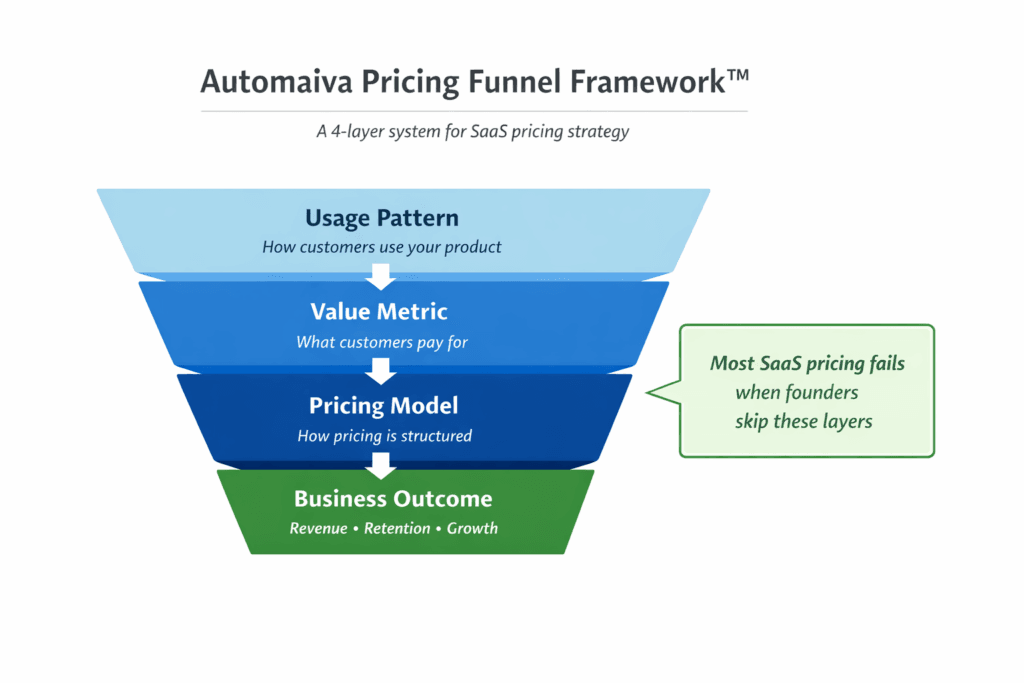
This framework provides a structured way to approach pricing decisions—starting from how users interact with your product and ending with measurable business outcomes.
See how this framework translates into real-world pricing strategies in the SaaS pricing models comparison section below.
The Shift: Why Old Pricing Models Are Breaking
For nearly two decades, SaaS pricing meant one thing: per-user subscriptions. Simple, predictable, easy to bill. Companies like Salesforce built empires on it.
But that model is cracking.
Three things changed:
First, AI broke the unit economics. When a single AI agent can replace dozens of human seats, charging per user makes no sense. The value isn’t in access—it’s in output, tokens, compute minutes, and tasks completed.
Second, customers got smarter. Enterprise buyers realized they were overprovisioning licenses to cover fluctuating needs. They now demand pricing that reflects actual usage, not just access.
Third, competition intensified. In crowded SaaS categories, pricing flexibility became a competitive advantage. Static monthly fees no longer cut it when competitors offer pay-as-you-go options.
The result? Hybrid and usage-based models are now the fastest-growing pricing strategies. By 2025, 85% of SaaS leaders had adopted usage-based components, with 61% using hybrid models.
The Seven Core SaaS Pricing Models
Let’s walk through the main models, with real examples and practical trade-offs.
Real SaaS Pricing Examples (2026)
| Company | Model | Pricing (Starting) | Key Insight |
|---|---|---|---|
| Slack | Freemium → Tiered | Free, ~£6–£10/user/month | Limits message history to drive upgrades |
| Notion | Freemium → Tiered | Free, ~£8–£15/user/month | Feature-gating for advanced collaboration |
| Figma | Per-user → Tiered | Free, ~£12–£45/user/month | Collaboration drives upgrade triggers |
| Zoom | Freemium → Per-host | Free, ~£13–£20/host/month | 40-minute limit pushes conversion |
| GitHub | Freemium → Tiered | Free, ~£4–£20/user/month | Free for individuals, paid for teams |
| Salesforce | Per-user (Tiered) | ~£25–£300+/user/month | Complexity and features scale pricing |
| Twilio | Usage-based | Pay-as-you-go | Pure usage-based API monetisation |
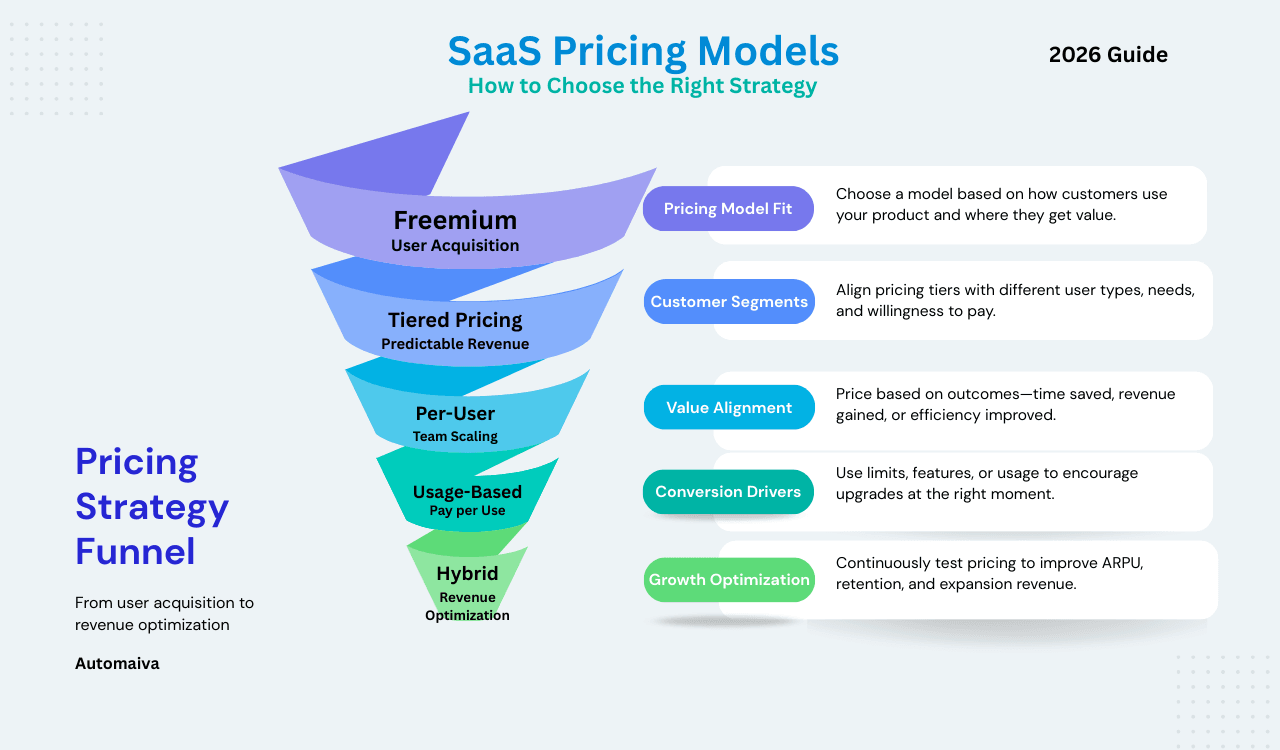
To make these differences clearer, here’s a simple comparison of the most common SaaS pricing models:
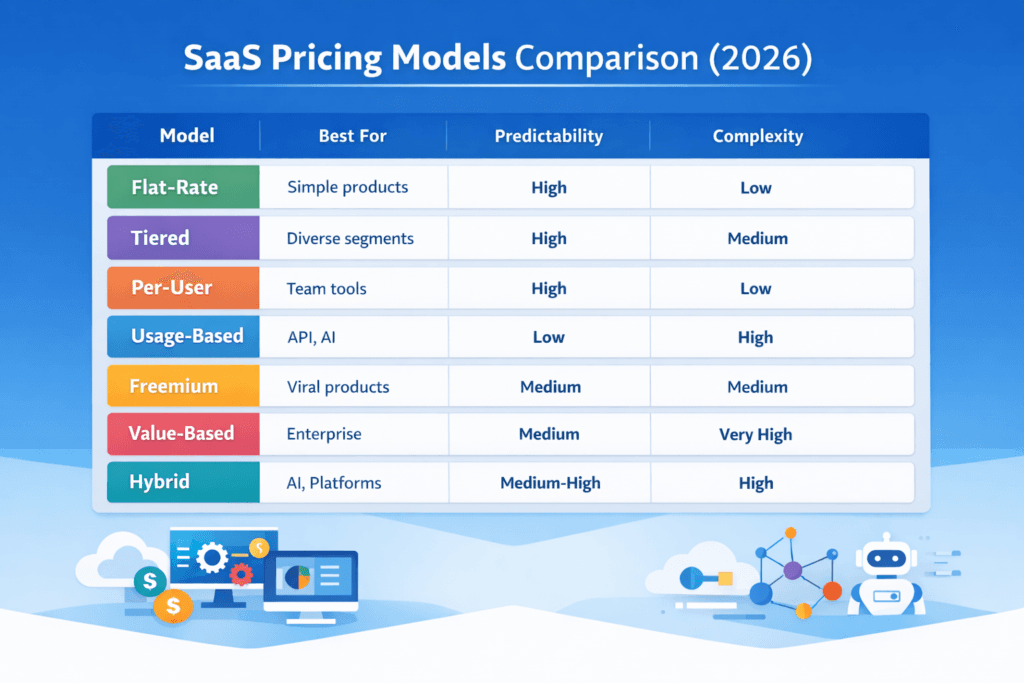
Each model has trade-offs—what works best depends on your product, customers, and growth strategy. Not sure which model fits your product? Use the pricing decision flow below to find the best approach.
1. Flat-Rate Pricing
One product, one price. Customers pay a consistent monthly or yearly fee for full access.
| Aspect | Details |
| Best for | Simple products, niche markets with little competition, predictable usage patterns |
| Pros | Extremely simple to sell and bill; predictable revenue; customers understand it instantly |
| Cons | No upselling opportunities; heavy users drain resources while light users feel overcharged; one shot to convince customers |
Example: Audible offers two simple plans at $7.95 and $14.95 per month. Listen to one book or twenty—price stays the same.
2. Tiered Pricing
Multiple packages at different price points, each with a unique feature mix. This is the most common SaaS model, averaging 3-4 tiers.
| Aspect | Details |
| Best for | Diverse customer bases with varying needs and usage patterns |
| Pros | Attracts different segments; clear upgrade paths; scalable as customer needs grow |
| Cons | Risk of choice overload; feature gating can frustrate customers; requires careful balancing |
Example: Zapier offers five tiers, from free to “Company” level, each with progressively more features and higher limits.
3. Per-User (Seat) Pricing
Customers pay based on the number of individuals using the product.
| Aspect | Details |
| Best for | Team collaboration tools, project management platforms, CRMs |
| Pros | Predictable revenue scaling; easy for customers to understand; straightforward sales process |
| Cons | Account sharing can reduce revenue; growth stalls when teams freeze hiring; small startups may find it expensive |
Example: Salesforce uses per-user pricing, scaling costs as organizations add team members.
4. Usage-Based Pricing
Customers pay based on measurable consumption: API calls, storage, compute minutes, transactions processed.
| Aspect | Details |
| Best for | API-first products, infrastructure tools, AI workloads with variable compute costs |
| Pros | Low barrier to entry; revenue scales with customer success; aligns cost with actual value |
| Cons | Unpredictable revenue; customers fear “bill shock”; requires robust metering and transparent dashboards |
Example: AWS pioneered this model, charging for storage, compute, and queries based on actual consumption.
5. Freemium
A free basic version with paid upgrades for advanced features.
| Aspect | Details |
| Best for | Products with viral potential, daily-use tools, PLG strategies |
| Pros | Massive user acquisition; organic growth; free users become advocates |
| Cons | Low conversion rates (typically 3-5%); free users consume support resources; balancing free vs paid is tricky |
Example: Slack starts free with 90-day message history, then upgrades to unlimited history and advanced features.
6. Value-Based Pricing
Prices set based on the perceived value to the customer, not production costs.
| Aspect | Details |
| Best for | Products with measurable business impact (revenue increase, cost savings, efficiency gains) |
| Pros | Highest revenue potential; strong customer loyalty; aligns with business outcomes |
| Cons | Complex to implement; requires deep customer research; risky if market perceptions shift |
Example: Avast offers free basic security, but premium plans aligned with customers’ perceived value of robust protection.
7. Hybrid Models
Combine two or more approaches, typically a base subscription plus usage-based components.
| Aspect | Details |
| Best for | AI products, platforms with variable usage, companies transitioning from legacy models |
| Pros | Predictable baseline revenue + usage-driven upside; flexibility for different customer types; captures value from power users |
| Cons | Complex to bill and meter; requires sophisticated infrastructure; customers need education |
Example: GitHub Copilot charges a monthly subscription that includes a set number of AI completions, with options to purchase more.
How to Choose Your Model: Four Critical Factors
Based on analysis from VCs and pricing experts, here’s a framework to evaluate which model fits your product.
Factor 1: Frequency of Usage
How often do customers use your product?
If usage is daily or multiple times per day, usage-based pricing creates friction. Users mentally calculate costs before every action, reducing adoption. Slack is the classic example—per-message pricing would kill it. Flat or tiered pricing works better.
If usage is sporadic or unpredictable, usage-based pricing makes perfect sense. Customers only pay when they get value. Financial planning tools, which see intense usage during budgeting cycles and quiet periods otherwise, fit this pattern.
Factor 2: Magnitude of Cost Savings
How much value are you delivering compared to the alternative?
If you’re saving customers significant money (e.g., replacing human labor), you can justify premium transactional pricing. AI products that automate tasks previously done by employees can charge based on the labor cost saved, not just software value.
If savings are marginal, customers will scrutinize every dollar. Fixed pricing may feel safer to them.
Factor 3: Integration Point in the Workflow
Where in their process do customers use you?
If you’re the first line of contact handling all volume, you have predictable revenue. Customers can forecast usage based on historical data.
If you’re further downstream, handling only complex edge cases after human triage, your volume depends on their operational decisions. This unpredictability may favor subscription models.
Factor 4: Customer Budget Type
Are they paying from software budgets or labor budgets?
Software budgets are fixed, scrutinized, and optimized for efficiency. Labor budgets are larger, mission-critical, and tied to outcomes.
If you can credibly replace or augment labor, you can price proportionally to that labor cost. This opens significantly larger total addressable markets.
Decision Matrix: Which Model Fits Your Product?
| If your product… | Consider this model | Example |
| Helps individuals work smarter daily | Per-user or flat-rate | Slack, Notion |
| Automates sporadic tasks | Usage-based | Twilio, AWS |
| Replaces manual labor | Value-based or hybrid | AI copilots, automation platforms |
| Requires top-down enterprise buy-in | Tiered with custom contracts | Salesforce, Workday |
| Benefits from viral adoption | Freemium → tiered | Zoom, Dropbox |
| Has high fixed costs + variable usage | Hybrid (base + usage) | GitHub Copilot, ElevenLabs |
To simplify this further, here’s a practical decision flow you can use when choosing a pricing model:
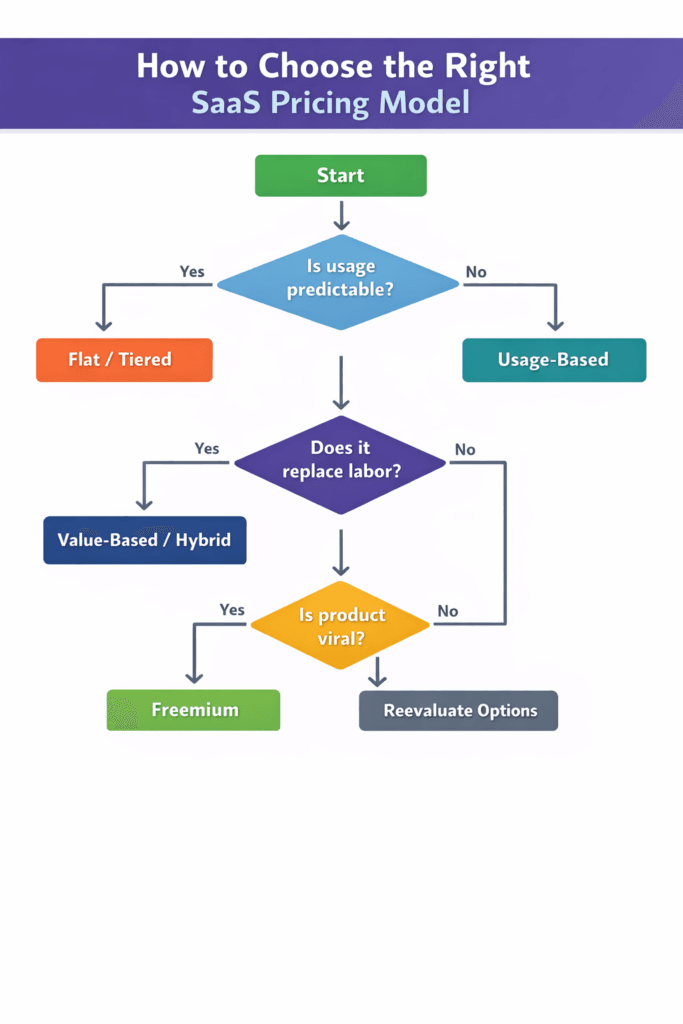
In practice, many SaaS companies combine these approaches—using this decision flow as a starting point rather than a strict rule. This decision process builds on the Automaiva Pricing Funnel Framework explained earlier.
Common Pricing Mistakes (And How to Avoid Them)
Mistake 1: Underpricing to Attract Users
Low prices don’t just limit profit—they attract the wrong customers. Bargain hunters flood your support inbox, churn quickly, and rarely generate enough revenue to justify the effort.
Fix: Price based on value, not cost. Remember: a 1% price increase drives an average 11% profit boost. Start higher than feels comfortable—lowering prices later is easy; raising them risks backlash.
Mistake 2: Copying Competitors Blindly
Your competitor’s pricing reflects their costs, customer base, and value proposition—not yours. Blindly matching them ignores your unique advantages.
Fix: Do competitive research to understand market ranges, then set your price based on your specific value delivery.
Mistake 3: Too Many Tiers
Choice overload paralyzes customers. Research shows too many options reduce conversion rates.
Fix: Start with 2-3 tiers. Test adding more later—removing tiers without annoying existing customers is much harder than adding them.
Mistake 4: Ignoring Economic Value
If you don’t quantify your product’s economic impact, customers will default to price-based comparisons.
Fix: Calculate dollar values for benefits like time saved, revenue increased, or risk mitigated. Use these in your messaging.
Mistake 5: Never Testing
Pricing feels permanent, so founders avoid changing it. But markets shift, products evolve, and competitors emerge.
Fix: Treat pricing as an experiment. Test new tiers on new customers first. Track metrics like conversion rate, churn, and ARPU.
How to Test and Evolve Your Pricing
A 2025 study found that only 4% of SaaS companies saw a slowdown after changing pricing. The other 96% grew faster.
Here’s a safe testing framework:
Step 1: Audit Your Current Pricing
Ask yourself:
- Has ARPU grown with your product improvements?
- Is net revenue retention above 100%?
- Do you rely heavily on discounts?
- Do low-value users consume disproportionate support?
If two or more apply, your pricing needs attention.
Step 2: Test on New Customers First
Run a 50/50 split test: half of new users see old pricing, half see new. Track conversion rates, churn, and ARPU over 90 days.
One SaaS company using this approach saw ARPU rise 48%, MRR grow from $38k to $56k, and churn drop from 5.8% to 4.5%.
Step 3: Grandfather Existing Customers
When you change pricing, reward early adopters by keeping them at their original rate or phasing increases gradually. This goodwill preserves loyalty while you optimise.
Step 4: Add Visible Value First
Before raising prices, ship features customers have requested or improve support. Tie every increase to visible progress—customers pay more when they feel they’re getting more.
The Future: Why Hybrid Is Winning
Across the SaaS landscape, one trend dominates: hybrid pricing is becoming the new default.
| Model Component | Why It Works |
| Base subscription | Predictable revenue, covers fixed costs, easy for customers to budget |
| Usage-based add-ons | Captures value from power users, scales with customer success, aligns with AI economics |
High-growth SaaS companies (40%+ YoY) show 21% median growth when using hybrid models. According to OpenView, 46% of SaaS companies now take a hybrid approach, either testing UBP or offering usage-based subscription plans. Pure subscriptions, while still valuable, can’t capture the upside that hybrid enables.
Common hybrid structures include:
- Seats with included usage limits
- Base fee + overage billing
- Credit pools shared across teams
- Prepaid credit packs with auto-refill
For AI products especially, hybrid pricing solves the core dilemma: AI has real marginal costs (compute, tokens), but customers want predictability.
Final Takeaway
Here’s what I wish someone had told that founder staring at his spreadsheet:
Pricing isn’t a number you find. It’s a strategy you build.
Start simple. Pick a model that aligns with how your customers use and value your product. Test it. Watch what happens. Then iterate.
The companies that win aren’t the ones who get pricing “right” on day one. They’re the ones who keep experimenting, keep listening, and keep evolving as their product and market change.
Your pricing should tell a story—one where the customer sees clearly why the cost is fair, where the value is obvious, and where both sides walk away feeling good about the exchange.
That’s not a spreadsheet problem. That’s a strategy problem. And now you have the framework to solve it.
Pricing Model Cheat Sheet
| Model | Best For | Revenue Predictability | Implementation Complexity |
| Flat-rate | Simple products, niche markets | High | Low |
| Tiered | Diverse customer segments | High | Medium |
| Per-user | Team collaboration | High | Low |
| Usage-based | API, infrastructure, AI | Low | High |
| Freemium | PLG, viral products | Medium | Medium |
| Value-based | High-impact enterprise | Medium | Very High |
| Hybrid | AI, platforms, transitions | Medium-High | High |
Download the SaaS Growth Toolkit
Want a complete SaaS toolkit with templates, calculators, and frameworks?
Download the free SaaS Growth Stack Toolkit below.
Includes metrics cheat sheet, pricing framework, and SaaS tools checklist.
Deepen your SaaS knowledge:
SaaS Metrics 101: The Definitive Guide
Master MRR, LTV, CAC, and the numbers that drive pricing decisions.
SaaS Growth Stack: The Tools Every Startup Needs in 2026
See how pricing fits into your complete technology ecosystem.
Best AI Tools for SaaS Startups
Explore AI tools mentioned in the hybrid pricing section.
Best Email Marketing Tools for SaaS Startups
Examples of freemium and tiered pricing in action.
CRM vs Marketing Automation for SaaS Startups
Understand how different tools use different pricing models.
Best CRM for SaaS Startups in 2026
See per-user pricing examples with Salesforce and HubSpot.
Best Workflow Automation Tools for SaaS Teams
Zapier’s tiered pricing explained.
Written by the Automaiva Editorial Team
Automaiva publishes research-based insights on AI tools, SaaS platforms, and automation systems used by modern startups. Our editorial team analyses SaaS tools, automation workflows, and emerging software trends to help founders choose the right technology stack.
Editorial Policy · Suggest a Topic
Disclaimer: The pricing models, benchmarks, and strategies in this guide are based on industry research and real-world examples as of March 2026. Every business is unique. Test assumptions with your specific customer base before implementing major pricing changes. For specific financial or legal advice, consult qualified professionals.