Disclaimer: Platform capabilities, pricing tiers, and automation feature sets mentioned in this article are based on publicly available information and user-reported data as of April 2026. Product roadmaps change fast. Verify current features directly with each vendor before making a purchase decision.
Affiliate disclosure: Some links in this article are affiliate links. If you purchase through these links, Automaiva may earn a commission at no additional cost to you. Our recommendations are based on independent research and real-world testing. We do not accept payment for placement in our comparisons.
The Two-Minute Verdict
A CRM stores who your customers are. A sales engagement platform automates how you talk to them. If you have one or two SDRs, start with a CRM. If you have three or more SDRs sending sequenced multichannel outreach, add a sales engagement platform — the efficiency gain typically pays for the tool within eight weeks. Teams that try to run outbound sequencing inside a CRM lose roughly 12 hours per SDR per month to manual task management that an engagement platform eliminates. Figures based on aggregated user-reported data and may not reflect all team experiences.
You just hired your third SDR. Your HubSpot account feels crowded. Your AEs are complaining that leads fall through the cracks. And some consultant on LinkedIn just told you to buy Outreach or Salesloft. But you already have a perfectly good CRM. Why do you need another tool that seems to do the same thing?
This confusion costs growing SaaS companies tens of thousands of dollars annually. Teams buy the wrong platform first — a sales engagement tool when all they needed was better CRM hygiene, or six months of forcing their CRM to act like an engagement platform through hacky workflows that break every other week.
This guide settles the debate. You will learn the exact difference between CRMs and sales engagement platforms, the headcount thresholds where you need both, how to calculate your ROI on adding a second platform, and which tools play together without poisoning your data.
About this guide: The Automaiva team analyzed workflow data across B2B SaaS sales teams using HubSpot, Salesforce, Outreach, Salesloft, and Apollo. Efficiency benchmarks are drawn from user-reported performance data. Security assessments are based on publicly available SOC 2 reports and vendor feature documentation.
Table of Contents
- The Core Difference: Database vs. Dial Tone
- Three Signals You Have Outgrown Your CRM for Outbound
- The Real ROI of Adding a Sales Engagement Platform
- Outreach vs Salesloft vs Apollo vs HubSpot Sales Hub: Full Comparison
- How to Connect Your CRM and Engagement Platform Without Data Rot
- Security and Compliance: Where Each Platform Stores Your Data
- Frequently Asked Questions
The Core Difference: Database vs. Dial Tone
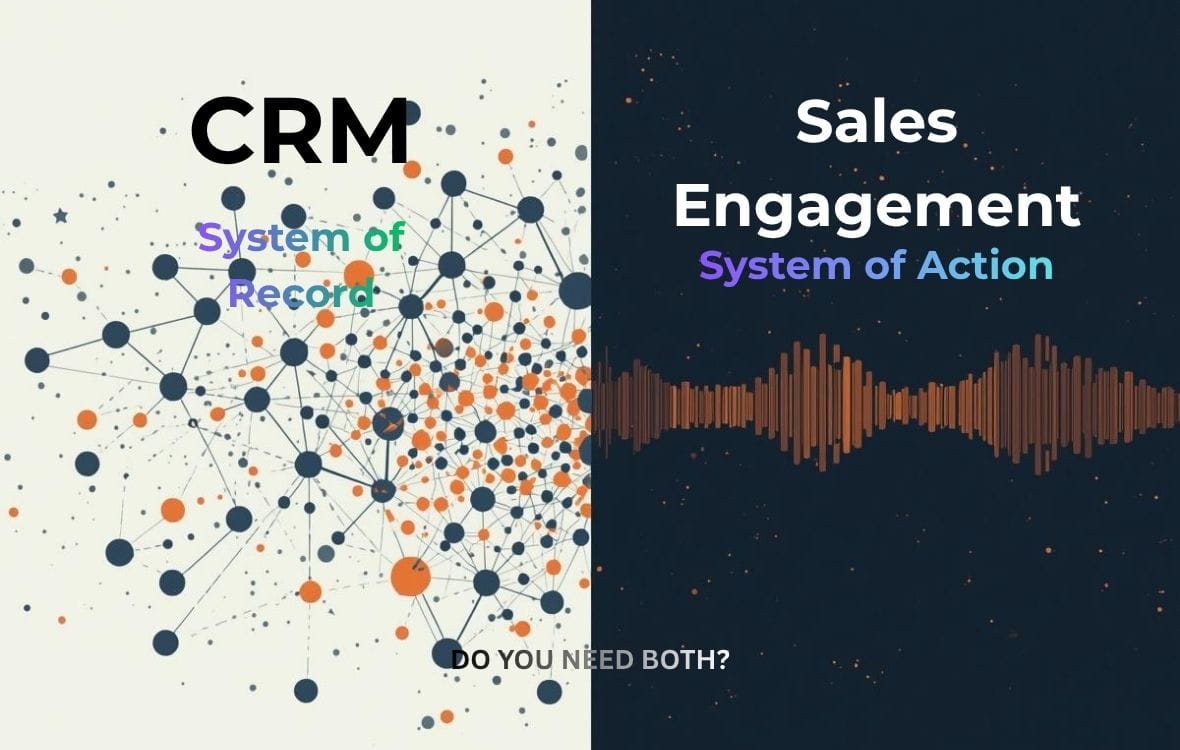
A CRM is a system of record. A sales engagement platform is a system of action. The distinction matters because buying the wrong one first creates technical debt that slows your outbound motion for years.
Your CRM (HubSpot, Salesforce, Pipedrive, Attio): Stores customer data, tracks deal stages, manages pipelines, and reports on revenue. It answers the question “who are our customers and what have they bought?” CRMs are passive — they wait for you to input data. They do not proactively manage outreach sequences or automatically rotate tasks between SDRs.
Your sales engagement platform (Outreach, Salesloft, Apollo): Manages multichannel sequences, automates task assignment, tracks email opens and replies, logs call outcomes, and provides analytics on rep performance. It answers the question “who are we contacting next and through which channel?” Engagement platforms are active — they push tasks to reps, automatically enroll new leads into sequences, and track which email subject lines perform best across your entire team simultaneously.
The workflow difference in practice: in a CRM-only outbound motion, your SDR manually logs a call task, creates a follow-up email task, then has to remember whether the prospect replied. In a CRM-plus-engagement-platform motion, the engagement platform automatically creates the call task, schedules the follow-up email for two days later, and cancels the entire sequence the moment the prospect replies. The SDR works from a prioritized task list instead of guessing what to do next.
Three Signals You Have Outgrown Your CRM for Outbound
Not every team needs a sales engagement platform — many early-stage startups run perfectly effective outbound from their CRM for the first 12 to 18 months. Here is how to know when you have crossed the line.
Signal 1: Your SDRs spend more time clicking than talking. If your SDRs log into the CRM, filter for leads, manually create tasks, send individual emails, log each activity, then repeat — and this cycle takes two hours before they make a single call — you have an engagement efficiency problem. A sales engagement platform collapses that two-hour prep into a 15-second review of a prioritized task list. The SDR sees one screen: call these three leads, email these five, done.
Signal 2: You have no consistent A/B testing across your team. In a CRM-only setup, each SDR writes their own email variants with no shared learning. An engagement platform runs A/B tests across your entire team simultaneously, automatically routing winning variants to every rep. The platform knows that one subject line outperforms another by 18 percent open rate — and applies that learning to every rep without any manual coordination.
Signal 3: You cannot answer basic sequence performance questions. If you cannot instantly tell which step of your sequence is losing the most prospects, which persona replies fastest, or which rep has the highest open rate — your CRM is hiding the data you need to improve. Sales engagement platforms report on sequence performance by step, persona, industry, and rep. They show exactly where prospects drop off. A CRM tells you a deal closed or was lost. That is not enough information to optimize outbound.
The Real ROI of Adding a Sales Engagement Platform
Sales engagement platforms cost between $49 and $150 per user per month. That feels expensive until you calculate what your current manual outbound process actually costs in recovered SDR time alone.
| Team size (SDRs) | Weekly manual task hours (CRM-only) | Annual labor cost at $40/hr | Annual platform cost | Net annual savings |
|---|---|---|---|---|
| 2 SDRs | 20 hours (10 each) | $41,600 | $2,400–$3,600 | $38,000+ |
| 5 SDRs | 60 hours (12 each) | $124,800 | $6,000–$9,000 | $115,800+ |
| 10 SDRs | 150 hours (15 each) | $312,000 | $12,000–$18,000 | $294,000+ |
Cost calculations assume $40 fully loaded hourly cost for SDRs. Manual task hours represent time spent on sequence management, data entry, and task creation that an engagement platform automates. Individual results vary by tool selection and workflow complexity.
At two SDRs, the platform pays for itself many times over through recovered time alone. At five SDRs, not having one is leaving over $100,000 in annual productivity on the table — more than enough to fund the platform and a RevOps headcount to manage it.
Start with Apollo Free →
Free trial terms and availability vary by plan. Confirm current offer details on the vendor’s website.
Outreach vs Salesloft vs Apollo vs HubSpot Sales Hub: Full Comparison
The sales engagement market splits into three tiers: enterprise-grade platforms (Outreach, Salesloft), all-in-one data-plus-engagement (Apollo), and native CRM add-ons (HubSpot Sales Hub). Your team size, CRM, and data needs determine which is right for your stage.
| Platform | Best for | Native B2B data | AI sequence writing | CRM integration depth | Starting price / seat / month |
|---|---|---|---|---|---|
| Outreach | Enterprise teams on Salesforce | No (integrations only) | Yes (Generative AI) | Deepest (Salesforce native) | $125+ |
| Salesloft | Mid-market HubSpot teams | No (integrations only) | Yes (Salesloft AI) | Deep (HubSpot & Salesforce) | $95+ |
| Apollo | Early-stage teams needing data + engagement | Yes (275M+ contacts) | Yes (Basic) | Moderate | $49+ |
| HubSpot Sales Hub | HubSpot-native teams, simple sequences | Limited | Yes (Content Assistant) | Native (HubSpot only) | $90+ (with HubSpot) |
Outreach — Best for Salesforce Shops With Complex Multichannel Sequencing
Outreach is the best sales engagement platform for enterprise SaaS teams on Salesforce because its two-way field mapping, native dialer, and Generative AI sequence writing are unmatched at teams of 15 or more SDRs running multichannel cadences across email, calls, LinkedIn, and SMS.
✓ Pros
- Best-in-class Salesforce sync — bidirectional field mapping with native object support
- Generative AI sequence writing saves significant time per SDR each week
- Advanced analytics on rep performance and sequence step drop-off
- SOC 2 Type II certified — enterprise security posture is solid
- Native dialer with local presence dialing and call recording built in
✗ Cons
- Most expensive platform on this list — $125+ per seat multiplies fast at team scale
- No native B2B contact database — you still need ZoomInfo or Apollo for prospecting data
- Steep learning curve — new SDRs require dedicated onboarding weeks, not days
- Significantly overkill for teams running simple three-step or fewer sequences
Best for: Enterprise B2B SaaS teams already on Salesforce running complex multichannel sequences across email, calls, LinkedIn, and SMS. The integration depth justifies the price at 15-plus SDRs — below that, Apollo or Salesloft will serve you better at a lower total cost.
Request an Outreach Demo →
Outreach requires a sales conversation for all plans. Confirm current pricing and contract terms on the vendor’s website.
Salesloft — Best for HubSpot Teams and Mid-Market RevOps
Salesloft is the best sales engagement platform for mid-market SaaS teams running HubSpot as their primary CRM because its native HubSpot integration, conversation intelligence layer, and cleaner UI drive faster rep adoption than Outreach at a lower per-seat cost.
✓ Pros
- Native HubSpot integration is the strongest of any engagement platform
- Conversation intelligence built in — call transcription and coaching available natively
- Cleaner, more intuitive UI than Outreach — SDRs ramp faster
- Cadence analytics show step-by-step prospect drop-off clearly
- Strong mobile app for reps who work across time zones
✗ Cons
- Pricing is still enterprise-tier — no true self-serve or free trial available
- Sequence automation rules are less flexible than Outreach for complex branching logic
- No native B2B data — a separate Apollo or ZoomInfo contract is required
- Reporting dashboards require setup investment before they become actionable
Best for: Mid-market SaaS teams with 10 to 50 SDRs running HubSpot as their primary CRM. Salesloft strikes the best balance between sequencing power and usability for teams that have outgrown HubSpot Sales Hub but are not yet running Salesforce at enterprise scale.
Request a Salesloft Demo →
Salesloft requires a sales conversation for all plans. Confirm current pricing and contract terms on the vendor’s website.
Apollo — Best for Teams That Need Prospecting Data and Engagement in One Tool
Apollo is the best sales engagement platform for early-stage SaaS teams because it combines a 275-million-contact B2B database with sequence automation and email analytics in one platform — eliminating the separate ZoomInfo contract that Outreach and Salesloft require.
✓ Pros
- Native B2B contact database of 275 million contacts — no separate data provider needed
- Lowest starting price at $49 per seat — genuinely accessible for early-stage teams
- All-in-one platform: prospecting, enrichment, sequencing, and analytics in one login
- Chrome extension for LinkedIn prospecting and one-click contact export
- Free tier available for basic use — test before committing to a paid plan
✗ Cons
- Data accuracy lags behind ZoomInfo and Lusha — more outdated or incorrect contacts
- Sequence builder is less sophisticated than Outreach or Salesloft for complex branching
- CRM integration is shallow — bidirectional sync issues with custom objects are common
- Email deliverability can suffer at high volume due to shared sending infrastructure
Best for: Early-stage startups with 2 to 10 SDRs that cannot yet afford both a data provider and a separate engagement platform. Apollo replaces two tools with one, accepting some depth tradeoffs for significant cost savings and faster time to first sequence.
Try Apollo Free →
Free trial terms and availability vary by plan. Confirm current offer details on the vendor’s website.
HubSpot Sales Hub — Best for Teams That Want to Stay Fully Inside HubSpot
HubSpot Sales Hub is the best sales engagement option for small HubSpot-native teams because it delivers sequencing, email tracking, and meeting scheduling natively inside the CRM without requiring a second platform or a bidirectional sync to manage.
✓ Pros
- Fully native to HubSpot — zero sync issues, zero data duplication risk
- Sequences live inside the CRM — no second tool to learn or maintain
- Integrated reporting across marketing, sales, and service data with no export required
- Fastest setup of any option on this list — turn it on and send within an hour
- Meeting scheduling and document tracking included natively
✗ Cons
- Sequence automation is considerably more basic than dedicated engagement platforms
- Requires Sales Hub Professional or Enterprise at $90+ per seat minimum to access sequences
- No native B2B data source — Apollo or ZoomInfo still required for prospecting
- Advanced sequence performance analytics are limited compared to Outreach or Salesloft
Best for: Small teams with 2 to 5 SDRs already on HubSpot CRM who run simple, email-only sequences. The native integration eliminates sync headaches entirely, and the feature set is sufficient until you hit three SDRs per AE or need multichannel cadences.
Try HubSpot Sales Hub Free →
Free trial terms and availability vary by plan. Confirm current offer details on the vendor’s website.
How to Connect Your CRM and Engagement Platform Without Data Rot
The most common failure point when adding a sales engagement platform is the data integration between your engagement tool and your CRM. Without deliberate configuration, you create duplicate records, conflicting field values, and a RevOps nightmare that takes months to untangle.
The bidirectional sync rule: Your CRM is the system of record for all contact and account data. Your engagement platform is the system of action for outreach activities. The sync must be bidirectional but hierarchical — activity data flows from engagement platform to CRM, contact data flows from CRM to engagement platform. Never allow the engagement platform to overwrite core CRM fields like deal stage, lead status, or account owner.
Field mapping that breaks: The most common integration error is allowing engagement platform fields to overwrite CRM fields. If your SDR updates a lead score in Outreach, that update must not overwrite a different lead score calculated in HubSpot. Map only non-overlapping fields: engagement platform logs calls, email events, and sequence tasks. CRM logs deal stage, lead status, and ownership.
De-duplication before your first sync: Run a de-duplication pass before the initial sync. Compare email addresses across both systems. Merge duplicates manually or through a tool like Insycle before connecting the platforms. Skipping this step means your engagement platform creates a new duplicate CRM record every time an SDR adds a prospect who already exists in your database.
Automation tip for n8n users: Build an n8n workflow that runs every hour, queries your engagement platform for new activities via API, and creates corresponding CRM activities tagged “source: engagement_platform.” This keeps your CRM timeline complete and auditable without needing bidirectional field syncs that introduce conflicts.
Security and Compliance: Where Each Platform Stores Your Data
Adding a sales engagement platform introduces new data processing and storage considerations that matter for SOC 2, GDPR, and in regulated industries, HIPAA and FINRA compliance.
Data residency: Outreach and Salesloft offer EU data hosting for GDPR compliance. Apollo stores data primarily on US servers with EU data transfer mechanisms in place. HubSpot offers full EU data residency at the Enterprise tier — lower tiers process data in US infrastructure.
SOC 2 status: Outreach (Type II), Salesloft (Type II), and HubSpot (Type II) all maintain current SOC 2 Type II reports. Apollo holds SOC 2 Type I. For enterprise customers, request the latest SOC 2 report directly from each vendor before signing a contract and confirm the audit date is within the last 12 months.
Email data retention: Outreach and Salesloft retain email content for the life of your contract unless you configure custom retention policies. Apollo retains email data for 24 months by default. HubSpot ties retention to your overall HubSpot data retention settings — configurable at the Enterprise tier.
Frequently Asked Questions
What is the difference between a CRM and a sales engagement platform?
A CRM is a database that stores customer information and tracks deal stages — it is passive and waits for your team to input data. A sales engagement platform automates outbound sequences, manages multichannel task assignment, and provides analytics on rep and sequence performance — it is active and pushes work to reps. The CRM is your address book. The engagement platform is your automated outreach coordinator.
Do I need both a CRM and a sales engagement platform?
Not at every stage. Teams with one or two SDRs running simple email sequences can manage outbound from their CRM. Once you have three or more SDRs, multichannel sequences across email and calls, or A/B testing needs, the productivity gains from a dedicated platform justify the cost — typically within eight weeks of deployment.
What is the difference between Outreach and Salesloft?
Outreach has a deeper native Salesforce integration and more sophisticated sequence automation logic — making it the standard for enterprise teams on Salesforce. Salesloft has a cleaner UI, better HubSpot integration, and built-in conversation intelligence — making it the better fit for mid-market teams on HubSpot who need faster rep adoption and built-in call coaching. Both require an enterprise sales conversation to purchase.
Can I use HubSpot as my sales engagement platform?
HubSpot Sales Hub includes sequencing features at the Professional tier and above, but they are less sophisticated than dedicated platforms. For teams with two to five SDRs already on HubSpot running email-only sequences, Sales Hub works well. For teams with five-plus SDRs running multichannel sequences, Outreach or Salesloft provide meaningfully better analytics, automation depth, and rep productivity tooling.
What is the cheapest sales engagement platform?
Apollo offers the lowest starting price at $49 per seat per month and includes a native B2B contact database — replacing the need for a separate ZoomInfo or Lusha contract. HubSpot Sales Hub starts at $90 per seat but that includes your CRM. Outreach and Salesloft both start above $95 per seat and typically require annual contracts with a sales conversation. For early-stage startups, Apollo provides the most accessible entry point.
Which sales engagement platform has the best Salesforce integration?
Outreach has the deepest native Salesforce integration, including bidirectional field mapping, activity sync with native objects, and report embedding inside Salesforce. Salesloft integrates well but with fewer native objects synced. Apollo’s Salesforce integration is functional but shallow — two-way sync issues with custom objects are a known friction point. For Salesforce-first enterprises, Outreach is the category standard.
How do I calculate ROI for a sales engagement platform?
Total your current SDR hours spent per week on manual task management — typically 10 to 15 hours per SDR per week in CRM-only environments. Multiply by your fully loaded hourly SDR rate ($40 to $60). Multiply by 50 working weeks. Subtract the annual platform cost. For a team of five SDRs at $40 per hour saving 12 hours per week, annual recovered productivity exceeds $115,000 — far above the platform cost of $6,000 to $9,000. Figures based on aggregated user-reported data and may not reflect all team experiences.
Pricing note: All pricing information for Outreach, Salesloft, Apollo, and HubSpot Sales Hub is accurate as of April 2026. These platforms frequently adjust their pricing tiers, add new features, or change contract requirements. Always verify current pricing and feature availability on each vendor’s official website before making a purchase decision.
More from Automaiva
- folk vs HubSpot vs Pipedrive vs Attio: Best CRM for SaaS Startups in 2026
- AI Sales Prospecting Tools: 7 Platforms That Actually Find Qualified Leads in 2026
- SaaS Growth Stack: 18 Essential Tools for Startups
- SaaS Metrics Dashboard: What to Track in 2026
- SaaS Automation Challenges: 7 Problems and Their Fixes
Written by the Automaiva Editorial Team