Disclaimer: Platform capabilities, pricing tiers, and automation feature sets in this article are based on publicly available information and user-reported data as of April 2026. Marketing automation tools update their features and pricing frequently. Always verify current details directly with each vendor before making a purchase decision.
Affiliate disclosure: Some links in this article are affiliate links. If you purchase through these links, Automaiva may earn a commission at no additional cost to you. Our recommendations are based on independent research and real-world testing. We do not accept payment for placement in our comparisons.
Last updated: April 2026
The Hard Truth
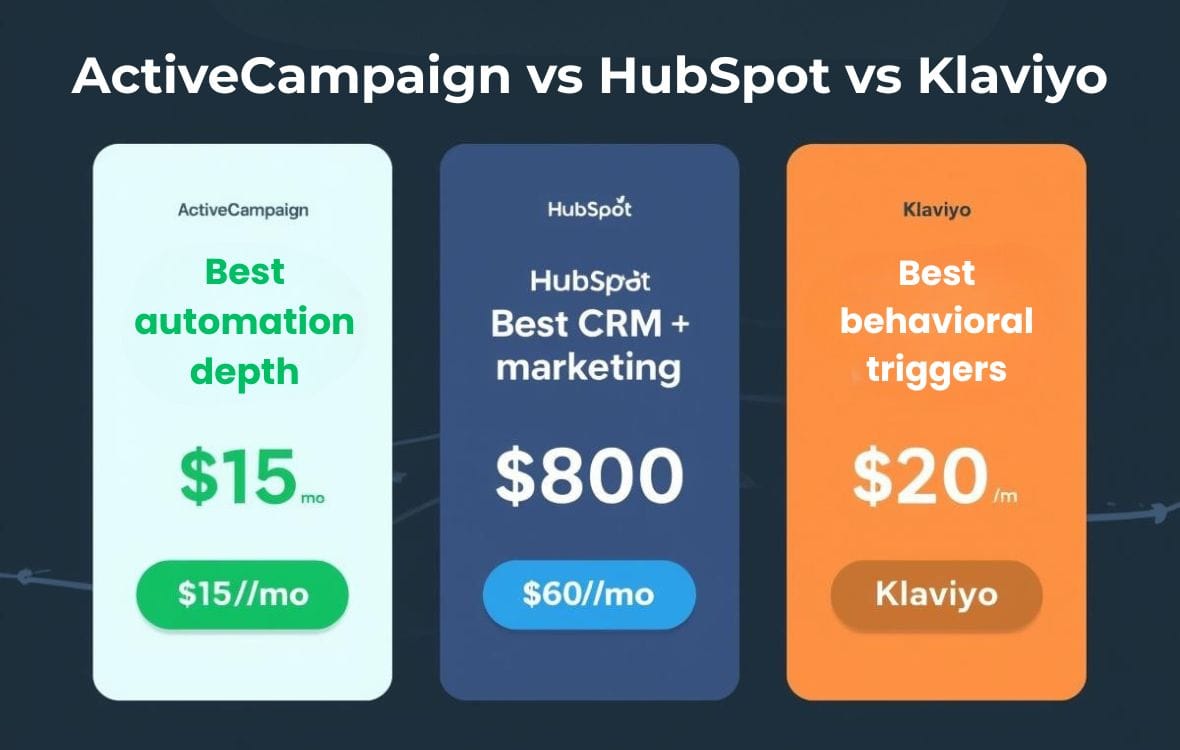
Most SaaS teams buy a marketing automation platform, spend three weeks setting up a welcome sequence, and never touch it again. The workflows sit idle, the leads go cold, and the tool gets blamed for results that were always a strategy problem. The platforms are not the issue — the wrong platform for your stage is. ActiveCampaign wins on automation depth for B2B SaaS teams under $5M ARR. HubSpot wins when your CRM and marketing need to share a single data layer. Klaviyo wins if you run a product-led motion and need behavioral triggers tied to in-product events. Pick the wrong one and you spend six months fighting the tool instead of closing deals. Figures based on aggregated user-reported data and may not reflect all team experiences.
Here is the pattern that repeats across every SaaS team that switches marketing automation platforms after 12 months: they picked their first tool based on a free trial and a friend’s recommendation, not on what their actual workflow required. They outgrew it, switched, lost their contact history, rebuilt their sequences from scratch, and spent two months explaining to the sales team why the pipeline went quiet during the migration.
This guide prevents that. It compares ActiveCampaign, HubSpot, and Klaviyo specifically for B2B SaaS teams — on automation depth, CRM integration, behavioral triggering, deliverability, and the hidden costs that show up six months after you sign the annual contract.
About this guide: The Automaiva team evaluated marketing automation platforms across B2B SaaS teams from seed stage through Series B. All benchmarks are sourced from user-reported performance data and publicly available feature documentation as of April 2026.
Table of Contents
- Why Most SaaS Marketing Automation Workflows Fail Before They Start
- ActiveCampaign vs HubSpot vs Klaviyo: Full Feature Comparison
- ActiveCampaign — Best Automation Depth for B2B SaaS
- HubSpot — Best When CRM and Marketing Share One Platform
- Klaviyo — Best for Product-Led SaaS With Behavioral Triggers
- The 3 Automation Workflows That Actually Convert in 2026
- Which Platform Is Right for Your Stage
- Frequently Asked Questions
Why Most SaaS Marketing Automation Workflows Fail Before They Start
The best marketing automation platform for B2B SaaS is the one that matches your current stage — not the one with the most features or the biggest brand name. Buying the wrong platform at the wrong stage is the single most common reason SaaS teams run complex automation that produces no measurable pipeline impact.
Five workflow failure patterns show up consistently across SaaS teams, regardless of which platform they use:
The welcome onslaught. Four emails in four days. Day one welcome, day two content, day three founder story, day four product push. Open rates start strong and collapse by email three as users feel pitched before they have decided whether they like the product. A three-email sequence over ten days consistently outperforms a four-email sequence over four days on click-to-open rate and free-to-paid conversion. Figures based on aggregated user-reported data and may not reflect all team experiences.
The conditional logic nightmare. “If user opens email A and clicks link B but does not visit the pricing page within three days, send email C unless they downloaded asset D.” Every additional branch doubles the chance of something breaking. Most SaaS teams do not have the ops bandwidth to maintain complex conditional trees reliably. Simple linear sequences with one or two behavioral branches outperform elaborate flowcharts for teams under 50 employees.
The tool-first purchase. Buying ActiveCampaign or HubSpot before defining what you need the automation to do. A platform decision made without a workflow map is a contract signed before you know what you are building. Define your three core sequences — welcome, trial nurture, and re-engagement — before evaluating any platform.
The one-size-fits-all sequence. Sending the same automation to a startup founder and an enterprise procurement manager who both signed up for your trial. Segmentation by company size, role, and acquisition source is the single highest-leverage improvement most SaaS teams can make to existing automation — and it requires only a conditional branch at the start of each sequence, not a full platform rebuild.
The vanity metric trap. Measuring open rates and click rates instead of downstream conversion. The only metrics that matter in SaaS marketing automation are trial-to-paid conversion rate, time-to-activation, and email-attributed pipeline. If you cannot attribute revenue to your automation sequences, you cannot improve them.
ActiveCampaign vs HubSpot vs Klaviyo: Full Feature Comparison
| Feature | ActiveCampaign | HubSpot | Klaviyo |
|---|---|---|---|
| Automation depth | Best-in-class | Strong (Pro+) | Strong (behavioral) |
| Native CRM | Basic built-in | Full native CRM | No native CRM |
| Behavioral triggers | Strong | Strong (Pro+) | Best-in-class |
| Email deliverability | Industry leading | Good | Industry leading |
| Lead scoring | Advanced | Advanced (Pro+) | Basic |
| Segmentation | Deep | Deep | Deep (event-based) |
| Salesforce integration | Yes (paid) | Native | Via Zapier |
| A/B testing | Yes | Yes (Pro+) | Yes |
| SOC 2 compliance | Yes (Type II) | Yes (Type II) | Yes (Type II) |
| Starting price / month | $15 (Starter) | $20 (Starter) | $20 (500 contacts) |
ActiveCampaign — Best Automation Depth for B2B SaaS Teams Under $5M ARR
ActiveCampaign is the best marketing automation platform for B2B SaaS teams under $5M ARR because its visual automation builder, advanced lead scoring, and industry-leading deliverability give growth-stage teams enterprise-grade automation capability at a fraction of HubSpot’s cost at equivalent feature depth.
✓ Pros
- Best-in-class visual automation builder — conditional branching, goal steps, and split testing on all paid plans
- Advanced lead scoring with behavioral, demographic, and engagement signals combined
- Industry-leading email deliverability — consistently rates above 95 percent inbox placement in third-party audits
- 500-plus native integrations including deep Salesforce, HubSpot CRM, and Pipedrive connections
- CRM built in — basic deal management without needing a separate tool at early stage
- SOC 2 Type II certified and GDPR compliant — enterprise security out of the box
✗ Cons
- Interface is less polished than HubSpot — learning curve is steeper for non-technical marketers
- Reporting is functional but not beautiful — dashboard customization lags behind HubSpot
- Landing page builder is limited compared to HubSpot — you will still need a separate tool for conversion pages
- Price scales with contact count — costs rise faster than expected as your list grows beyond 10,000 contacts
ActiveCampaign pricing (monthly billing): Starter plan at $15/month for 1,000 contacts. Plus at $49/month adds CRM and lead scoring. Professional at $79/month adds predictive sending and site messaging. Enterprise pricing requires a sales conversation. Annual billing saves approximately 20 percent. See current ActiveCampaign pricing →
Who should not use ActiveCampaign: Teams that need a full CRM with pipeline management and marketing in a single platform — HubSpot is the better fit. Teams running a pure product-led motion where automation needs to trigger from in-product events like feature usage or session frequency — Klaviyo’s event-based segmentation handles this more elegantly.
Best for: B2B SaaS teams at seed to Series A stage running sales-assisted or inbound-led motions, who need deep automation without HubSpot’s pricing, and where the marketing team has at least one moderately technical operator who can build and maintain complex sequences.
Try ActiveCampaign Free →
Free trial terms and availability vary by plan. Confirm current offer details on the vendor’s website.
HubSpot — Best When CRM and Marketing Need to Share One Data Layer
HubSpot is the best marketing automation platform for B2B SaaS teams that already use or plan to use HubSpot CRM, because having your contact records, deal pipeline, email sequences, and marketing automation sharing the same database eliminates the sync issues, attribution errors, and duplicate records that plague teams running separate CRM and marketing tools.
✓ Pros
- Native CRM — marketing automation and sales pipeline share one contact record with zero sync required
- Full attribution reporting from first touch to closed deal — no manual stitching across tools
- Best-in-class landing page and form builder included at all tiers
- AI-powered email writer, subject line suggestions, and send-time optimization built in
- Free CRM tier is genuinely useful — teams can start with zero cost and upgrade when ready
- SOC 2 Type II, GDPR, and HIPAA compliance available — strongest compliance posture on this list
✗ Cons
- Marketing automation requires Professional tier at $800/month minimum — the Starter plan has severely limited automation
- Price jumps are steep — going from Starter to Professional is a $780/month increase
- Contact-based pricing becomes expensive fast — 10,000 marketing contacts adds significant cost at Professional tier
- Automation depth trails ActiveCampaign at equivalent price points — fewer conditional branches and goal-step options
HubSpot pricing (monthly billing): Free CRM with basic email tools. Marketing Hub Starter at $20/month for 1,000 contacts but with limited automation. Marketing Hub Professional at $800/month for 2,000 contacts with full automation — this is the minimum tier for serious marketing automation use. Enterprise at $3,600/month. Annual billing required for best pricing. See current HubSpot pricing →
The HubSpot pricing trap: Many teams start on HubSpot Starter because the $20/month price looks accessible. They then discover that meaningful automation — behavioral triggers, lead scoring, A/B testing — requires the Professional plan at $800/month. This $780/month surprise is the most common reason SaaS teams switch away from HubSpot in their first year. Budget for Professional from day one if automation is your primary use case.
Who should not use HubSpot: Early-stage teams that need deep automation but cannot justify $800/month — ActiveCampaign delivers comparable automation depth at $49/month. Teams running a product-led motion that need in-product behavioral triggers — Klaviyo handles event-based automation more elegantly than HubSpot at any tier.
Best for: Growth-stage and scale-up B2B SaaS teams (Series A and above) that can justify the Professional tier cost, already use or plan to use HubSpot CRM, and want a single platform covering marketing, sales, and service without managing multiple tool integrations.
Try HubSpot Free →
Free trial terms and availability vary by plan. Confirm current offer details on the vendor’s website.
Klaviyo — Best for Product-Led SaaS With Behavioral Event Triggers
Klaviyo is the best marketing automation platform for product-led SaaS teams because its event-based segmentation and real-time behavioral triggers fire automations based on what users actually do inside your product — not just what emails they open — making it the strongest platform for driving activation and expansion revenue from in-product behavior signals.
✓ Pros
- Best-in-class event-based segmentation — trigger automations from any in-product event via API in real time
- Predictive analytics built in — identifies users at risk of churn before they cancel
- Industry-leading deliverability — dedicated IP pools available from $150/month
- Flows (automations) are visually intuitive — non-technical marketers can build complex sequences without code
- Deep Shopify and Stripe integrations — revenue data feeds directly into segmentation and automation triggers
- Generous free plan — 500 contacts and 150 SMS credits with full flow access
✗ Cons
- No native CRM — you need a separate CRM tool for deal management and sales pipeline
- B2B lead scoring is weaker than ActiveCampaign — better suited to product-led than sales-assisted motions
- Pricing scales steeply with contact count — can become expensive faster than ActiveCampaign at large list sizes
- Salesforce integration requires Zapier or a third-party connector — no native bidirectional sync
Klaviyo pricing (monthly billing): Free plan for up to 500 contacts and 150 SMS credits. Email plan starts at $20/month for 500 contacts, scaling with list size — 5,000 contacts costs $100/month, 25,000 contacts costs $415/month. Email and SMS combined plan adds approximately 20 percent. See current Klaviyo pricing →
Who should not use Klaviyo: Sales-assisted B2B SaaS teams that need deep CRM integration and lead scoring as core automation inputs — ActiveCampaign or HubSpot are better fits. Teams that cannot invest engineering time in event tracking setup — Klaviyo’s behavioral trigger power requires sending custom events from your product, which needs a developer or a CDP like Segment to configure properly.
Best for: Product-led SaaS teams that want to trigger automation from in-product behavior — user hits a usage milestone, user invites a teammate, user reaches a feature limit — and need real-time event-based sequences that respond to what users actually do rather than time-based drips.
Try Klaviyo Free →
Free trial terms and availability vary by plan. Confirm current offer details on the vendor’s website.
The 3 Automation Workflows That Actually Convert in 2026
Every platform on this list can run these three workflows. The difference between teams that see 3 to 5 percent trial-to-paid conversion and teams that see 8 to 12 percent is almost always one of these three sequences being absent or misconfigured — not a platform limitation.
Workflow 1: The Segmented Welcome Sequence
Send different welcome emails to users based on how they found you and what role they selected at signup. A startup founder who found you via organic search needs a different first email than an enterprise IT manager who came from a paid LinkedIn ad. The segmentation branch takes under two hours to configure and consistently outperforms a single unsegmented welcome email on activation rate.
Structure: Day 1 — welcome email segmented by role or acquisition source. Day 3 — ask one question: “What are you hoping to solve?” Replies from this email generate more product insight than six months of analytics dashboards. Day 7 — send relevant content based on the answer or based on which features they have or have not used since signup.
Best platform for this workflow: ActiveCampaign — the conditional branching at the start of the sequence is more flexible and easier to configure than HubSpot Starter or Klaviyo’s flow builder for purely email-based segmentation.
Workflow 2: The Behavioral Trial Nurture
Trigger emails based on what users do or do not do inside your product during the trial — not on time elapsed since signup. A user who connected their first integration on day two gets a different email than a user who signed up four days ago and has not logged in since. Time-based drips send the wrong message to the wrong user at the wrong moment. Behavioral triggers do not.
Structure: Trigger: user completes onboarding step → send congratulations email with next recommended action. Trigger: user has not logged in for 72 hours → send re-engagement email highlighting one specific feature. Trigger: user hits usage limit → send upgrade email with a direct comparison of what they get on the paid plan.
Best platform for this workflow: Klaviyo — its real-time event API handles in-product behavioral triggers with more precision and less configuration overhead than ActiveCampaign or HubSpot at equivalent price points.
Workflow 3: The At-Risk Subscriber Rescue
Identify contacts who have not engaged with your emails in 60 days and run a two-step re-engagement sequence before removing them from your active list. Removing unengaged contacts is not a failure — it is list hygiene that protects your sender reputation and improves deliverability for contacts who actually want to hear from you.
Structure: Email 1 (day 1): “We noticed you have been quiet — are we sending the right content?” Offer a one-click preference update. Email 2 (day 8, if no response): “Should we keep your spot on our list?” Single yes/no button. If no response after email 2 — unsubscribe automatically. Clean, respectful, effective.
Best platform for this workflow: Any of the three platforms handles this equally well. ActiveCampaign’s engagement scoring makes it slightly easier to identify at-risk contacts automatically without manual list filtering.
Which Platform Is Right for Your Stage
The right marketing automation platform is determined by three variables: your go-to-market motion, your current ARR, and whether you already have a CRM in place. Use this framework to find your answer in under two minutes.
| Your situation | Best platform | Why | Starting cost |
|---|---|---|---|
| Pre-seed, sales-assisted, no CRM yet | ActiveCampaign Starter | Deep automation at low cost. Built-in CRM handles early-stage pipeline without extra tools. | $15/month |
| Seed to Series A, sales-assisted, HubSpot CRM already in use | HubSpot Marketing Pro | Single data layer eliminates sync headaches. Attribution across CRM and marketing is native. | $800/month |
| Any stage, product-led motion, behavioral triggers needed | Klaviyo | Event-based segmentation from in-product behavior is Klaviyo’s core strength. No other platform matches it at this price point. | $20/month |
| Growth stage, sales-assisted, Salesforce already in use | HubSpot or ActiveCampaign | HubSpot has native Salesforce sync. ActiveCampaign has a paid Salesforce integration that costs less overall. | $49–$800/month |
| Enterprise SaaS, HIPAA or strict compliance required | HubSpot Enterprise | Only platform on this list offering HIPAA-compliant data processing at the Enterprise tier. SOC 2 Type II across all tiers. | $3,600/month |
Pricing note: All pricing information for ActiveCampaign, HubSpot, and Klaviyo is accurate as of April 2026. These platforms update their pricing tiers and feature availability regularly. Always verify current pricing on each vendor’s official website before making a purchase decision.
Frequently Asked Questions
Which marketing automation platform is best for B2B SaaS?
ActiveCampaign is the best marketing automation platform for most B2B SaaS teams because it delivers the deepest automation capability at the lowest price point — starting at $15/month versus HubSpot’s $800/month minimum for comparable automation features. HubSpot is the better choice when your CRM and marketing need to share a single data layer. Klaviyo wins for product-led teams that need behavioral triggers from in-product events.
Is HubSpot worth the price for SaaS marketing automation?
HubSpot Marketing Hub Professional at $800/month is worth the price specifically for teams already using HubSpot CRM who want native attribution from first marketing touch to closed deal without managing a separate integration. For teams not already on HubSpot CRM, ActiveCampaign delivers comparable automation depth at $49/month on the Plus plan — a $751/month saving at equivalent capability for most SaaS use cases.
What is the difference between ActiveCampaign and Klaviyo for SaaS?
ActiveCampaign is stronger for sales-assisted B2B SaaS teams that need deep email automation, lead scoring, and CRM integration. Klaviyo is stronger for product-led SaaS teams that need real-time behavioral triggers based on what users do inside the product — feature usage, session frequency, upgrade intent signals — rather than purely email engagement signals. The two platforms are not direct competitors for most SaaS teams: your go-to-market motion determines which fits.
How many emails should a SaaS welcome sequence have?
Three emails over seven to ten days is the most effective structure for most B2B SaaS teams. Email one on day one covers welcome and next steps. Email two on day three asks one open question about what the user hopes to solve — replies to this email generate more actionable product insight than most analytics dashboards. Email three on day seven sends relevant content based on either their answer or their in-product behavior since signup. More than three emails in the first ten days consistently increases unsubscribe rates without improving activation. Figures based on aggregated user-reported data and may not reflect all team experiences.
Can Klaviyo replace a CRM for SaaS teams?
No. Klaviyo is a marketing automation and email platform, not a CRM. It has no deal pipeline, no contact ownership model for sales reps, and no native integration with Salesforce or HubSpot CRM without a third-party connector. Teams using Klaviyo for marketing automation still need a separate CRM — HubSpot CRM (free tier), Pipedrive, or Attio — for sales pipeline management.
What is the cheapest marketing automation platform for SaaS startups?
ActiveCampaign Starter at $15/month for 1,000 contacts is the cheapest paid option with meaningful automation capability. Klaviyo’s free plan covers 500 contacts with full flow access — useful for validating automation strategy before committing to a paid plan. HubSpot’s free CRM includes basic email tools but automation requires the Professional plan at $800/month minimum, making it the most expensive entry point for serious automation use.
How do I measure whether my marketing automation is actually working?
Track three metrics exclusively: trial-to-paid conversion rate from email-attributed contacts, time-to-activation for users who enter your welcome sequence versus those who do not, and email-attributed pipeline value in your CRM. Open rates and click rates are vanity metrics for SaaS — they tell you whether your subject lines are compelling, not whether your automation is driving revenue. Set up UTM parameters on every email CTA and connect your email platform to your CRM to track the full funnel from first email to closed deal.
More from Automaiva
- Zapier vs Make vs n8n: Which Automation Tool Pays for Itself Fastest at Your Usage Volume? (2026 Data)
- CRM vs Marketing Automation for SaaS: Which to Buy First
- SaaS Growth Stack: 18 Essential Tools for Startups
- SaaS Automation Challenges: 7 Problems and Their Fixes
- folk vs HubSpot vs Pipedrive vs Attio: Best CRM for SaaS Startups (2026)
Written by the Automaiva Editorial Team