Updated: April 12, 2026
Disclaimer: AI agent capabilities and pricing models are evolving rapidly. This guide reflects industry trends and best practices as of April 2026. Always test AI features with your specific use cases before full deployment.
Quick Answer
AI agents for SaaS are replacing entire categories of manual workflow — but most teams deploying them right now are discovering the hard way that the failure modes are just as significant as the wins.
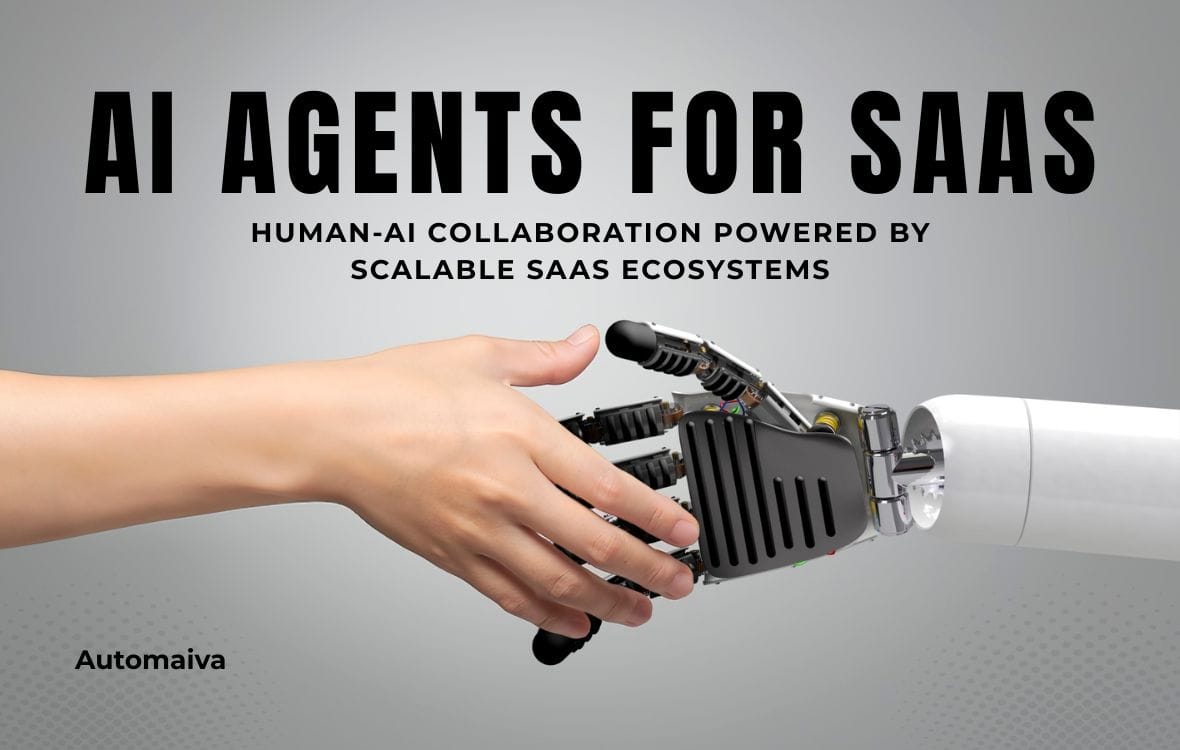
AI agents for SaaS are autonomous software systems that execute tasks end-to-end inside your product. Unlike chatbots that just answer questions, AI agents take action: they onboard users, analyze data, resolve support tickets, and close sales. For SaaS founders, AI agents represent the shift from selling “tools for humans” to selling “outcomes delivered by AI coworkers.” The time to start planning your agent strategy is now.
Your users no longer want tools. They want outcomes.
Dashboards, alerts, and workflows still require effort from users. In 2026, that friction causes churn. This shift is why AI agents for SaaS are becoming the foundation of next-generation software products.
AI agents do not wait for users to click buttons. They observe behavior, reason over data, and act inside your product. A CRM agent qualifies leads. A finance agent flags anomalies. A product agent fixes configuration issues before users complain [citation:1].
This guide explains what AI agents actually are, how they differ from chatbots, where they create value, and how to start building your agent strategy.
Table of Contents
- What Are AI Agents for SaaS?
- AI Agent vs. Chatbot: The Critical Difference
- High-Impact Use Cases for SaaS AI Agents
- Multi-Tenant AI Agent Architecture
- How to Price AI Agents (New Models for 2026)
- Your 90-Day AI Agent Roadmap
- Frequently Asked Questions
What Are AI Agents for SaaS?
An AI agent is an autonomous software system that can understand a goal, plan steps to achieve it, and execute those steps without human intervention.
Unlike traditional software that requires users to click buttons and navigate menus, AI agents act like digital coworkers. They have memory, can reason across multiple steps, and can use tools (APIs) to perform work inside your product [citation:1].
The three core capabilities of an AI agent:
- Reasoning and planning: Instead of following a rigid script, the agent understands the user’s goal and thinks through the steps required to solve the problem.
- Tool use (actionability): A true agent connects to your tech stack via APIs. It can update records, send emails, trigger workflows, and complete tasks.
- Autonomous orchestration: AI agents can manage multi-step processes across days or weeks. They ask clarifying questions, handle interruptions, and coordinate with other specialized agents [citation:4].
This transition marks the rise of Agentic SaaS. Products powered by autonomous AI agents deliver value immediately and continuously. SaaS companies that adopt this model increase retention, justify premium pricing, and build defensible IP [citation:1].
AI Agent vs. Chatbot: The Critical Difference
The difference between an AI agent and a chatbot comes down to one word: execution.
- A chatbot answers questions.
- An AI agent completes tasks.
Chatbots are passive. They wait for users to ask something, then retrieve information from a knowledge base. They do not take action [citation:1].
AI agents are active. They write queries, trigger APIs, update records, and manage workflows. They also maintain memory, which allows them to run long processes like onboarding or renewals across days or weeks [citation:1].
| Capability | Chatbot | AI Agent |
|---|---|---|
| Answers questions | Yes | Yes |
| Takes action (updates, creates, deletes) | No | Yes |
| Maintains memory across sessions | Limited | Yes (long-term) |
| Executes multi-step workflows | No | Yes |
| Uses APIs to trigger external systems | No | Yes |
When your software performs work instead of explaining work, users stop leaving. This is why the best AI agents for SaaS companies directly reduce churn and increase Net Dollar Retention [citation:1].
High-Impact Use Cases for SaaS AI Agents
The best place to deploy AI agents is where users struggle the most. Based on industry research, these four use cases deliver the highest ROI for SaaS companies [citation:1][citation:4][citation:7].
1. Automated Onboarding & Success
An onboarding agent watches user actions. If setup stalls, it steps in, configures integrations, validates settings, and confirms success automatically.
Result: Faster time-to-value and higher activation rates. One project management tool saw activation rates increase by 40% after deploying an onboarding agent [citation:1].
How to start: Identify where users get stuck in your onboarding flow. Build an agent that detects stalled actions and offers help or completes the step automatically.
2. Intelligent Analytics
Users hate building reports. Generative AI agents answer questions like “Why did churn increase last month?” The agent queries data, analyzes cohorts, identifies causes, and delivers a written explanation.
Result: Users get insights without learning your reporting interface.
How to start: Build an agent that connects to your data warehouse or analytics API. Let users ask natural language questions about their data.
3. Autonomous Customer Support
True AI agents for customer service resolve requests end-to-end. They understand the customer’s goal, determine necessary steps, and execute actions across billing, CRM, and ticketing systems [citation:4].
Result: McKinsey reports that adopting agentic AI in customer operations can decrease service operation costs by up to 30% [citation:4].
How to start: Automate your highest-volume, lowest-complexity support requests first. Issue refunds, password resets, and subscription changes are great starting points.
4. Autonomous Sales Development
Sales agents research leads, score accounts, personalize outreach, and follow up automatically. They act as always-on SDRs inside your platform [citation:1].
Result: Sales teams focus on closing, not prospecting.
How to start: Build an agent that qualifies inbound leads based on firmographic data and engagement signals. Have it send personalized follow-ups automatically.
Multi-Tenant AI Agent Architecture
Building one agent is easy. Scaling it across customers is hard. This is where multi-tenant AI agent architecture matters [citation:1].
Three critical considerations:
1. Data Isolation: AI agents must enforce strict tenant-level isolation. Every memory retrieval and action must be scoped to a tenant ID. This prevents data leakage and ensures compliance [citation:1][citation:5].
2. Cost Control: Scalable AI agents require strong cost governance: per-tenant token limits, rate limiting for heavy workloads, and serverless execution so agents run only when triggered. Without this, your AI costs grow uncontrollably [citation:1].
3. Custom Rules per Tenant: Enterprise AI agents must follow customer-specific policies. Your architecture must support per-tenant prompts, permissions, and guardrails without branching codebases [citation:1].
According to industry analysis, the next generation of AI agents won’t live inside individual apps. They will communicate, coordinate, and act across entire tech ecosystems [citation:2].
How to Price AI Agents (New Models for 2026)
AI agents are forcing SaaS companies to rethink pricing. Seat-based pricing breaks down in a world where greater automation creates more value with fewer human users [citation:7][citation:8].
Emerging pricing models for AI agents:
| Model | How It Works | Example |
|---|---|---|
| Outcome-based | Charge per measurable result delivered | Intercom Fin: $0.99 per resolved conversation |
| Credit-based | Customers buy credits consumed by different features | HubSpot: credits for AI tools on top of per-seat plans |
| Hybrid (seats + usage) | Base platform fee plus usage-based overages | Salesforce Agentforce: $2 per conversation + seats |
According to industry benchmarks, companies using outcome-based pricing see 31% higher customer retention and 21% higher satisfaction scores [citation:8]. AI-monetized providers using credit systems see 2 to 3 times higher traction because customers perceive pricing as more accurate and performance-based [citation:3].
If your pricing still relies purely on per-seat fees, you are leaving money on the table from power users and creating friction for light users.
Your 90-Day AI Agent Roadmap
You do not need to rebuild your product overnight. Here is a phased approach that works for most SaaS startups.
Days 1-30: Discovery & Planning
- Identify the single most painful manual task in your product. Do not build a “do-everything” agent. Focus on one job to automate.
- Document the steps a human takes to complete that task. Map every decision point and API call.
- Define success metrics: time saved, error reduction, user adoption.
Days 31-60: Build Your MVP Agent
- Build a simple agent that automates that one task. Use existing LLM APIs (OpenAI, Anthropic, or open-source models).
- Implement basic guardrails. Define what the agent can and cannot do.
- Test with 5-10 internal users or trusted customers. Collect feedback obsessively.
Days 61-90: Deploy & Iterate
- Roll out to a small customer cohort (10-20 accounts).
- Monitor usage, errors, and user satisfaction. Track how often users override or correct the agent.
- Use feedback to improve accuracy and add features. Expand to more customers.
If you lack internal AI expertise, consider partnering with an AI development agency. The AI agent development cost for an MVP typically ranges from $30,000 to $50,000 [citation:1].
Frequently Asked Questions
What is the difference between an AI agent and an AI feature?
An AI feature adds intelligence to a specific function (like smart email replies). An AI agent is autonomous and can execute multi-step tasks without human intervention. Agents take action; features assist.
Do I need to rebuild my entire product to add AI agents?
No. Start with one high-impact use case. Build an agent that automates a single painful task. Expand from there as you learn.
How do I ensure AI agents don’t make costly mistakes?
Implement guardrails, human-in-the-loop review for critical actions, and audit logs. Start with low-risk automations and add autonomy as trust builds.
What is multi-tenant AI agent architecture?
A design pattern that isolates each customer’s data, enforces per-tenant limits, and supports custom rules without branching code. Essential for B2B SaaS [citation:1].
How much does it cost to build an AI agent?
An MVP agent typically costs $30,000 to $50,000 in development. Enterprise-grade agents with complex integrations can range from $100,000 to $250,000 [citation:1].
Will AI agents replace my product’s user interface?
Not entirely, but they will change it. Conversational command interfaces are becoming the primary way users delegate high-level tasks, complemented by dashboards for configuration and oversight [citation:7].
What is the ROI of adding AI agents to my SaaS?
Early adopters report 40% higher activation rates, 30% lower support costs, and 20% higher customer retention [citation:1][citation:4][citation:8].
More from Automaiva
Final Thoughts
AI agents are not a future trend. They are already reshaping how SaaS products deliver value. The question is not whether to adopt them, but when and how.
Start small. Pick one high-impact use case. Build a focused agent. Learn from real usage. Expand from there.
The software that works — truly works, without friction, without manual effort — wins. AI agents are how you get there.
Written by the Automaiva Editorial Team
Automaiva publishes research-backed guides on AI agents, SaaS platforms, and automation systems. We help founders navigate the shift to agentic software.