Disclaimer: Pricing, feature availability, and platform capabilities referenced in this article are based on publicly available vendor documentation and independent research as of April 2026. Email marketing platform pricing changes frequently. Always verify current pricing directly on each vendor’s website before purchasing. Automaiva may earn affiliate commissions from purchases made through links in this article. This does not affect our editorial independence.
Editorial note: Automaiva selects and recommends tools based on independent research. We have no paid relationships with any vendor that affect our editorial conclusions.
Email marketing automation SaaS teams need in 2026 is not a features race — it is a company stage question. The platform that is right at seed stage costs a fraction of the platform that is right at Series B, and the cost of choosing the wrong one is not just money spent. It is months of migration work after you realise your email tool cannot grow with your sales motion.
Quick Answer: Which Email Marketing Platform for Which SaaS Stage?
ActiveCampaign is the best email marketing automation platform for B2B SaaS teams at seed through Series A ($0–$10M ARR) that need deep automation — trial-to-paid sequences, behavioural triggers, churn recovery, and lead scoring — without enterprise pricing. Start a 14-day free trial here — no credit card required. HubSpot Marketing Hub is the right choice once you have sales and marketing running on HubSpot CRM and need email to work natively from the same contact and deal data — typically Series A and beyond. Brevo is the best choice when your primary constraint is cost and contact volume — its send-based pricing model is the most affordable for SaaS teams with large lists and moderate sending frequency. All pricing based on published vendor data as of April 2026.
| ActiveCampaign | HubSpot Marketing Hub | Brevo | |
|---|---|---|---|
| Free plan | 14-day trial — no free plan | Yes — 2,000 emails/month, unlimited contacts | Yes — 300 emails/day, unlimited contacts |
| Entry paid plan | Starter: $15/month (1,000 contacts) | Starter: $20/seat/month | Starter: $9/month (5,000 emails) |
| Full automation plan | Plus: $49/month (1,000 contacts) ⭐ | Professional: $800/month + $3,000 onboarding | Business: $18/month (5,000 emails) |
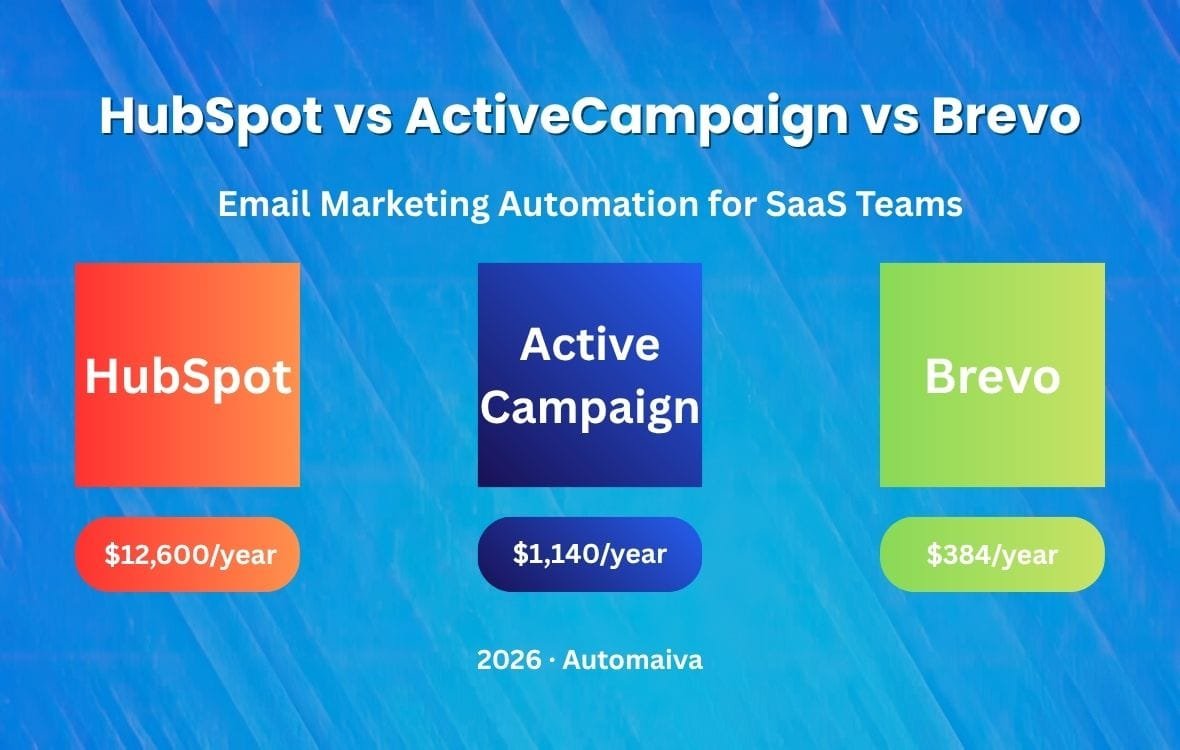
| 5-person team, 10K contacts, Year 1 | $1,140 | $12,600 (incl. $3,000 mandatory onboarding) | $384 |
| Automation depth | Best in category — 900+ recipes, visual builder, behavioural triggers | Strong — but requires Professional tier ($800/month) | Good for basics — limited vs ActiveCampaign |
| Built-in CRM | Yes — lightweight sales pipeline included | Yes — full CRM, most powerful in category | Yes — basic deal tracking |
| Pricing model | Per contacts stored | Per seats (Starter) / flat platform (Pro) | Per emails sent |
| Best SaaS stage | Seed to Series A ($0–$10M ARR) | Series A to Series B ($5M–$50M ARR) | Pre-revenue to Seed (budget-first teams) |
Your head of marketing just told you the team has been manually updating trial expiry emails in Mailchimp for eighteen months. Every time someone starts a trial, a person on the team manually adds them to a sequence. Every time they upgrade, a person removes them. Every time they churn, nobody does anything because there is no automated churn recovery workflow — it requires pulling a Stripe export and sending a campaign batch.
This is not a Mailchimp problem. It is a platform stage problem. The team adopted the easiest email tool available when the company had 200 contacts and needed to send a newsletter. Now it has 12,000 contacts, a trial funnel, an onboarding sequence, three product tiers, and a churn rate that warrants automated intervention. Mailchimp was not built for this. Neither, at this stage and at this budget, was HubSpot Marketing Hub Professional.
This guide maps the three platforms that come up most often for B2B SaaS teams evaluating email marketing automation in 2026 — HubSpot, ActiveCampaign, and Brevo — against the specific automation jobs that determine whether your email programme scales with your product or requires manual intervention at every inflection point.
About this guide: The Automaiva team analysed email marketing automation deployments across B2B SaaS companies from seed through Series B, drawing on published platform research, user-reported cost and implementation data, and 2026 vendor documentation. All pricing sourced from vendor websites as of April 2026.
Table of Contents
- What B2B SaaS Teams Actually Need From Email Marketing in 2026
- ActiveCampaign: Best Automation Depth for Seed and Series A SaaS
- HubSpot Marketing Hub: Best When Your CRM Is Already HubSpot
- Brevo: Best When Budget Is the Primary Constraint
- Automation Depth Comparison: The Feature That Separates Them
- Real Pricing: What a 5-Person SaaS Team Pays in Year 1
- Migration: What You Lose When You Switch
- Which Platform at Which Stage
- Frequently Asked Questions
What B2B SaaS Teams Actually Need From Email Marketing in 2026
General email marketing platforms are built around campaigns — you create a list, write an email, click send. B2B SaaS teams need something architecturally different: automation that triggers on product behaviour, not on campaign schedules.
The seven automation workflows that every B2B SaaS team eventually needs — and that determine which platform is the right fit — are:
1. Trial onboarding sequence. When a user starts a free trial, a multi-step email sequence fires based on what they do in the product — activating a feature triggers one path, not activating triggers a different path with a help offer. This requires behavioural triggers connected to your product data, not just a timed drip.
2. Trial-to-paid conversion. Emails that fire as the trial approaches expiry, segmented by how engaged the user was during the trial. A highly engaged user who has not upgraded gets a different email than a user who never logged in twice.
3. Feature adoption nudges. When a user is active but has not discovered a high-value feature, an automated sequence introduces it based on their usage pattern. Requires event-based triggers from your application.
4. Churn recovery automation. When a customer shows churn signals — usage drop, support ticket about cancellation, billing failure — an automated sequence fires before they cancel rather than after.
5. Expansion revenue sequences. When a customer on a Starter plan approaches its limits, an automated sequence introduces the next tier based on their specific usage pattern — not a generic upgrade pitch.
6. Win-back campaigns. Automated reactivation sequences for churned customers at 30, 60, and 90 days post-cancellation, with different messaging based on why they left.
7. Lead nurture for free users. PLG-motion sequences that convert free plan users to paid over time based on their product engagement, not on a calendar schedule.
ActiveCampaign: Best Automation Depth for Seed and Series A SaaS
ActiveCampaign was built around one thesis: marketing automation should be sophisticated enough for complex B2B workflows and affordable enough for teams that are not yet enterprise scale. In 2026 it is the platform that most consistently delivers on that thesis for B2B SaaS teams between $0 and $10M ARR.
The automation builder is the deepest in its price category — and it is not close. ActiveCampaign’s visual automation builder supports conditional logic, multi-branch sequences, lead scoring that adjusts based on behaviour, event-based triggers from external systems through webhooks and the API, and 900+ pre-built automation recipes that cover every standard SaaS email workflow. A trial onboarding sequence with conditional branching based on feature activation — the kind that requires a developer to build in most platforms — takes a marketer 45 minutes to configure in ActiveCampaign’s visual builder.
The built-in CRM tracks deals, assigns them to sales reps, scores leads automatically as contacts engage with email content, and alerts the sales team when a free user reaches a threshold that signals purchase intent. There is currently a 25% discount on the Plus plan for new subscribers — start your 14-day free trial here and the discount applies automatically.
ActiveCampaign — strengths
- Deepest automation builder in the category — 900+ recipes, multi-branch conditional logic, no developer required
- Behavioural triggers from external systems via webhooks and API — trial activation, feature usage, payment events
- Built-in CRM with lead scoring — sales pipeline management without a separate tool
- 93% inbox placement rate in independent testing — highest deliverability of the three platforms
- 14-day free trial — full feature access, no credit card required
- Contact-based pricing scales predictably — cost tied to list size, not seat count
ActiveCampaign — weaknesses
- Starter plan (5 automation actions) is too limited for real SaaS workflows — Plus at $49/month is the practical entry point
- Steeper learning curve than Brevo or Mailchimp — visual builder requires initial investment to master
- No free plan — 14-day trial only
- Reporting is functional but not as advanced as HubSpot for multi-touch revenue attribution
- Pricing scales with contacts — large lists (50K+) become expensive at this model
Where it falls short: ActiveCampaign is not the right tool once you need email to work natively from your HubSpot CRM deal data, or once your marketing team needs multi-touch revenue attribution tied to pipeline. At that point — typically Series A with a dedicated marketing ops function — HubSpot’s unified platform advantage outweighs the cost difference.
Verdict: Best for B2B SaaS teams from pre-revenue through $10M ARR that need sophisticated automation without a marketing ops hire or enterprise budget. Start the 14-day free trial here — no credit card required.
HubSpot Marketing Hub: Best When Your CRM Is Already HubSpot
HubSpot Marketing Hub is the right email marketing platform for one specific situation: your team already runs on HubSpot CRM and you need email to work natively from the same contact, deal, and lifecycle data without building an integration between two separate systems.
When that condition is true, HubSpot’s advantage is real and significant. Smart lists update in real time based on CRM properties, deal stages, and website behaviour without any sync delay. Email personalisation draws directly from custom CRM objects — subscription tier, feature adoption status, trial day count — in ways that require API integration work to replicate in ActiveCampaign or Brevo. The Breeze AI layer, included at no extra cost on paid plans, handles email subject line optimisation, content suggestions, and predictive send-time across the contact database.
When that condition is not true — when your team is not already on HubSpot CRM — the case for HubSpot Marketing Hub becomes very hard to make at early stage. The Professional tier at $800/month plus a mandatory $3,000 onboarding fee means Year 1 costs $12,600 before a single email is sent.
HubSpot Marketing Hub — strengths
- Native CRM integration — email triggers fire directly from deal stage, lifecycle stage, and custom object data
- Breeze AI included — subject line optimisation, content suggestions, predictive send-time at no extra cost
- Multi-touch revenue attribution — connect email campaigns directly to pipeline and closed revenue
- Free CRM with 2,000 marketing emails/month — most generous free tier for teams starting out
- HubSpot MCP server (April 2026) — Claude and ChatGPT can read and update HubSpot contact data directly
- Marketing, sales, and service on one platform — zero integration overhead between functions
HubSpot Marketing Hub — weaknesses
- $800/month + $3,000 mandatory onboarding for Professional — biggest Year 1 cost jump in the category
- Starter plan has very limited automation — most SaaS workflows require Professional
- Not the right choice if your CRM is Salesforce, Pipedrive, or any non-HubSpot platform
- Automation depth trails ActiveCampaign — fewer pre-built recipes at comparable price
- Deliverability performance less of a core focus than ActiveCampaign or Brevo
Where it falls short: HubSpot Marketing Hub is not the right choice for a SaaS team not already on HubSpot CRM, without a marketing ops function, or operating at seed stage where $12,600 Year 1 cost represents meaningful runway.
Verdict: Best for Series A and beyond SaaS teams already running on HubSpot CRM that need email marketing to work natively from the same contact and pipeline data.
Brevo: Best When Budget Is the Primary Constraint
Brevo — formerly Sendinblue — occupies a specific position in the email marketing category that the other two platforms cannot match: it prices by emails sent rather than by contacts stored. For B2B SaaS teams with large contact lists but moderate sending frequency, this pricing model creates meaningful savings.
A SaaS team with 50,000 contacts sending 4 emails per month pays dramatically less on Brevo’s send-based pricing than on ActiveCampaign’s contact-based pricing at the same list size. At 50,000 contacts sending 200,000 emails per month, ActiveCampaign Plus costs approximately $299/month while Brevo Business costs approximately $65/month. That is a meaningful difference for a bootstrapped team watching burn carefully.
Brevo includes email, SMS, WhatsApp messaging, transactional email via SMTP relay, a lightweight CRM, and live chat in every paid plan. For a pre-revenue or seed-stage SaaS team that needs multi-channel customer communication without paying for five separate tools, this bundling creates genuine value.
Brevo — strengths
- Send-based pricing — most affordable for large lists with moderate send frequency
- Free plan with 300 emails/day, unlimited contacts — genuinely usable for early-stage teams
- Email + SMS + WhatsApp + transactional SMTP in every plan — broadest multi-channel coverage at lowest cost
- Lightweight CRM and deal tracking included — no separate tool required for basic sales pipeline
- EU-hosted infrastructure — GDPR compliance simpler for teams serving European customers
- Fastest setup time — lowest learning curve of the three platforms
Brevo — weaknesses
- Automation depth trails ActiveCampaign significantly — fewer pre-built recipes, less granular conditional logic
- Template library limited — 40+ templates versus ActiveCampaign’s more extensive library
- No advanced reporting or revenue attribution — campaign-focused analytics only
- Lead scoring less sophisticated than ActiveCampaign
- Send-based pricing becomes expensive at high send frequency — if you email daily, contact-based pricing wins
Where it falls short: Brevo is not the right tool when automation sophistication is the primary requirement. SaaS teams that need multi-branch conditional sequences, event-based triggers from product usage, and advanced lead scoring will hit Brevo’s automation ceiling within 6 months and face a migration to ActiveCampaign.
Verdict: Best for pre-revenue to seed-stage SaaS teams where budget is the primary constraint, teams with large contact lists and low send frequency, and teams that need multi-channel email plus SMS plus WhatsApp from a single affordable platform.
Automation Depth Comparison: The Feature That Separates Them
| Automation capability | ActiveCampaign | HubSpot Pro | Brevo |
|---|---|---|---|
| Visual workflow builder | Best in class — multi-branch, conditional logic | Strong — CRM-native | Basic — limited branching |
| Pre-built automation recipes | 900+ templates covering SaaS workflows | Solid library — CRM-focused | 12 pre-built templates |
| Behavioural triggers (product events) | Webhooks + API — fire on any product event | Via CRM custom objects — powerful but complex | Basic webhook support |
| Lead scoring | Advanced — multi-factor, auto-adjust on behaviour | Predictive scoring — AI-powered on Pro | Basic only |
| Trial onboarding sequence | Pre-built recipe — configure in 45 minutes | Requires Professional + ops setup | Possible but limited branching |
| Churn recovery automation | Fire on usage drop via webhook from Stripe or Mixpanel | Via CRM + workflow trigger | Manual segment required |
| A/B testing in automations | Split testing within automation flows | A/B testing on emails and workflows | Basic A/B on campaigns only |
| Inbox placement rate (2026 testing) | 93% — highest of the three | 87–90% | 87–90% |
Real Pricing: What a 5-Person SaaS Team Pays in Year 1
| Cost component | ActiveCampaign Plus | HubSpot Marketing Pro | Brevo Business |
|---|---|---|---|
| Monthly platform fee (10K contacts) | $95/month | $800/month | ~$32/month |
| Mandatory onboarding fee | $0 | $3,000 one-time | $0 |
| Implementation time | 1–3 days (self-service) | 4–8 weeks (with onboarding) | Same day (fastest setup) |
| Year 1 total | $1,140 | $12,600 | $384 |
All pricing based on published vendor rates as of April 2026. ActiveCampaign pricing is contact-based — 10K contacts used as comparison basis. Brevo pricing based on email volume — 500K emails/month assumed. HubSpot Professional includes 2,000 marketing contacts; additional contacts billed separately. Verify current pricing at each vendor’s website before purchasing.
Migration: What You Lose When You Switch
Every SaaS team eventually outgrows their first email marketing platform. Planning the migration before you need it prevents the most common and most costly mistakes.
What transfers cleanly: Contact lists with standard fields — email, name, company — export as CSV from any platform and import to any other. Unsubscribe lists must be exported and imported — this is a legal requirement under GDPR and CAN-SPAM.
What does not transfer: Automation workflows do not migrate between platforms. Every sequence you have built must be rebuilt from scratch in the destination platform. For a team with 15 active automation sequences, this is 20 to 40 hours of ops work. Contact engagement history — open rates, click data, behavioural scores — does not transfer. Lead scores must be rebuilt from zero. Domain reputation does not transfer — warm up your sending on the new platform gradually over 4 to 6 weeks to avoid deliverability issues.
Best time to migrate: The lowest-disruption migration window is the start of a new quarter, when campaign calendars reset. Run both platforms in parallel for two weeks to catch anything the rebuild missed. ActiveCampaign provides a native Mailchimp migration tool that automates the contact import — start your trial and test the migration before committing.
Which Platform at Which Stage
| Your situation | Best platform | Why |
|---|---|---|
| Pre-revenue, under 1,000 contacts, budget is primary constraint | Brevo (free plan) | Free plan with 300 emails/day and unlimited contacts covers early-stage needs at zero cost |
| Seed stage, $0–$2M ARR, need trial sequences and churn recovery automation | ActiveCampaign Plus ($49/month) | Best automation depth at seed-stage budget. 25% off Plus plan currently available. |
| Seed stage, large contact list (20K+), low send frequency, budget-first | Brevo Business | Send-based pricing is significantly cheaper than contact-based pricing at this list size |
| Series A, $2M–$10M ARR, already on HubSpot CRM | HubSpot Marketing Hub Pro | Native CRM integration pays back the premium when your team already lives in HubSpot |
| Series A, $2M–$10M ARR, not on HubSpot CRM, need advanced automation | ActiveCampaign Pro ($149/month) | Full automation depth without the $12,600 Year 1 HubSpot cost |
| Series B+, $10M+ ARR, need revenue attribution, marketing-sales-service unified | HubSpot Marketing Hub Pro or Enterprise | Revenue attribution, Breeze AI, and unified platform justify the cost at this scale |
| Currently on Mailchimp, need to upgrade without disruption | ActiveCampaign Plus | Most common upgrade path from Mailchimp. Native Mailchimp migration tool included. |
Frequently Asked Questions
Is ActiveCampaign worth it for a B2B SaaS startup in 2026?
ActiveCampaign is the best email marketing automation platform for most B2B SaaS startups in 2026 because it delivers the deepest automation builder in the category — trial sequences, behavioural triggers, churn recovery, lead scoring — at a price accessible from seed stage. The Plus plan at $49/month covers every standard SaaS email workflow. There is currently a 25% discount on the Plus plan for new subscribers. Start the 14-day free trial here — no credit card required. Pricing based on published ActiveCampaign rates as of April 2026.
What is the real difference between ActiveCampaign and HubSpot Marketing Hub?
ActiveCampaign is an email automation tool that added a CRM. HubSpot is a CRM that added email automation. ActiveCampaign wins on automation depth and price for email-first marketing teams under 10 people. HubSpot wins on breadth, CRM integration, and revenue attribution for teams that need sales, marketing, and service on one platform. The Year 1 cost gap for a 5-person team is approximately $11,460 — $1,140 for ActiveCampaign Plus versus $12,600 for HubSpot Marketing Hub Professional including mandatory onboarding.
Is Brevo good enough for a SaaS startup?
Brevo is good enough for a SaaS startup in the early stages where budget is the primary constraint and automation requirements are straightforward. Its free plan and low-cost paid plans make it the most accessible entry point in the category. The limitation is automation depth — teams that build trial onboarding sequences and churn recovery automations in Brevo typically migrate to ActiveCampaign within 12 to 18 months as their requirements outgrow what Brevo’s builder can handle.
What is the HubSpot Marketing Hub mandatory onboarding fee?
HubSpot charges a mandatory onboarding fee of $3,000 for Marketing Hub Professional and $6,000 for Enterprise. This fee is paid upfront in addition to the monthly subscription and cannot be waived for direct purchases. The effective Year 1 cost for HubSpot Marketing Hub Professional is $12,600 — not the $9,600 annual subscription figure that appears in most comparisons.
Which email marketing platform has the best deliverability for SaaS teams?
ActiveCampaign has the highest inbox placement rate of the three platforms in independent testing — 93% in 2026 benchmarks. Deliverability is determined more by list hygiene, authentication setup (SPF, DKIM, DMARC), and sending practices than by platform choice. ActiveCampaign’s predictive sending — which uses machine learning to optimise delivery time for individual recipients — contributes to its consistently higher placement rates in head-to-head tests. Deliverability figures based on published independent testing. Individual results vary.
How do I migrate from Mailchimp to ActiveCampaign?
ActiveCampaign provides a native Mailchimp migration tool that imports contacts, lists, tags, and basic automation data automatically. The migration takes 30 to 60 minutes for most teams. Automation workflows must be rebuilt from scratch — plan 20 to 40 hours for a team with multiple active sequences. After migration, warm up your sending gradually on ActiveCampaign’s infrastructure — start with 20% of your normal volume and increase by 20% per day over the first week. Start your ActiveCampaign trial before migrating to validate the workflow rebuild.
Can I try ActiveCampaign before paying?
Yes. ActiveCampaign offers a 14-day free trial with full access to all features on the plan you select — including the visual automation builder, CRM, lead scoring, and all integrations. No credit card is required to start the trial. There is currently a 25% discount on the Plus plan for new subscribers which applies when you convert from trial to paid. Start your free trial here.
Pricing note: All pricing information referenced in this article is accurate as of April 2026 and subject to change. ActiveCampaign, HubSpot, and Brevo update pricing and plan structures regularly. Always verify current pricing directly at each vendor’s website before purchasing. Automaiva may earn affiliate commissions from purchases made through links in this article.
More from Automaiva
- HubSpot vs Salesforce for SaaS Startups: Which CRM at Which Stage (2026)
- folk vs HubSpot vs Pipedrive vs Attio: Best CRM for B2B SaaS Teams (2026)
- SaaS Churn Prevention: How to Build an Automated Early Warning System (2026)
- Apollo vs Clay vs Instantly vs Lemlist: Cold Outreach Stack Audit (2026)
- AI Agents vs Automation Tools: What’s the Difference for SaaS Teams (2026)
- Want to try ActiveCampaign free for 14 days? Start here — no credit card required.
Written by the Automaiva Editorial Team