Disclaimer: Pricing, feature availability, and performance data referenced in this article are based on publicly available vendor documentation, independent testing, and official ActiveCampaign comparison data as of April 2026. Mailchimp pricing and plan structures have changed significantly in 2025–2026. Always verify current pricing directly on each vendor’s website before purchasing. Automaiva may earn affiliate commissions from purchases made through links in this article.
Editorial note: Automaiva selects and recommends tools based on independent research. We have no paid relationships with any vendor that affect our editorial conclusions.
ActiveCampaign vs Mailchimp in 2026 is not a close race for B2B SaaS teams. Mailchimp is the right tool when you need to send your first newsletter. ActiveCampaign is the right tool when you need email to do the actual work of growing your product — and more than 100 teams make that switch every single month.
Quick Answer: ActiveCampaign vs Mailchimp for SaaS Teams
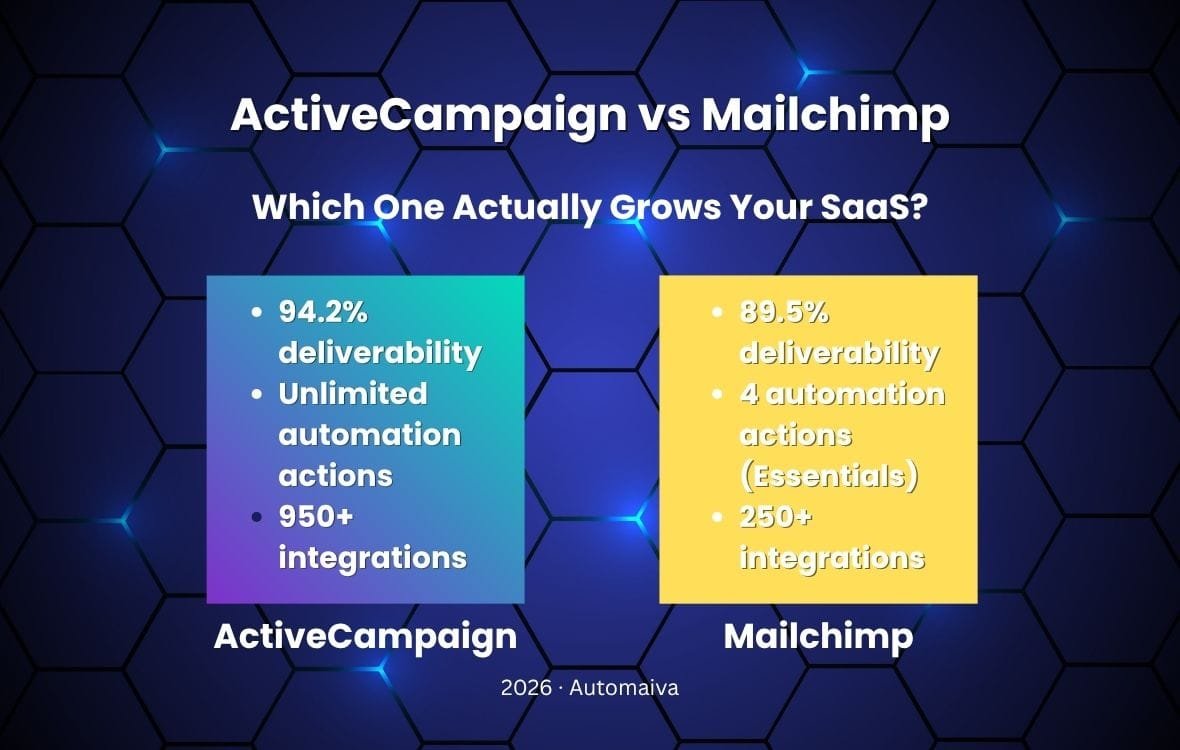
Choose Mailchimp if you are sending basic newsletters, have under 500 contacts, and need to get started today with zero learning curve. The free plan works for proof of concept. Choose ActiveCampaign if you need automation that triggers on product behaviour — trial onboarding sequences, churn recovery, feature adoption nudges, lead scoring — and you want a built-in CRM without paying for a separate tool. ActiveCampaign has a 94.2% deliverability rate versus Mailchimp’s 89.5%, unlimited automation actions versus Mailchimp’s 4-action cap on Essentials, and 950+ integrations versus Mailchimp’s 250+. Start a 14-day free trial here — no credit card required. All data sourced from official ActiveCampaign comparison documentation and independent testing as of April 2026.
| ActiveCampaign | Mailchimp | |
|---|---|---|
| Free plan | 14-day trial only — no free plan | Yes — 250 contacts, 500 sends/month (reduced in 2026) |
| Entry paid plan | Starter: $15/month (1,000 contacts) | Essentials: $13/month (500 contacts) |
| Full automation plan | Plus: $49/month — unlimited automation actions ⭐ | Standard: $20/month — 200 automation steps max |
| Automation actions per workflow | Unlimited | 4 on Essentials / 200 on Standard+ |
| Native triggers available | 75+ triggers (contact, account, deal-based) | Under 35 triggers (contact-only) |
| Deliverability rate (2026) | 94.2% | 89.5% |
| Integrations | 950+ | 250+ |
| Built-in CRM | Yes — deal pipelines, lead scoring, sales automation | No — basic contact management only, no deal pipelines |
| G2 rating | 4.6 / 5 | 4.3 / 5 |
| Best for | B2B SaaS teams that have outgrown basic email marketing | Beginners, newsletters, simple campaigns |
You signed up for Mailchimp when you had 300 contacts, a free trial, and no dedicated marketer. It took 20 minutes to set up, the first campaign went out the same day, and it cost nothing. That was the right decision at the time.
Now you have 8,000 contacts, a trial funnel, three product tiers, and a churn rate that needs addressing. Your onboarding sequence is a five-email timed drip that does not change based on what users actually do in your product. Your churn recovery workflow is a Zapier automation someone built eight months ago that nobody is sure still works. Your Mailchimp Essentials plan caps automation at four steps per workflow — which is not enough to branch based on trial activation, send different paths to engaged versus dormant users, and escalate to a sales rep when a lead score threshold is crossed.
This is the point where more than 100 teams per month make the switch from Mailchimp to ActiveCampaign. This guide maps exactly what that switch delivers, what it costs, and how to do it without losing your existing contacts or disrupting live campaigns.
About this guide: The Automaiva team analysed this comparison using official ActiveCampaign feature comparison documentation, independent deliverability testing data, and user-reported migration outcomes as of April 2026. The data points in this article are sourced from ActiveCampaign’s own published comparison research and verified against independent third-party reviews.
Table of Contents
- The Real Difference: Automation Depth
- Automation Comparison: Where Mailchimp Hits Its Ceiling
- Deliverability: The 4.7% Gap That Matters
- CRM: What ActiveCampaign Has That Mailchimp Does Not
- Pricing: What You Actually Pay in 2026
- Mailchimp Free Plan: What Changed in 2026
- AI Features: Active Intelligence vs Intuit Assist
- When Mailchimp Is Still the Right Choice
- How to Migrate from Mailchimp to ActiveCampaign
- The Decision: Which One for Your Stage
- Frequently Asked Questions
The Real Difference: Automation Depth
Both platforms call their feature “automation.” The practical difference between them is not terminology — it is how much of your customer journey each platform can actually run without manual intervention.
Mailchimp’s automation is built around their Customer Journeys feature. On the Essentials plan, you get a maximum of 4 journey steps per automation. On Standard and above, you get 200 steps. The triggers available are contact-only — meaning you can trigger automations based on email opens, clicks, and form submissions, but not on external product events like trial activation, feature usage, or payment status changes without a third-party integration.
ActiveCampaign’s automation builder supports unlimited actions per workflow, 75+ native triggers covering contacts, accounts, and deals, and multi-branch conditional logic that creates genuinely different paths based on what each contact actually does. The same trial onboarding automation that would require a Zapier integration and custom coding to build in Mailchimp is a drag-and-drop 45-minute build in ActiveCampaign’s visual builder.
Automation Comparison: Where Mailchimp Hits Its Ceiling
The automation gap between these two platforms is the most consequential feature difference for B2B SaaS teams. Here is what each platform can and cannot do across the automation workflows that SaaS growth depends on:
| Automation capability | ActiveCampaign | Mailchimp |
|---|---|---|
| Actions per automation | Unlimited | 4 (Essentials) / 200 (Standard+) |
| Triggers per automation | Up to 5 triggers | Up to 3 triggers |
| Native trigger types | 75+ — contact, account, and deal-based | Under 35 — contact-only |
| Branching logic | Advanced — if/else, percentage, date, event, goal | Limited — if/else or percentage only |
| Automate SMS in same workflow | Yes — email, SMS, and 1:1 in one flow | Marketing email only — SMS requires third party |
| AI automation generation | Yes — AI builds multi-step workflows from plain language | No AI in automations |
| Automation split testing | Yes — test entire workflow variants | Basic A/B on emails only |
| Automation visualisation map | Yes — full map of all active automations | No automation visualisation |
| Pre-built recipes | 900+ | ~100 templates |
| Unique contact journeys | Yes — each contact gets individual path | Limited — same path for all contacts in segment |
The 4-action cap on Mailchimp Essentials is the most commonly cited reason teams switch to ActiveCampaign. A basic SaaS trial onboarding sequence — welcome email, day 2 activation nudge, day 5 feature highlight, day 10 check-in, day 13 trial expiry warning, day 14 upgrade offer — is already 6 steps before any conditional branching. That sequence requires Mailchimp Standard at minimum, and even then you cannot branch based on whether the user activated a specific feature without custom integration work.
Deliverability: The 4.7% Gap That Matters
ActiveCampaign has a 94.2% deliverability rate. Mailchimp has an 89.5% deliverability rate. That 4.7 percentage point gap sounds small until you calculate what it means for a SaaS team sending 50,000 emails per month.
At 94.2% deliverability, 47,100 of your 50,000 emails reach the inbox. At 89.5%, 44,750 reach the inbox. That is 2,350 emails per month going to spam or getting blocked — emails that include your trial expiry warnings, your churn recovery sequences, and your expansion revenue pitches. For a team with a 2% trial-to-paid conversion rate, those 2,350 missed emails represent approximately 47 missed conversion opportunities per month. At $49/month average revenue, that is $2,303 in monthly revenue that your email platform is silently blocking.
ActiveCampaign’s deliverability advantage comes from three technical factors: predictive sending that optimises delivery time per individual contact based on their historical engagement patterns (which ActiveCampaign data shows drives a 17% CTR lift), built-in spam testing before sends, and list hygiene tools that automatically suppress unengaged contacts before they damage your sender reputation.
CRM: What ActiveCampaign Has That Mailchimp Does Not
Mailchimp has what they call a “marketing CRM.” It does not include pipelines, deals, or stages. There are no native sales tools. You can organise contacts and track their email behaviour, but there is no mechanism for tracking where a lead sits in your sales process, assigning deals to sales reps, or triggering automations based on deal stage changes.
ActiveCampaign includes a fully functional sales CRM with deal pipelines, stages, deal tracking, contact and account management, custom and predictive lead scoring on Plus and above, and sales automation that triggers emails when deals move between stages. For a SaaS team running both a PLG motion (free users converting to paid) and an outbound motion (SDR working qualified leads), ActiveCampaign handles both in one platform without requiring a separate CRM tool.
The practical outcome: a Mailchimp user who needs deal tracking pays for Mailchimp plus a CRM like Pipedrive or HubSpot. An ActiveCampaign Plus user has both in one platform at $49/month for up to 1,000 contacts.
ActiveCampaign — strengths
- 94.2% deliverability rate — highest independent benchmark in this comparison
- Unlimited automation actions — no artificial cap on workflow complexity
- 75+ native triggers including account and deal-based triggers
- Full CRM with deal pipelines, lead scoring, and sales automation included
- 950+ integrations — connects to virtually every SaaS tool in your stack
- AI automation builder — generates multi-step workflows from plain language description
- Free onboarding included on Plus and Pro plans — no mandatory fee
- Native Mailchimp migration tool — import contacts, lists, and tags automatically
ActiveCampaign — weaknesses
- No free plan — 14-day trial only
- Steeper learning curve than Mailchimp — most users need 3 to 4 sessions to feel self-sufficient
- Starter plan (5 automation actions) is not enough for real SaaS workflows — Plus is the practical entry point
- Contact-based pricing scales up at large list sizes (50K+ contacts)
- Reporting depth on lower plans is less granular than HubSpot for revenue attribution
Mailchimp — strengths
- Fastest setup — most users send their first email within 30 minutes
- Free plan available — 250 contacts, 500 sends/month
- Best template library for design-focused campaigns — 100+ templates on Standard+
- Lowest learning curve in the category — beginner-friendly interface
- Multi-channel marketing hub — email, social, ads, landing pages, website builder in one place
- Cheaper at very small list sizes — Essentials at $13/month for 500 contacts
Mailchimp — weaknesses
- 4-action cap on Essentials — insufficient for any real SaaS onboarding or nurture sequence
- 89.5% deliverability — 4.7 percentage points below ActiveCampaign
- No CRM — no deal pipelines, no lead scoring, no sales activity tracking
- Contact deduplication billing — if a contact is on multiple lists, you pay for them twice
- Free plan reduced significantly in 2026 — from 2,000 contacts to just 250
- No AI in automations — AI features limited to content generation only
Pricing: What You Actually Pay in 2026
| Contacts | ActiveCampaign Plus | Mailchimp Standard | Capability at this price |
|---|---|---|---|
| 1,000 contacts | $49/month | $20/month | Mailchimp is cheaper — but automation is capped at 200 steps and no CRM |
| 5,000 contacts | $79/month | $75/month | Near-equal price — ActiveCampaign delivers significantly more capability |
| 10,000 contacts | $111/month | $135/month | ActiveCampaign is cheaper — and includes CRM, unlimited automations, 94.2% deliverability |
| 25,000 contacts | $179/month | $270/month | ActiveCampaign is significantly cheaper at scale |
| 50,000 contacts | $279/month | $350/month | ActiveCampaign is $71/month cheaper at this list size |
All pricing based on published vendor rates as of April 2026 on annual billing. Mailchimp Standard plan used for comparison as it is the minimum tier for meaningful automation. ActiveCampaign Plus used as it is the minimum tier that includes full automation depth and CRM. Verify current pricing at each vendor’s website before purchasing. There is currently a 25% discount on ActiveCampaign Plus for new subscribers.
The pricing crossover happens at approximately 5,000 contacts. Below that, Mailchimp Standard is cheaper. At 5,000 contacts and above, ActiveCampaign Plus is either comparable or cheaper — while delivering meaningfully more capability. The common assumption that ActiveCampaign is the expensive option is accurate only at small list sizes. At the contact counts where B2B SaaS teams typically operate — 8,000 to 30,000 contacts — ActiveCampaign Plus costs less than Mailchimp Standard and includes a CRM that Mailchimp does not.
Mailchimp Free Plan: What Changed in 2026
Mailchimp’s free plan has been significantly reduced over the past two years. In 2026 the free plan allows 250 contacts and 500 sends per month with a 250 email daily limit. Automation features are no longer available to free users. The free plan contact limit has dropped from 2,000 to 500 to the current 250.
For a SaaS team evaluating whether Mailchimp free is a viable starting point: it covers proof of concept for a very early-stage product with a small waitlist. It does not cover any meaningful automated email workflow. The moment you need a welcome sequence, a trial onboarding flow, or any triggered email based on user behaviour, you are on a paid Mailchimp plan — at which point the comparison with ActiveCampaign Plus becomes relevant and the automation gap becomes the deciding factor.
AI Features: Active Intelligence vs Intuit Assist
Since Intuit’s $12 billion acquisition of Mailchimp, AI features have been consolidated under “Intuit Assist.” Zapier’s 2026 analysis found that most of Mailchimp’s AI design features “seem to have either been demoted or quietly retired” in the process of this consolidation.
ActiveCampaign’s AI layer — called Active Intelligence — works differently and more deeply. The AI Automation Builder generates complete multi-step workflows from plain-language descriptions — you describe what you want the sequence to do and the builder creates it. Predictive Sending optimises delivery timing per individual contact based on their historical engagement patterns and drives a 17% click-through rate lift. AI-discovered segments surface audiences you would miss in manual segmentation. The AI Brand Kit imports your brand’s colours, fonts, logos, and social links to create consistent branding across all content automatically.
For B2B SaaS teams, the practical difference is that ActiveCampaign’s AI reduces the time to build and launch automation workflows — the primary operational bottleneck for small marketing teams — while Mailchimp’s AI primarily assists with content creation for campaigns that already exist.
When Mailchimp Is Still the Right Choice
Mailchimp is the right tool in three specific situations that are worth being honest about:
You are just getting started and have under 500 contacts. Mailchimp’s free plan covers proof of concept at zero cost with zero learning curve. If you are validating your product and need to send a newsletter to a waitlist, Mailchimp free is the right starting point. Switch to ActiveCampaign when your automation requirements outgrow what the free plan offers.
Your team has no dedicated marketer and needs something operational in one afternoon. Mailchimp’s learning curve is genuinely lower than ActiveCampaign’s. If your only email need is monthly newsletters and basic campaign sends, Mailchimp Standard handles this effectively and your team will be self-sufficient faster. ActiveCampaign’s depth requires investment to master.
You need a multi-channel marketing hub including a website builder, social posting, and ad management. Mailchimp has evolved into a broader marketing platform that includes these features. ActiveCampaign is focused on email automation and CRM — it does not compete on website building or social media management.
How to Migrate from Mailchimp to ActiveCampaign
ActiveCampaign provides a native Mailchimp migration tool that automates the most time-consuming parts of the switch. Here is the complete process:
Step 1 — Start your ActiveCampaign trial before cancelling Mailchimp. Run both platforms in parallel for two weeks. Start the 14-day free trial here. The trial gives you full access to rebuild and test your automation workflows before your contacts migrate.
Step 2 — Use the native Mailchimp import tool. In ActiveCampaign go to Contacts → Import → Import from Mailchimp. Connect your Mailchimp account. ActiveCampaign imports contacts, lists, tags, and basic automation data automatically. This takes 30 to 60 minutes for most teams.
Step 3 — Rebuild your automation workflows. Automation workflows do not migrate — they must be rebuilt. For a team with 5 active sequences, budget 10 to 20 hours. Use ActiveCampaign’s 900+ pre-built recipes as starting points — your Mailchimp welcome sequence, trial onboarding flow, and churn recovery sequence all have direct recipe equivalents that you customise rather than build from scratch.
Step 4 — Export your unsubscribe list from Mailchimp before cancelling. This is a legal requirement under GDPR and CAN-SPAM. In Mailchimp: Audience → All Contacts → filter by Unsubscribed → Export. Import this list to ActiveCampaign as a suppression list before sending any campaigns.
Step 5 — Warm up your sending on ActiveCampaign’s infrastructure. Start with 20% of your normal send volume and increase by 20% per day over the first week. This protects your sender reputation on the new infrastructure and ensures your deliverability starts strong.
What transfers automatically: Contacts, lists, tags, basic automation data, unsubscribe status.
What must be rebuilt: Automation workflows, email templates, custom reports, form designs.
What stays in your CRM: Any data already pushed to HubSpot or Salesforce from Mailchimp remains there permanently — it is not affected by switching email platforms.
The Decision: Which One for Your Stage
| Your situation | Choose | Why |
|---|---|---|
| Under 250 contacts, validating your product, zero budget | Mailchimp free | Free plan covers newsletters and basic outreach at zero cost |
| Under 1,000 contacts, need basic automation, tight budget | Mailchimp Standard ($20/month) | Cheaper than ActiveCampaign at this list size for basic workflows |
| 1,000–5,000 contacts, need trial sequences and churn recovery | ActiveCampaign Plus ($49/month) | Unlimited automation, CRM, 94.2% deliverability — the Mailchimp 4-step cap is a hard blocker at this stage |
| 5,000+ contacts, B2B SaaS growth motion | ActiveCampaign Plus | Cheaper than Mailchimp Standard at this scale and significantly more capable |
| Currently on Mailchimp, hitting the automation ceiling | Switch to ActiveCampaign | Native migration tool makes the switch straightforward. 100+ teams make this move every month. |
| Need website builder, social posting, ad management alongside email | Mailchimp Standard | Mailchimp’s broader marketing hub includes features ActiveCampaign does not offer |
Frequently Asked Questions
Is ActiveCampaign better than Mailchimp for B2B SaaS teams?
Yes — for B2B SaaS teams that have moved beyond basic newsletter sending, ActiveCampaign is significantly better than Mailchimp. The key differences are automation depth (unlimited actions vs Mailchimp’s 4-step Essentials cap), deliverability (94.2% vs 89.5%), integrations (950+ vs 250+), and a built-in CRM that Mailchimp does not have. At list sizes above 5,000 contacts, ActiveCampaign Plus is also cheaper than Mailchimp Standard. Start the 14-day free trial here.
Why do teams switch from Mailchimp to ActiveCampaign?
The most common reason is hitting Mailchimp’s automation ceiling. The Essentials plan caps automation at 4 steps per workflow — insufficient for any meaningful SaaS onboarding or nurture sequence. Teams also switch for ActiveCampaign’s CRM (Mailchimp has no deal pipelines or lead scoring), higher deliverability (94.2% vs 89.5%), and the ability to trigger automations based on product events through webhooks. Over 100 teams make this switch every month according to ActiveCampaign’s own data.
Is Mailchimp free plan still worth it in 2026?
Mailchimp’s free plan was significantly reduced in 2026 — from 2,000 contacts previously to 250 contacts with a 500 send/month limit and automation features removed. For a SaaS team validating a product with a small waitlist it is still a viable starting point at zero cost. For any team running automated email sequences, the free plan is too restrictive and the paid Essentials plan’s 4-step automation cap becomes the next limitation almost immediately.
How hard is it to switch from Mailchimp to ActiveCampaign?
ActiveCampaign provides a native Mailchimp migration tool that imports contacts, lists, and tags automatically in 30 to 60 minutes. The parts that require manual work are rebuilding automation workflows (plan 10 to 20 hours for a team with 5 active sequences) and rebuilding email templates. All contact data transfers cleanly. Unsubscribe lists must be exported from Mailchimp and imported to ActiveCampaign as a suppression list before sending — this is a legal requirement. Start your ActiveCampaign trial to test the migration before committing.
What does Mailchimp charge for duplicate contacts across lists?
Mailchimp’s contact counting methodology charges you per subscriber — so if the same contact appears in multiple audience lists, you pay for them multiple times. This is a known cost inflation issue that affects teams with contacts segmented across multiple audiences. ActiveCampaign uses tags and custom fields rather than separate audiences, so the same contact is counted once regardless of how many segments they belong to. For teams with complex segmentation across multiple lists, this billing difference can meaningfully affect monthly cost.
Does ActiveCampaign have a free plan?
No — ActiveCampaign does not have a free plan. It offers a 14-day free trial with full access to all features on the plan you select, including the full automation builder, CRM, lead scoring, and all integrations. No credit card is required to start the trial. There is currently a 25% discount on the Plus plan for new subscribers converting from trial to paid. Start your free trial here.
Which has better email deliverability — ActiveCampaign or Mailchimp?
ActiveCampaign has a 94.2% deliverability rate versus Mailchimp’s 89.5% in 2026 independent testing — a 4.7 percentage point advantage. For a SaaS team sending 50,000 emails per month, this gap represents approximately 2,350 additional emails reaching the inbox on ActiveCampaign versus going to spam on Mailchimp. ActiveCampaign’s deliverability advantage comes from predictive sending that optimises timing per contact, built-in spam testing, and automated list hygiene tools. Deliverability figures sourced from official ActiveCampaign comparison documentation as of April 2026.
Pricing note: All pricing information in this article is accurate as of April 2026 and subject to change. ActiveCampaign and Mailchimp update pricing and plan structures regularly. Always verify current pricing directly at each vendor’s website before purchasing. Automaiva may earn affiliate commissions from purchases made through links in this article.
More from Automaiva
- HubSpot vs ActiveCampaign vs Brevo: Best Email Marketing Automation for SaaS Teams (2026)
- HubSpot vs Salesforce for SaaS Startups: Which CRM at Which Stage (2026)
- SaaS Churn Prevention: How to Build an Automated Early Warning System (2026)
- AI Agents vs Automation Tools: What’s the Difference for SaaS Teams (2026)
- Try ActiveCampaign free for 14 days — no credit card required.
Written by the Automaiva Editorial Team