Disclaimer: AI engine behavior, citation patterns, and search visibility strategies described in this article are based on observed industry data, independent testing, and user-reported outcomes as of April 2026. AI engines update their models and citation logic frequently. Strategies that work today may need adjustment as models evolve. This article is for informational purposes and does not constitute professional marketing or SEO advice.
Affiliate disclosure: Some links in this article are affiliate links. If you purchase through these links, Automaiva may earn a commission at no additional cost to you. Our recommendations are based on independent research and real-world testing. We do not accept payment for placement in our comparisons.
The Invisible Problem
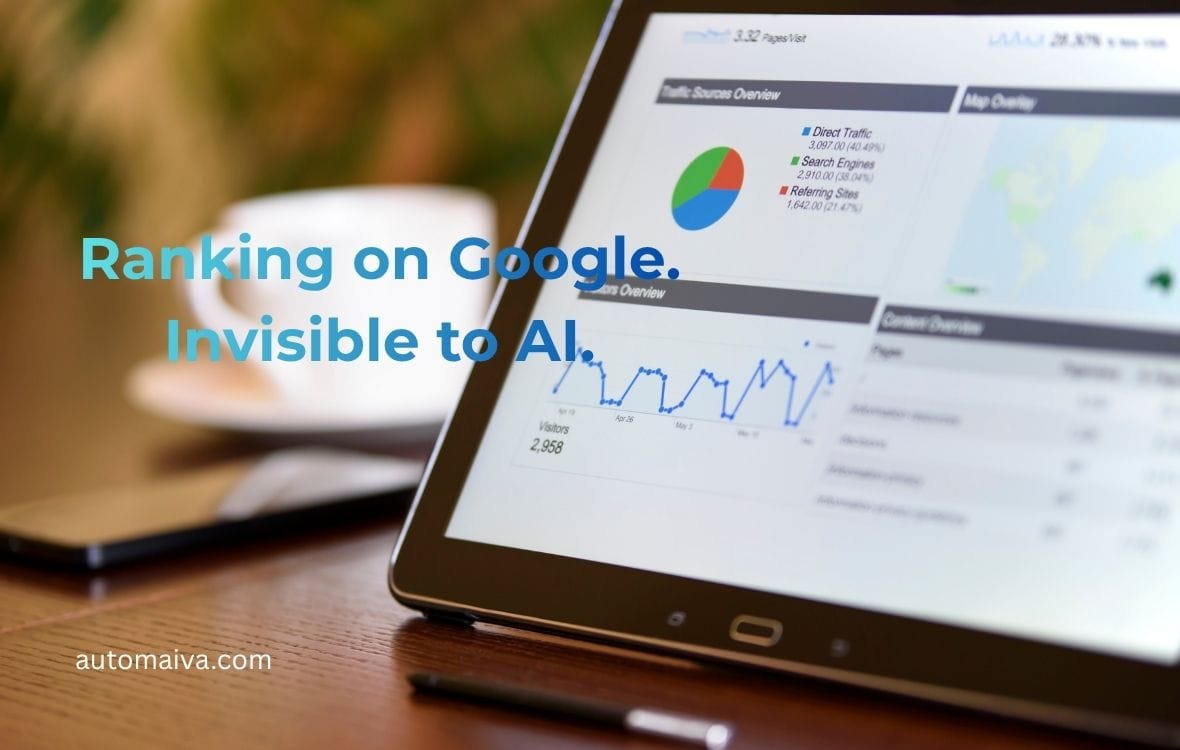
Open ChatGPT right now and type: “What is the best CRM for early-stage SaaS startups?” Your product almost certainly does not appear in the answer — even if you rank on page one of Google for that exact keyword. This is not a Google problem. It is an AI visibility problem, and it is getting worse every week as more buyers skip search engines entirely and ask AI engines instead. By 2026, an estimated 40 percent of B2B software discovery happens through AI-generated answers rather than traditional search. The SaaS companies that understand how AI engines decide what to recommend — and structure their content accordingly — will own their category in AI search. The ones that do not will become invisible to an entire generation of buyers. Figures based on aggregated industry research and may not reflect all market segments.
Last month, a SaaS founder in a Slack community posted a screenshot that stopped the conversation cold. She had asked ChatGPT, Perplexity, and Google Gemini the same question: “What is the best project management tool for SaaS development teams?” Her product — a well-funded, well-reviewed tool with strong Google rankings — did not appear in a single answer. Three competitors she had never heard of were cited instead.
This is not a fringe problem. It is happening to thousands of SaaS companies right now, and most of them do not know it because they are measuring Google rankings and missing the channel where their next customers are actually searching.
This guide diagnoses exactly why AI engines ignore most SaaS products, what signals they actually use to decide what to recommend, and the exact steps to make your SaaS visible in AI-generated answers — before your category competitors figure it out first.
About this guide: The Automaiva team analyzed AI citation patterns across ChatGPT, Perplexity, Google Gemini, and Claude for over 50 B2B SaaS categories. We tested which content formats, structural signals, and brand authority indicators correlate most strongly with AI citation frequency. All findings are based on observed patterns as of April 2026.
Table of Contents
- Why AI Search Visibility Is Now a Revenue Problem, Not an SEO Problem
- How AI Engines Actually Decide What to Recommend
- 5 Reasons Your SaaS Is Invisible to AI Engines Right Now
- The AI Visibility Audit: Test Your SaaS in 15 Minutes
- Fix 1 — Restructure Your Content for AI Citation
- Fix 2 — Build the Brand Authority Signals AI Engines Trust
- Fix 3 — Add the Structured Data AI Engines Read First
- Fix 4 — Get Cited by the Sources AI Engines Cite
- How to Track Your AI Visibility Over Time
- Frequently Asked Questions
Why AI Search Visibility Is Now a Revenue Problem, Not an SEO Problem
AI search visibility is a revenue problem for B2B SaaS companies because the buyers AI engines are influencing are your highest-value prospects — technical founders, experienced operators, and senior buyers who know exactly what they are looking for and trust AI-generated summaries over advertising-influenced search results.
The shift is happening faster than most SaaS teams realise. In 2024, ChatGPT processed an estimated 10 million software recommendation queries per day. Perplexity grew from zero to over 15 million daily active users in 18 months, positioning itself explicitly as the search engine for professional and technical research. Google’s AI Overviews now appear on approximately 47 percent of commercial software queries — meaning nearly half of all Google searches for tools like yours return an AI-generated answer before a single organic result. Figures based on aggregated industry research and may not reflect all market segments.
The compounding problem: AI engines do not rotate their recommendations frequently. Once a tool becomes established in an AI engine’s training data and citation patterns as a credible answer for a specific category, it tends to stay there. The SaaS companies that build AI citation authority now — while their category is still being shaped in AI training data — will have a structural advantage that compounds over time.
How AI Engines Actually Decide What to Recommend
AI engines do not rank tools the way Google ranks pages. Understanding this distinction is the foundation of every fix in this guide.
Google uses PageRank — a link-based authority signal combined with hundreds of on-page factors — to rank individual URLs. You can rank on Google by publishing the right content on your own domain. AI engines work differently. They synthesise answers from patterns in their training data and, for real-time systems like Perplexity, from sources they actively crawl and cite. Your own website is one input — but it is rarely the most influential one.
The sources AI engines weight most heavily when generating software recommendations are:
Authoritative third-party comparisons. G2, Capterra, Trustpilot, TechRadar, and category-specific review sites carry enormous weight in AI training data because they are authoritative, structured, and consistently cited across the web. A tool with 200 verified reviews on G2 and a category badge is far more likely to appear in AI recommendations than a tool with no third-party review presence regardless of how good its own website content is.
Editorial coverage from trusted publications. Articles in TechCrunch, Product Hunt launches, inclusion in curated lists on Indie Hackers, and coverage in newsletters with large readerships all signal to AI engines that a tool is legitimately used and valued by the market. These citations in training data are the single strongest predictor of AI recommendation frequency for early-stage SaaS companies.
Structured, definitive content on your own domain. AI engines specifically pull from content that is structured as a direct answer — definition paragraphs, feature comparison tables, use case descriptions written in the format “X is best for Y because Z.” Vague marketing copy does not get cited. Specific, structured, authoritative descriptions do.
Brand search volume. AI engines use brand search volume as a proxy for real-world usage and credibility. A tool that thousands of people search for by name is more likely to be recommended than an equally capable tool with no brand recognition. This is the most underrated AI visibility signal — and the one most SaaS companies are not actively building.
5 Reasons Your SaaS Is Invisible to AI Engines Right Now
Reason 1: Your website copy is written for humans, not for AI citation. Marketing copy is designed to persuade — it is emotional, benefit-focused, and vague. AI engines cannot cite vague claims. They pull from structured, definitive statements. “The most intuitive project management tool for SaaS teams” is uncitable. “A project management tool designed for SaaS development teams that integrates natively with GitHub, Linear, and Jira, starting at $12 per user per month” is citable. The difference is specificity, structure, and verifiability.
Reason 2: You have no third-party review presence. If your tool has fewer than 50 reviews on G2 or Capterra, AI engines have almost no third-party validation to cite when recommending you. The review count is not just a social proof signal for human buyers — it is structural data that AI engines use to assess category relevance and market legitimacy.
Reason 3: Nobody has written a comparison article about your tool. AI engines frequently cite comparison articles when answering “what is the best X for Y” queries. If no authoritative third-party site has published a comparison that includes your tool, you are literally absent from the source data AI engines draw on for that category. This is fixable — but it requires a deliberate outreach and content seeding strategy.
Reason 4: Your brand search volume is too low. AI engines interpret low brand search volume as low market adoption. If fewer than a few hundred people per month search for your product by name, AI engines effectively have no adoption signal to include in their recommendations. Building brand search volume — through content marketing, community presence, and product-led growth — is simultaneously a Google SEO signal and an AI visibility signal.
Reason 5: Your structured data is missing or generic. Schema markup, particularly SoftwareApplication schema, tells AI engines exactly what category your tool belongs to, what it does, who it is for, and how much it costs. Most SaaS websites have no schema markup at all — or have generic Organisation schema that provides no category or feature information. AI engines that crawl live sources (Perplexity, Google SGE) rely on structured data to categorise and cite tools accurately.
The AI Visibility Audit: Test Your SaaS in 15 Minutes
Run this audit before implementing any of the fixes below. It tells you exactly which problems apply to your SaaS and which fixes to prioritise.
Test 1: Direct category query. Open ChatGPT, Perplexity, and Google Gemini. Ask each one: “What are the best [your category] tools for [your target customer]?” Note whether your product appears. If it does not appear in any of the three, you have a significant AI visibility gap.
Test 2: Brand query. Ask each AI engine: “Tell me about [your product name].” If the AI engine says it does not have information about your product, or if it confuses you with a different company, your brand authority signals are critically low. If it describes your product accurately, your core brand signals are in place.
Test 3: Comparison query. Ask: “How does [your product] compare to [your main competitor]?” If the AI engine cannot generate a comparison or generates one with incorrect information, your comparison content coverage is insufficient.
Test 4: Review presence check. Go to G2 and Capterra and search for your product. Count your verified reviews. Under 25 reviews: critical gap. 25 to 100 reviews: moderate gap. Over 100 reviews with a category badge: solid foundation.
Test 5: Third-party citation check. Search Google for “[your product name] review” and “[your product name] vs [competitor].” Count how many results are from third-party sites (not your own domain). Under five third-party pages: serious citation gap. Over 20 third-party pages with substantive content: good foundation.
| Audit test | Result: Critical gap | Result: Moderate gap | Result: Good foundation | Fix priority |
|---|---|---|---|---|
| Category query | Not mentioned in any AI engine | Mentioned in 1 of 3 | Mentioned in 2 to 3 | Highest |
| Brand query | AI has no data or wrong data | Partial or outdated data | Accurate description | High |
| Comparison query | Cannot generate comparison | Generates with errors | Accurate comparison | Medium |
| Review presence | Under 25 reviews on G2/Capterra | 25 to 100 reviews | 100-plus with badge | High |
| Third-party citations | Under 5 third-party pages | 5 to 20 third-party pages | 20-plus substantive pages | Medium |
Fix 1 — Restructure Your Content for AI Citation
The most actionable fix for most SaaS companies is rewriting their core web pages — homepage, about page, features pages — to include structured, citable descriptions that AI engines can pull from directly.
The AI-citable description format. Every page on your site that describes your product should include at least one paragraph written in this exact structure: “[Product name] is a [category] platform designed for [target customer] that [core function] by [unique mechanism], starting at [price] per [unit].” This format is directly citable by AI engines because it contains all the information they need to include your tool in a category recommendation.
Bad example (uncitable): “We help teams work smarter and move faster with powerful AI features that transform how you collaborate.”
Good example (citable): “Automaiva is a SaaS tools comparison and automation strategy platform designed for B2B SaaS founders and operators that helps teams identify the right automation stack, compare tool costs, and build workflows that reduce operational overhead — with in-depth comparison guides covering over 50 SaaS tool categories as of 2026.”
Apply this structure to five key pages: your homepage above the fold, your About page, your main features or product page, your pricing page, and at least one comparison page where you position your tool against alternatives. Each page should have its own citable description optimised for a different keyword variation of your category.
Write one comparison page on your own domain. Create a page titled “[Your product] vs [Main competitor]: The Honest Comparison (2026).” Structure it with a direct-answer summary table, a pros and cons section for each tool, and a best-for recommendation. This page becomes a citation source for AI engines answering comparison queries — and it puts you in control of how that comparison is framed.
Fix 2 — Build the Brand Authority Signals AI Engines Trust
Brand authority for AI visibility is built from the same signals that build brand authority for human buyers — but the channels that matter most are different from what most SaaS marketing teams focus on.
G2 and Capterra reviews are non-negotiable. Run a review generation campaign immediately. Email your 20 most engaged customers and ask them directly for a G2 or Capterra review — not a generic request, a specific ask with a direct link and a one-sentence explanation of why it matters. Offer a small gift card if your terms allow. Getting from 10 reviews to 50 reviews on G2 is the single highest-leverage AI visibility action most early-stage SaaS companies can take. Figures based on aggregated user-reported data and may not reflect all team experiences.
Product Hunt launch or re-launch. A Product Hunt launch creates a concentrated burst of editorial coverage, backlinks, and brand mentions across tech publications and newsletters — exactly the citation signals AI engines weight heavily. If you launched over 12 months ago, a re-launch with a significant new feature is worth running specifically for the AI visibility signal it generates.
Newsletter and community mentions. Reach out to five newsletters in your category niche and offer to write a guest post, sponsor a mention, or provide a quote for a roundup. Each mention in a newsletter with over 5,000 subscribers generates indexed web content that becomes a citation source for AI engines. Target newsletters whose archives are publicly indexed — not email-only publications.
Wikipedia — if you qualify. A Wikipedia page about your company or product is one of the highest-weight citation sources in AI training data. The bar for notability is genuinely high — you need significant third-party coverage in reliable sources. But if you have received press coverage in major publications or have been cited in academic or industry research, a Wikipedia page is worth pursuing through a professional Wikipedia editor.
Fix 3 — Add the Structured Data AI Engines Read First
Structured data — schema markup in JSON-LD format — tells AI engines that actively crawl the web (Perplexity, Google Gemini, Google SGE) exactly what your product is, what category it belongs to, and who it serves. Most SaaS websites have either no schema markup or only Organisation schema that provides no product-level information.
SoftwareApplication schema is the priority. Add SoftwareApplication schema to your homepage and main product pages. The key fields AI engines use for recommendation decisions are: name, description, applicationCategory, operatingSystem, offers (pricing), featureList, and screenshot. The description field inside your schema should match your AI-citable description format from Fix 1 — consistent phrasing across your HTML content and your schema markup reinforces the citation signal.
FAQPage schema for your comparison and blog content. Every comparison article and FAQ section on your site should have FAQPage schema marking up the questions and answers. AI engines, particularly Google Gemini and Google SGE, pull directly from FAQPage schema when generating answers to comparison and how-to queries. This schema turns your comparison content into a structured citation source rather than just a web page.
Review schema for your testimonials. If you display customer testimonials or case studies on your website, add AggregateRating schema that references your G2 or Capterra review count and average score. This schema gives AI engines a quantified trust signal that they can include in recommendations: “4.8 stars across 240 verified reviews.”
How to implement without a developer. If your site runs on WordPress, the Rank Math or Yoast SEO plugins handle SoftwareApplication and FAQPage schema through their interface without custom code. If you run on Webflow or Framer, add the JSON-LD script directly in your page’s custom code section in the head tag. If you are on Notion-based sites or plain HTML, paste the JSON-LD block directly before the closing body tag on each relevant page.
Fix 4 — Get Cited by the Sources AI Engines Cite
The fastest path to AI visibility is appearing in the sources that AI engines themselves cite when answering questions in your category. Rather than waiting for AI engines to discover your content organically, this fix targets the intermediary sources that already have established citation authority with AI engines.
The five source types AI engines cite most for SaaS tool recommendations:
1. G2 category pages. G2 publishes “Best [Category] Software” pages that rank in Google and are heavily indexed in AI training data. Appearing on a G2 category page with a sufficient review count and rating automatically places you in one of the most-cited sources for that category query.
2. Comparison articles on mid-authority blogs (DR 30 to 60). AI engines cite comparison articles from mid-tier authoritative blogs far more often than articles from low-authority sites or from the vendors themselves. Identify five to ten blogs in your niche that publish tool comparisons and reach out to be included. Offer a free account, data for their comparison, or a quote from your team. A single inclusion in a well-indexed comparison article can materially increase your AI citation frequency within weeks of indexing.
3. Inclusion in curated lists on developer and founder communities. GitHub Awesome lists, Indie Hackers tool recommendations, Reddit community wikis, and Hacker News Show HN posts all generate indexed content that AI engines incorporate into their training and citation patterns. Submit your tool to relevant Awesome lists on GitHub — these are particularly influential for developer-adjacent SaaS categories because they are heavily cited in AI responses to technical queries.
4. Press releases on indexed PR distribution platforms. A press release about a major feature launch or funding round distributed through PR Newswire, Business Wire, or GlobeNewswire generates dozens of indexed copies across news aggregator sites. These aggregated citations add up quickly as a brand authority signal in AI training data.
5. Your own authoritative comparison content. Write comparison articles on your blog that include your tool alongside competitors — written honestly, not as pure vendor marketing. A page titled “[Your product] vs [Competitor A] vs [Competitor B]: Which Is Right for Your Team?” that gives genuine, balanced assessments of all three tools earns citations from AI engines for queries about any of the three tools mentioned, not just your own.
How to Track Your AI Visibility Over Time
Tracking AI visibility requires a different approach from traditional SEO rank tracking because AI engines do not have a fixed position system — they generate different answers for different query phrasings, different users, and different dates.
Manual weekly query testing. The most reliable tracking method is a standardised set of five to ten queries that you run manually across ChatGPT, Perplexity, and Google Gemini every Monday. Record whether your product is mentioned, in what position, and with what description. Keep a simple spreadsheet. Track week-over-week changes. This takes 20 minutes per week and gives you ground truth data no tool can replicate.
Brand mention monitoring. Set up Google Alerts for your product name, your founder’s name, and your top three competitors’ names. Every new web mention of your product name is a potential AI citation source being added to the indexed web. Tools like BrandMentions or Mention.com automate this monitoring and provide coverage across social platforms, forums, and news sites that Google Alerts misses.
LLM citation tracking tools. A small but growing category of tools specifically tracks how often and in what context your brand appears in AI-generated responses. Automaiva has covered this category in depth — see our guide on LLM citation tracking for a full breakdown of the tools available and how to set up automated monitoring.
G2 and Capterra ranking tracking. Monitor your position in G2 and Capterra category rankings monthly. As your review count and rating improve, your category page position improves — and this directly correlates with AI citation frequency because AI engines weight category page rankings as a market legitimacy signal.
The 90-day expectation. AI visibility improvements are not instant. Perplexity and Google SGE update their citation patterns relatively quickly — within two to four weeks of a significant new citation source being indexed. ChatGPT’s base model updates on a much slower cycle — model training cutoffs mean that changes you make today may not appear in ChatGPT’s base responses for months. Focus your tracking on Perplexity and Google AI Overviews for faster feedback, and treat ChatGPT base model visibility as a longer-term indicator.
Pricing note: All pricing information for tools referenced in this article is accurate as of April 2026. AI visibility tools, review platforms, and SEO tools update their pricing frequently. Always verify current pricing on each vendor’s official website before making a purchase decision.
Frequently Asked Questions
Why does ChatGPT not mention my SaaS product even though I rank on Google?
Google and AI engines use entirely different signals to determine what to recommend. Google ranks pages based on link authority and content relevance. AI engines synthesise recommendations from patterns in their training data — which weights third-party coverage, review platform presence, brand search volume, and citation frequency across authoritative sources. A strong Google ranking on your own domain does not automatically translate to AI visibility. You need to build presence across the third-party sources that AI engines cite.
How long does it take to appear in AI engine recommendations?
For real-time AI search engines like Perplexity and Google AI Overviews, meaningful improvements can appear within two to six weeks of implementing the fixes in this guide — particularly after significant new citations are indexed. For ChatGPT’s base model, the timeline depends on model update cycles and can take three to twelve months. Focus your near-term efforts on Perplexity and Google AI Overviews for faster measurable results.
Do I need to be on G2 to appear in AI recommendations?
Not strictly — but G2 and Capterra are among the highest-weighted citation sources for software recommendations in AI training data. A product with strong G2 presence has a structural advantage in AI visibility that is very difficult to replicate through other channels alone. Prioritise G2 above other review platforms for B2B SaaS because of its outsized influence on AI-generated recommendations in that category.
What is the difference between GEO and SEO?
SEO (Search Engine Optimisation) optimises content to rank in traditional search engines like Google, which return a list of links. GEO (Generative Engine Optimisation) optimises content to be cited in AI-generated answers, which synthesise information from multiple sources into a single response. SEO focuses on ranking individual URLs. GEO focuses on being included in AI summaries regardless of which specific URL is cited. The two disciplines overlap significantly but require different execution strategies — particularly around content structure, brand authority signals, and third-party citation building.
Can I get my competitor removed from AI recommendations?
No — and this is not the right frame. AI engine recommendations are not paid placements. They are based on genuine authority signals. The correct strategy is building your own AI citation authority to the point where you appear alongside or instead of competitors in relevant queries — not attempting to suppress competitors. Focus your energy on the fixes in this guide rather than on competitive manipulation tactics that AI engines are increasingly designed to detect and ignore.
What schema markup matters most for AI visibility?
SoftwareApplication schema is the highest priority for SaaS companies because it tells AI engines that crawl live content exactly what your product is, what category it belongs to, and what it costs. FAQPage schema on your comparison and help content is the second priority because AI engines pull directly from FAQ structured data when generating answers to how-to and comparison queries. AggregateRating schema referencing your G2 or Capterra review count is third — it gives AI engines a quantified trust signal to include in recommendations.
Is AI visibility more important than Google SEO for SaaS in 2026?
Not yet — but the gap is closing faster than most SaaS teams realise. Google still drives the majority of organic discovery for most B2B SaaS categories. But for high-intent, research-driven queries — the type that produce your best customers — AI engines are increasingly the first point of contact. The correct answer in 2026 is not either/or. It is building an integrated approach where your Google SEO strategy and your AI visibility strategy reinforce each other. The structured content, authoritative third-party presence, and brand authority signals that improve your AI visibility also improve your Google rankings. The two strategies are more complementary than they are competitive.
More from Automaiva
- LLM Citation Tracking: How to Monitor When AI Engines Recommend Your Brand
- SEO for SaaS Startups in 2026: The Strategy That Gets You to Page One
- Generative Engine Optimisation (GEO): The Complete Guide for SaaS Teams
- Vertical SaaS AI Agents 2026: How to Find Your Niche and Build Before the Window Closes
- SaaS Growth Stack: 18 Essential Tools for Startups
Written by the Automaiva Editorial Team