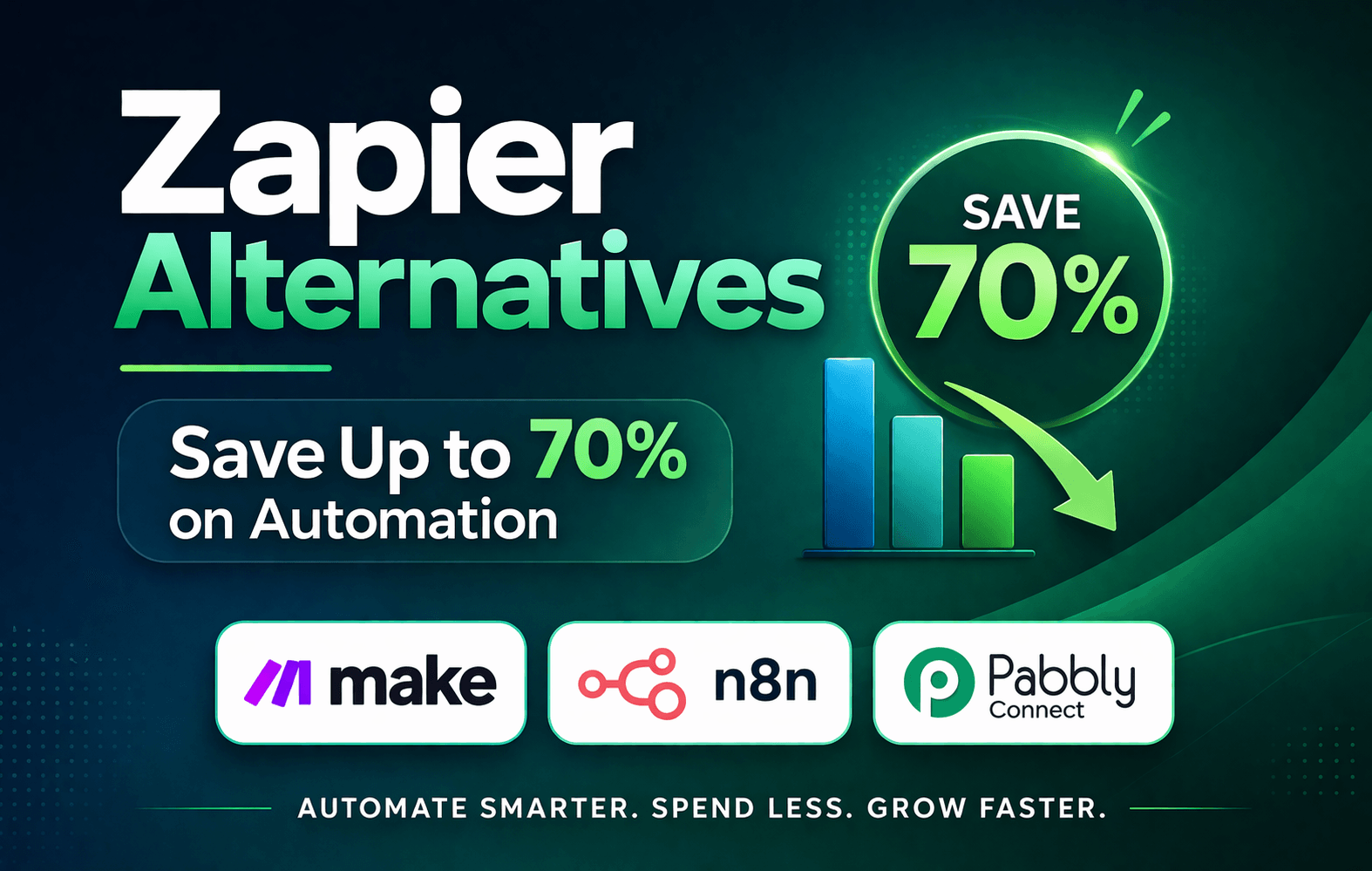
The Cost Reality: Zapier is powerful. But for SaaS startups, the bill grows faster than your revenue. We’ve tested 5 alternatives that can save you 50-90% on automation costs—without sacrificing functionality.
Introduction: The Day Your Zapier Bill Hit $500
You remember the moment. Maybe it was month six. Your startup had finally found product-market fit. Leads were flowing. Your automations were humming. Then the Zapier invoice arrived: $487 for the month. For tasks you thought were “free.”
If this sounds familiar, you’re not alone. Zapier alternatives for saas startups have become one of the most searched topics among founders who discover that usage-based pricing doesn’t scale with their growth.
The good news? There are excellent alternatives. Some are cheaper. Some offer more flexibility. Some give you complete control over your data. And in 2026, many have matured enough to handle complex SaaS workflows without the enterprise price tag.
Based on our testing and conversations with SaaS founders who’ve made the switch, we’ve identified the 5 best zapier alternatives for saas—with real pricing comparisons, use cases, and exactly when to choose each.
Quick Comparison: Zapier Alternatives at a Glance
| Tool | Best For | Pricing Model | Typical Monthly Cost (Medium Usage) | Key Difference from Zapier |
|---|---|---|---|---|
| Zapier | Quick, simple connections | Usage-based (tasks) | $100–$500 | Largest integration library |
| Make | Complex, visual workflows | Operation-based | $20–$80 | Branching logic, 60-80% cheaper |
| n8n | Developer teams, full control | Self-hosted (free) / cloud | $0–$50 | Open-source, unlimited operations |
| Pabbly Connect | Budget-conscious startups | Flat monthly / lifetime | $16 (fixed) | No usage limits, 80-90% cheaper |
| ActivePieces | Open-source without complexity | Free self-hosted | $0 (hosting only) | Growing community, simpler than n8n |
| Tray.io | Enterprise scale | Custom | $1,000+ | Enterprise security, overkill for startups |
Detailed Breakdown: 5 Best Zapier Alternatives for SaaS
Alternative #1: Make (Formerly Integromat) – Best for Complex Workflows
What it does: Make offers a visual drag-and-drop builder for multi-step automations with branching logic, filters, and data transformation. Unlike Zapier’s linear “if this, then that” structure, Make lets you build complex scenarios with multiple paths.
Why it’s a great Zapier alternative: The pricing model is operation-based, not task-based. A single Zapier “task” might be one operation; in Make, complex workflows cost significantly less. For SaaS teams with conditional logic needs, Make is typically 60-80% cheaper.
SaaS use case: A trial user reaches day 7. Make checks if they’ve completed onboarding. If yes, send upgrade email. If no, send tutorial. If still inactive by day 14, notify sales. This one workflow in Zapier would count as 3-5 tasks per execution. In Make, it’s one operation.
Pricing: Free for 1,000 operations/month; paid from $10.56/month for 10,000 operations (as of April 2026).
Limitation: The visual builder has a steeper learning curve than Zapier. For simple automations, Zapier is still faster to set up.
When to choose Make: You need conditional logic, multi-step branching, or complex data transformations—and you want to save money while doing it.
Alternative #2: n8n – Best for Developer Teams and Full Control
What it does: n8n is an open-source automation platform you can self-host or use in the cloud. It gives you complete control over your data, infrastructure, and costs.
Why it’s a great Zapier alternative: No per-operation fees. No surprise bills. If you self-host, your only cost is server hosting (as low as $5–$20/month). You can run unlimited automations without watching your usage counter.
SaaS use case: You need to sync user data from your product database to internal analytics tools, Slack, and support systems—without exposing customer data to third-party clouds. n8n lets you keep everything within your own infrastructure.
Pricing: Free self-hosted (just hosting costs); cloud plans from €20/month (as of April 2026).
Limitation: Requires technical expertise to set up and maintain, especially for self-hosted deployments. Not ideal for non-technical founders.
When to choose n8n: You have a technical team, care about data privacy, and want unlimited automation at minimal cost.
Alternative #3: Pabbly Connect – Best for Bootstrapped Startups
What it does: Similar to Zapier, Pabbly Connect lets you create automated workflows between apps. The interface is straightforward, and it supports 1,000+ integrations.
Why it’s a great Zapier alternative: Flat pricing. No usage limits. You pay a fixed monthly fee ($16) or a one-time lifetime payment ($249) and run as many automations as you want. For bootstrapped startups, this is a game-changer.
SaaS use case: You run 20+ automations for lead capture, email sequences, internal notifications, and reporting. With Zapier, that’s $100–$300/month. With Pabbly Connect, it’s $16/month fixed.
Pricing: $16/month or $249 lifetime one-time payment (as of April 2026).
Limitation: Smaller integration library than Zapier (~1,000 apps vs. Zapier’s 7,000+). Some niche tools may not be available.
When to choose Pabbly Connect: You’re bootstrapped, have predictable automation needs, and want fixed costs without worrying about usage spikes.
Alternative #4: ActivePieces – Best Open-Source Without the Complexity
What it does: ActivePieces is a growing open-source automation platform with 200+ integrations. It offers a visual builder similar to Make but with the flexibility of open-source.
Why it’s a great Zapier alternative: It’s free to self-host, and the interface is more approachable than n8n for non-developers. The community is growing rapidly, and new integrations are added regularly.
SaaS use case: You want the cost benefits of open-source automation but find n8n too complex for your team. ActivePieces offers a middle ground: self-hosted control with a cleaner UI.
Pricing: Free self-hosted (as of April 2026). Cloud version in development.
Limitation: Still maturing; smaller community and fewer pre-built templates than n8n or Zapier. Some enterprise features not yet available.
When to choose ActivePieces: You want open-source flexibility but prefer a simpler interface than n8n, and you’re comfortable with self-hosting.
Alternative #5: Tray.io – Best for Enterprise Scale
What it does: Tray.io is an enterprise-grade automation platform with powerful AI and orchestration features. It’s designed for complex, mission-critical workflows at scale.
Why it’s a great Zapier alternative: For startups that have outgrown Zapier and need enterprise-level security, compliance (SOC 2, HIPAA), and dedicated support, Tray.io offers capabilities Zapier can’t match.
SaaS use case: You’re scaling rapidly, have complex compliance requirements, and need to automate across 50+ apps with enterprise-level governance and audit trails.
Pricing: Custom pricing (typically $20,000+/year).
Limitation: Overkill for most early and mid-stage startups. The cost and complexity are only justified at enterprise scale.
When to choose Tray.io: You’ve outgrown Zapier, have enterprise security requirements, and have budget for a dedicated solution.
Real-World Pricing Comparison: When Alternatives Save You Money
| Scenario | Zapier Estimated Cost | Alternative Cost | Savings |
|---|---|---|---|
| 10 simple zaps, 1,000 tasks/month | ~$30/month | Pabbly Connect: $16/month | 47% |
| 1 complex workflow, 5,000 operations/month | ~$100/month | Make: ~$30/month | 70% |
| 50 workflows, unlimited operations | $500+/month | n8n self-hosted: $20/month (hosting) | 96% |
| Bootstrapped startup, fixed budget | $100–$300/month | Pabbly Connect: $16/month fixed | 80-90% |
Decision Framework: Which Zapier Alternative Should You Choose?
Use this simple guide to find your match:
Start here: What's your priority?

├─ Need complex, branching workflows with visual builder?
│  └─ Choose Make (60-80% cheaper than Zapier for complex scenarios)

├─ Have a technical team and want unlimited automation?
│  └─ Choose n8n self-hosted ($0–$20/month hosting, unlimited operations)

├─ Bootstrapped and want fixed costs?
│  └─ Choose Pabbly Connect ($16/month or $249 lifetime, no usage limits)

├─ Want open-source but find n8n too complex?
│  └─ Choose ActivePieces (free self-hosted, simpler interface)

├─ Enterprise scale with compliance needs?
│  └─ Choose Tray.io (custom pricing, enterprise-grade security)

└─ Still love Zapier? Keep it for simple automations. Use alternatives for high-volume or complex workflows.
Frequently Asked Questions About Zapier Alternatives for SaaS
Is there a completely free Zapier alternative?
Yes. n8n and ActivePieces are open-source and can be self-hosted for free (just pay for server hosting, typically $5–$20/month). Zapier and Make also have free tiers with limited operations—enough for early-stage startups.
Can I use multiple automation tools together?
Absolutely. Many SaaS teams use Zapier for simple connections and Make for complex workflows, or combine Pabbly Connect for cost-sensitive automations. They can trigger each other through webhooks if needed. See our full comparison of workflow automation tools for more details.
Will switching from Zapier break my existing workflows?
It can, if not done carefully. We recommend migrating one workflow at a time and testing thoroughly before deactivating the original. Most alternatives offer import tools or similar logic structures. Start with non-critical workflows first.
Which Zapier alternative is best for a non-technical founder?
Make has a visual builder but a learning curve. Pabbly Connect is most similar to Zapier’s interface and easiest to transition to. Start with Pabbly if you want a direct replacement with fixed pricing. Understanding common automation challenges can help you avoid migration pitfalls.
How much can I actually save by switching from Zapier?
Savings depend on your usage. For a SaaS startup with 20-50 automations, switching from Zapier to Pabbly Connect typically saves 80-90%. For complex workflows, moving to Make saves 60-80%. For high-volume startups willing to self-host, n8n can reduce costs by 95% or more. See our pricing comparison table above for detailed scenarios.
Related Reading
- 9 Best Workflow Automation Tools for SaaS Startups (2026): Tested & Compared
- SaaS Automation Challenges: 3 Problems Every Startup Faces (And How to Solve Them)
- Workflow Automation Tools for SaaS (2026): Best Picks
- Marketing Automation Tools for SaaS: 7 That Work (2026)
- CRM vs Marketing Automation for SaaS (2026): Key Differences
Final Thoughts
Zapier changed the game for no-code automation. But for SaaS startups, the pricing model doesn’t always align with growth. The good news is that in 2026, you have more zapier alternatives for saas than ever before—many of which are built specifically for the needs of growing startups.
Start by auditing your current Zapier usage. Identify the workflows costing you the most. Then pick one alternative from this guide that matches your technical comfort and budget. Migrate one workflow. Test it. Let it run for a week. Then decide if you want to move more.
You didn’t start a SaaS company to watch your automation bill grow faster than your revenue. With the right alternative, you can have both: powerful automation and predictable costs.
Disclaimer: Tool pricing, features, and availability are subject to change. This article reflects independent research and opinions based on publicly available information as of April 2026. We are not affiliated with any tools listed unless explicitly disclosed. Always verify current pricing and features directly with each vendor before making a purchase decision. This content is for informational purposes only and does not constitute professional advice.
Editorial Note: Automaiva publishes research-based insights on AI tools, SaaS platforms, and automation systems used by modern startups. Our recommendations are based on independent analysis, not vendor partnerships, unless explicitly disclosed.