Pricing Note: SaaS tool pricing and features change frequently. The information below reflects our research as of March 2026. Please verify current pricing and plans directly with each vendor before purchasing.
Introduction
Why SaaS Startups Need Workflow Automation
You didn’t start a SaaS company to spend 10 hours a week moving data between spreadsheets and CRMs. Yet for many founders, that’s exactly where time disappears—copying leads from Typeform to your CRM, manually updating email sequences, and chasing teammates for status updates.
Workflow automation tools connect your apps and handle repetitive tasks automatically. Instead of doing the work yourself, you set rules once, and the software executes them every time.
Based on our independent research and testing, we’ve compared the 9 best workflow automation tools for SaaS startups based on:
- Ease of setup for non-technical teams
- Integration libraries (how many apps they connect to)
- Pricing and scalability (what happens as you grow)
- SaaS-specific use cases
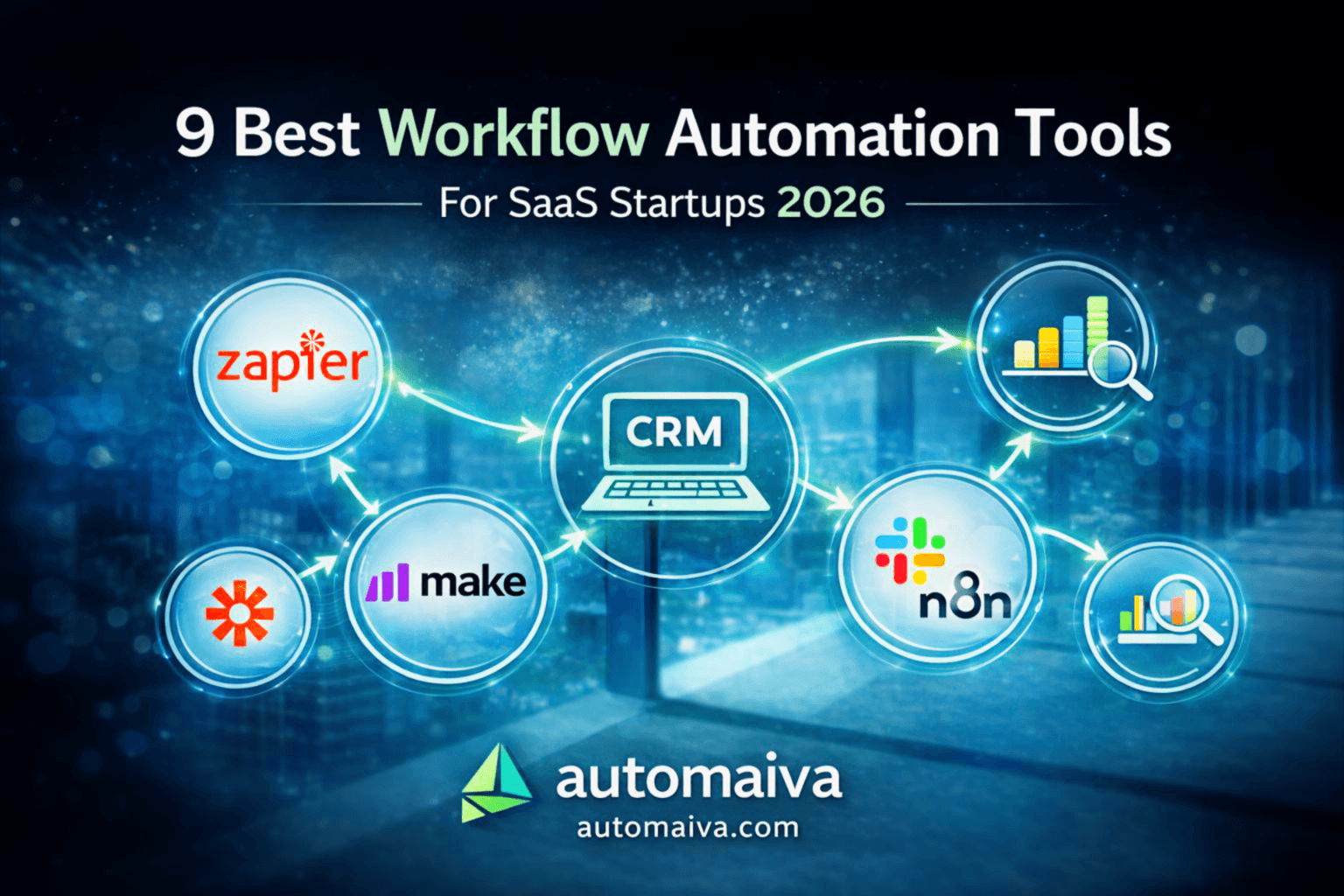
Here are the tools we recommend—with real-world examples, pricing, and guidance on when to choose each.
Quick Comparison: Top Workflow Automation Tools at a Glance
| Tool | Best For | Starting Price | Key Strength | Limitation |
|---|---|---|---|---|
| Zapier | Connecting 7,000+ apps | Free / $19.99/mo | Largest integration library | Can become expensive at scale |
| Make | Visual, complex workflows | Free / $10.56/mo | Branching logic, visual builder | Steeper learning curve |
| n8n | Developer teams, self-hosted | Free (self-hosted) / from €20/mo | Open-source, full control | Requires technical skills |
| Pabbly Connect | Budget-conscious startups | $16/mo (lifetime option) | Affordable, no usage limits | Smaller integration library |
| HubSpot Ops Hub | All-in-one with CRM | Free / $20/mo | Native CRM integration | Best only if you use HubSpot |
| ActivePieces | Open-source alternative | Free | Community-driven, growing | Newer, fewer integrations |
| Tray.io | Enterprise scale | Custom pricing | Powerful, secure | Overkill for most startups |
| Workato | Enterprise + AI | Custom pricing | AI-powered, enterprise-grade | Overkill for most startups |
| Zoho Flow | Zoho ecosystem users | Free / $10/mo | Native Zoho integration | Limited outside Zoho |
Detailed Breakdown: Best Tools by Category
Category 1: Best for Simplicity & Scale → Zapier
What it does: Zapier connects thousands of apps with simple “if this, then that” rules. No coding required.
Best for: SaaS teams with many different tools who need a quick setup without technical overhead.
SaaS use case: New lead signs up via Typeform → Zapier creates a contact in HubSpot → adds the lead to our guide to email marketing tools for SaaS onboarding sequence → notifies sales in Slack.
Zapier Pricing: Free for 100 tasks/month; paid plans start at $19.99/month for 750 tasks (as of March 2026).
Limitation: Costs can add up as automation volume grows.
Category 2: Best for Visual Complex Workflows → Make
What it does: Make (formerly Integromat) offers a drag-and-drop visual builder for multi-step automations with branching logic.
Best for: Teams that need conditional workflows—for example, “if X happens, do Y; otherwise, do Z.”
SaaS use case: Trial user reaches day 7 → Make checks if they’ve completed onboarding → if yes, send upgrade email; if no, send tutorial; if still inactive by day 14, notify sales.
Make Pricing: Free for 1,000 operations/month; paid from $10.56/month for 10,000 operations (as of March 2026).
Limitation: Visual builder has a steeper learning curve than Zapier.
Category 3: Best for Developer Teams → n8n
What it does: n8n is an open-source automation platform you can self-host or use in the cloud.
Best for: Technical SaaS startups that want to avoid per-operation fees and keep sensitive data within their own environment.
SaaS use case: Automatically sync user data from your product database to internal analytics tools without exposing customer data to third-party clouds.
n8n Pricing: Free self-hosted (just hosting costs); cloud plans from €20/month (as of March 2026).
Limitation: Requires technical expertise to set up and maintain.
Category 4: Best for Budget-Conscious Startups → Pabbly Connect
What it does: Similar to Zapier, Pabbly Connect lets you create automated workflows between apps with flat monthly or lifetime pricing.
Best for: Bootstrapped SaaS startups watching every dollar.
SaaS use case: Automate lead capture, email sequences, and internal notifications for a fixed cost.
Pabbly Pricing: $16/month or $249 lifetime one-time payment (as of March 2026).
Limitation: Smaller integration library than Zapier.
Category 5: Best All-in-One (If You Use HubSpot) → HubSpot Operations Hub
What it does: Native automation within HubSpot’s CRM and marketing platform.
Best for: SaaS startups already using HubSpot as their core CRM.
SaaS use case: Automatically sync deal stages between HubSpot and your product database; trigger Slack alerts when high-value opportunities close.
Pricing: Free for basic data sync; Operations Hub Starter from $20/month (as of March 2026).
Limitation: Only valuable if HubSpot is your central platform.
Category 6: Best Open-Source Alternative → ActivePieces
What it does: ActivePieces is a growing open-source automation platform with 200+ integrations.
Best for: Startups that want open-source flexibility but find n8n too complex.
Pricing: Free self-hosted (as of March 2026).
Limitation: Still maturing; smaller community than n8n or Zapier.
SaaS-Specific Use Cases: Which Tool We Recommend
| Use Case | Recommended Tool | Why We Recommend It |
|---|---|---|
| Lead capture → CRM → email onboarding | Zapier | Largest integration library connects most marketing and sales tools |
| Multi-step trial nurturing with conditional logic | Make | Branching workflows, visual builder for complex logic |
| Custom internal tool integrations with sensitive data | n8n | Self-hosted, full control over data and infrastructure |
| Bootstrapped startup with high-volume automation | Pabbly Connect | Fixed cost, no usage limits |
| HubSpot-native CRM and marketing automation | HubSpot Ops Hub | Seamless integration with existing HubSpot data |
Decision Framework: How to Choose the Right Tool for Your SaaS
Use this simple guide to narrow your options:
Start here: What's your primary need?

├─ Need to connect 7,000+ apps quickly? → Zapier
├─ Need complex, branching workflows? → Make
├─ Have a technical team and want full control? → n8n
├─ On a tight budget with high volume? → Pabbly Connect
├─ Already using HubSpot? → HubSpot Ops Hub
├─ Want open-source without complexity? → ActivePieces
├─ Enterprise scale with compliance needs? → Tray.io or Workato
└─ Deep in Zoho ecosystem? → Zoho Flow
Frequently Asked Questions
What’s the best workflow automation tool for a new SaaS startup?
Based on our research, most early-stage SaaS startups start with Zapier for its ease of use and large integration library. For bootstrapped startups, Pabbly Connect offers better value with fixed pricing. Technical founders comfortable with self-hosting often choose n8n for unlimited automation at minimal cost.
Is Make better than Zapier?
Make offers more flexibility for complex workflows with its visual builder and branching logic. Zapier is simpler for basic automations. In our experience, Make is better for conditional workflows; Zapier is better for quick, simple connections across thousands of apps.
Can I automate workflows without coding?
Yes. Zapier, Make, and Pabbly Connect are all no-code tools designed for non-technical users. n8n and ActivePieces also offer no-code interfaces, though self-hosting requires technical setup.
What’s the cheapest workflow automation tool?
For flat-rate pricing, Pabbly Connect offers lifetime access starting at $249 one-time payment. For free options, Zapier and Make have free tiers with limited operations. For unlimited free automation, self-hosted n8n or ActivePieces are the most cost-effective if you have technical resources.
How do I know when my SaaS startup needs workflow automation?
From our experience working with SaaS founders, if you or your team spend more than 5 hours a week on repetitive manual tasks—data entry, moving files between apps, sending follow-up emails—it’s time to automate.
Related Reading
- Marketing Automation Tools for SaaS: 7 That Work (2026)
- Workflow Automation Tools for SaaS (2026): Best Picks
- CRM vs Marketing Automation for SaaS (2026): Key Differences
- AI Tools for SaaS Startups: 10 That Actually Save Time
Final Thoughts
Workflow automation isn’t about replacing your team—it’s about freeing them to do the work that actually matters. The right tool depends on your stage, technical comfort, and budget.
Our recommendation: Start simple. Pick one repetitive task, automate it with the tool that best fits your needs, and expand from there.
For a deeper dive into the top 4 tools, see our detailed guide for SaaS teams
Disclaimer: Tool pricing, features, and availability are subject to change. This article reflects independent research and opinions based on publicly available information as of March 2026. We are not affiliated with any tools listed. Always verify current pricing and features directly with each vendor before making a purchase decision. This content is for informational purposes only and does not constitute professional advice.
Editorial Note: Automaiva publishes research-based insights on AI tools, SaaS platforms, and automation systems used by modern startups. Our recommendations are based on independent analysis, not vendor partnerships, unless explicitly disclosed.